Transmission Facilities Stagnate Despite Tenfold Surge in Solar Power Over 10 Years
Honam Discards Surplus Solar Electricity
Metropolitan Area Companies Worry About Power Shortages
Power Grid Special Act Still Awaits Passage
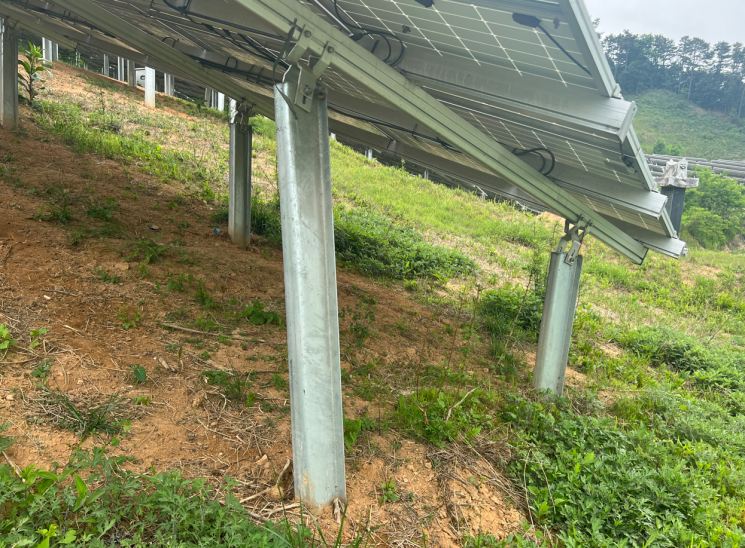
Company A, which has been operating a solar power plant in Yeonggwang, Jeollanam-do for 20 years, recently decided to wind down its renewable energy business. The existing solar facilities also need to be upgraded to continue producing electricity, but the company is hesitant to invest. This is because the government has been enforcing large-scale 'output control'?a forced shutdown of electricity production?on the mainland since last year. Company A believes that if output control increases further, the costs will outweigh the revenue from power generation. A company representative said, "We will no longer prioritize the solar power generation business," adding, "The competition has intensified, and receiving output control measures would cause too much damage."
It has been confirmed that solar power output control, which was mainly conducted in island regions, occurred extensively on the mainland last year. The rapid increase in solar power facilities was not matched by the government's expansion of transmission lines to deliver electricity. The special law aimed at resolving this issue remains stalled in the National Assembly. If the problem is not addressed promptly, there are concerns that the spread of eco-friendly renewable energy will be hindered in the future, and it will be difficult to respond smoothly to large-scale power demands from industries such as semiconductors.
Transmission Facilities Stagnate While Solar Power Increases Tenfold
According to data obtained by Asia Economy from the Korea Power Exchange and the Public Data Portal on the 17th, there were 27 instances of output control targeting mainland solar power plants last year. Output control, which occurred only twice in 2023, increased more than 13 times in one year. Output control for mainland solar power plants began in 2021 with three occurrences and did not occur at all in 2022.
Output control is a measure that forces power plants to stop producing electricity. It is usually implemented when electricity production is excessive. A sudden influx of electricity into the power grid can cause blackouts. It mainly occurred in Jeju Island, where it is difficult to send electricity externally. On the mainland, output control rarely occurred because electricity could be sent to high-demand areas.
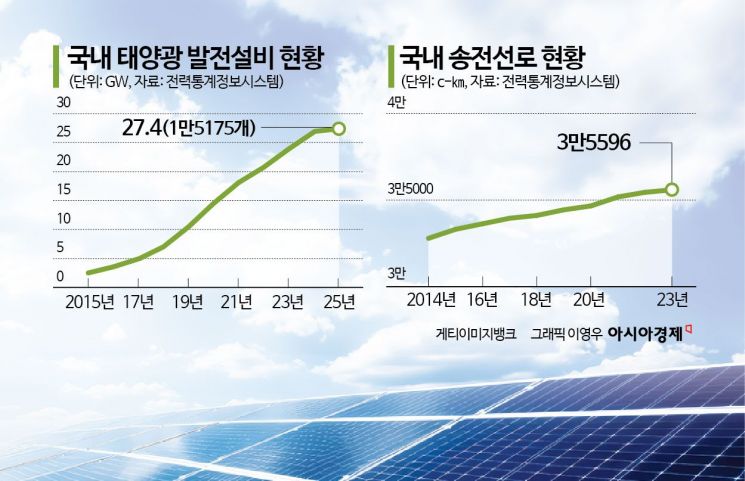
The unusual output control on the mainland is due to an imbalance between production and supply. According to the Power Statistics Information System, solar power generation capacity surged from 2.5GW in 2015 to 27.4GW earlier this year. Meanwhile, transmission lines for moving electricity measured 35,596 circuit kilometers (C-km) as of 2023, increasing only 8.5% from 32,794 C-km ten years ago. This means that while the amount of electricity that can be generated by solar power increased about tenfold over ten years, the transmission lines to deliver it have barely been expanded.
The shortage of transmission lines has also caused regional imbalances. About 60% of mainland solar power plants are built in Honam. However, companies that consume electricity are concentrated in the Seoul metropolitan area. Electricity surplus in Honam must be sent to the metropolitan area, but transmission lines are severely insufficient. There are only two 345kV transmission lines connecting Honam and the metropolitan area, with a transferable capacity of about 4.5GW. The remaining electricity must be discarded. Most of the output control incidents so far have occurred in the Honam region.
Resident opposition is behind the failure to expand transmission lines. Transmission towers are essential for laying transmission lines, but many residents oppose them due to concerns about aesthetics and health. Transmission line construction, which should normally take nine years, takes on average more than four additional years. The 'Bukdangjin~Sintangjeong' transmission network connecting the west coast and the metropolitan area is a representative example. Construction began in 2003 and was scheduled to finish in 2012, but due to strong resident opposition, it was only completed at the end of last year.
Electricity Surplus in Honam, Power Shortage in the Metropolitan Area
If the transmission facility problem is not resolved, the spread of eco-friendly energy will inevitably be hindered. According to the 11th Basic Plan for Electricity Supply and Demand being prepared by the Ministry of Trade, Industry and Energy, the government plans to expand solar power capacity to 55.7GW by 2030. However, the more frequent the output control, the more likely power producers will hesitate to invest. The industry estimates that for a 1MW solar power facility installed on 3,000 to 3,500 pyeong of land, losses due to transmission constraints amount to about 40 million KRW annually on average.
Disruptions in the industrial sector are also inevitable. Advanced high value-added industries such as semiconductors and artificial intelligence (AI) consume enormous amounts of electricity. The Yongin semiconductor cluster, to be built by 2050, alone requires 10GW of power, equivalent to 10 nuclear reactors. To supply electricity smoothly, surplus power from other regions must be utilized. If insufficient transmission facilities are not expanded, a paradoxical situation may arise where electricity is wasted in one area while the industrial sector suffers power shortages.
The industry expects output control to increase further this year. Kwak Young-joo, president of the Solar Industry Association, said, "The shortage of transmission lines is severe, so output control will inevitably increase every year," adding, "It is common for purchased solar power facilities to remain unused and for operators to wait for years."
The 'Special Act on Expansion of National Power Grid (Power Grid Special Act)' aimed at solving the problem has yet to pass the National Assembly. The Power Grid Special Act proposes establishing a separate committee to drastically reduce approval procedures and expand government support. The committee would also mediate conflicts between Korea Electric Power Corporation (KEPCO) and residents, accelerating the construction of transmission facilities. The bill was introduced in the 21st National Assembly but was discarded due to the end of the session. It has been reintroduced in the 22nd National Assembly and is currently under discussion in the Industry, Trade, Energy, Small and Medium Enterprises Committee.
However, given the delay, even if the special law passes, power supply issues are expected to persist for some time. The industry is requesting that eco-friendly energy be prioritized over coal and gas when electricity production is excessive, but the government opposes this. A government official explained, "If electricity generated by solar power is purchased first, consumers' electricity bills will rise, so we need to approach this carefully."
© The Asia Business Daily(www.asiae.co.kr). All rights reserved.


















