Industry Committee Patent Subcommittee to Convene on the 17th
Review of 47 Bills Including Semiconductor Special Act and Three Major Energy Laws
Democratic Party: "Exclude 52-Hour Workweek Clause"...
People Power Party: "Nothing Left Without It"
The National Assembly's Industry, Trade, Energy, Small and Medium Enterprises Committee will hold a bill subcommittee meeting on the 17th to review industry-related bills. It is expected to be difficult to find common ground between the ruling and opposition parties regarding the exemption clause for 52-hour workweek in the research and development (R&D) sector of the Semiconductor Special Act, which has become a contentious issue between the parties.
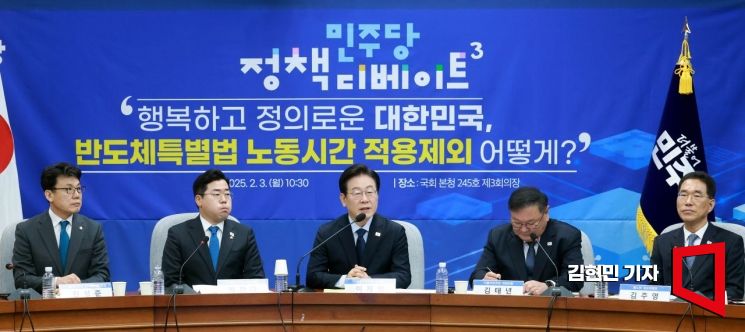 Lee Jae-myung, leader of the Democratic Party of Korea, is presiding over the party's third policy debate titled "A Happy and Just Republic of Korea, How to Exclude the Semiconductor Special Act from the Application of the Labor Hours Act," held at the National Assembly on the 3rd. Photo by Kim Hyun-min
On the same day at 10 a.m., the National Assembly's Industry, Trade, Energy, and Patent Subcommittee will convene its first meeting to review 47 bills, including the Semiconductor Special Act and the Energy 3 Laws (High-Level Radioactive Waste Special Act, Offshore Wind Power Special Act, and National Power Grid Expansion Special Act).
Sharp conflicts between the ruling and opposition parties are anticipated over the 'white-collar exemption (52-hour workweek exception)' clause in the Semiconductor Special Act during this bill subcommittee meeting. The Democratic Party is expected to maintain its stance to pass only the parts agreed upon by both parties, excluding the said clause. Kim Won-i, the opposition party's secretary of the Industry, Trade, Energy, Small and Medium Enterprises Committee and a Democratic Party lawmaker, stated, "The opposition members of the committee unanimously want to exclude the white-collar exemption clause and proceed."
On the other hand, the People Power Party is firmly opposing the removal of this clause, arguing that nothing would remain in the special act without it. Kwon Seong-dong, the floor leader of the People Power Party, criticized in his parliamentary negotiation group representative speech on the 11th, saying, "There is no country in the world where semiconductor researchers are hindered by a 52-hour workweek," and added, "However, the Democratic Party persistently refuses the bill that proposes an exception to the 52-hour workweek for high-paid R&D personnel."
However, even within the Democratic Party, there is a position that the bill will not be forcibly passed solely by the opposition in the bill subcommittee. Lawmaker Kim said, "We will try to reach an agreement in the bill subcommittee."
On the same day, the subcommittee will also review the Energy 3 Laws. The Energy 3 Laws include the High-Level Radioactive Waste Special Act, Offshore Wind Power Special Act, and National Power Grid Expansion Special Act. The High-Level Radioactive Waste Special Act regulates the procedures and responsibilities for safely managing and disposing of spent nuclear fuel generated after the operation of nuclear power plants. Currently, spent nuclear fuel is stored in temporary storage facilities, but as the capacity limit approaches, passing this bill is urgent.
The Offshore Wind Power Special Act includes provisions for the government to take the lead in discovering suitable locations during the site planning stage to increase the low adoption rate of wind power facilities and to secure acceptance from stakeholders such as residents and fishermen.
The National Power Grid Expansion Special Act aims to establish a government support and management system for national power grid construction projects to expand large-scale power grids amid worsening power supply and demand imbalances. Regarding the Energy 3 Laws, there is little disagreement between the ruling and opposition parties, and it is predicted that these bills are likely to pass in this bill subcommittee meeting.
© The Asia Business Daily(www.asiae.co.kr). All rights reserved.

















