KRW 18 Billion Investment Over Five Years
Pushing for Global Commercialization of Research Outcomes
Formosa Group, one of Taiwan's top three conglomerates, has decided to establish a bio-medical research center at the Korea Advanced Institute of Science and Technology (KAIST) and invest over 18 billion KRW over five years.
On the 17th, KAIST announced that it signed a bio-medical cooperation agreement with Sandy Wang (王瑞瑜, Sandy Wang), Executive Director of Formosa Group and Chairman of the Bio and Eco-friendly Energy Division.
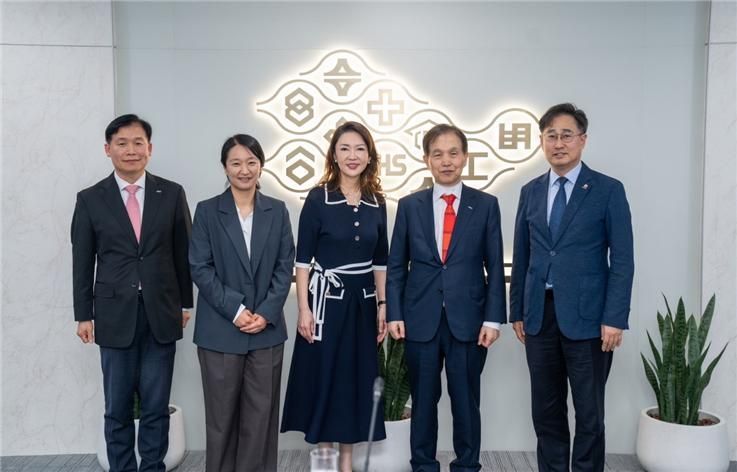 Sandy Wang, Chairman (third from the left), and Kwang-Hyung Lee, President (fourth from the left), who visited KAIST last May. Photo by KAIST
KAIST and Formosa Group will establish a joint venture in Korea with ㈜KAIST Holdings, a KAIST-invested company, to commercialize research outcomes.
The collaboration between the two institutions began in early 2023 when KAIST signed a comprehensive exchange and cooperation memorandum of understanding (MOU) with Myongji University of Science and Technology (明志科技大學), Chang Gung University (長庚大學), and Chang Gung Memorial Hospital (長庚記念醫院), all established and supported by Formosa Group. Subsequently, Chairman Sandy Wang visited KAIST in May 2024 to sign a more detailed memorandum of agreement (MOA).
KAIST Holdings, a holding company established by the government-funded KAIST to attract investment and manage business, is promoting the establishment of a joint venture with Formosa Group on a 50:50 equity basis. KAIST Holdings will contribute KAIST’s intellectual property rights, while Formosa Group will invest corresponding funds.
The KAIST-Formosa joint venture will support research funding for the future KAIST-Formosa Bio-Medical Research Center and secure licenses for the intellectual property generated to actively pursue commercialization.
The KAIST-Formosa Bio-Medical Research Center will build a "brain organoid bank" created from tissues obtained from hundreds of patients with degenerative brain diseases, securing high-level data to uncover the fundamental causes of aging and disease. Leveraging KAIST’s world-class artificial intelligence technology, large-scale patient data will be analyzed to identify the causes of aging and diseases.
Through this project, by 2030, it is expected to discover more than 10 treatments for intractable brain diseases and expand into over 20 businesses, including human cell-based diagnostics and preclinical projects, securing infrastructure and intellectual property capable of generating value worth approximately 250 billion KRW.
Chairman Sandy Wang stated, "This investment and cooperation are based on trust in KAIST’s research and development capabilities and the passion of its researchers," adding, "We hope to expand cooperation into various fields such as mobility and semiconductors following successful collaboration in the bio sector."
KAIST President Kwang Hyung Lee said, "This is a very important event marking the overseas expansion of KAIST’s bio technology," and expressed hope that "this cooperation will create new growth engines in the bio industry for both Taiwan and Korea, which have IT industry-centered structures."
Meanwhile, Formosa Group was founded by Chairman Sandy Wang’s father, Wang Yung-ching (王永慶). As the world’s leading producer of plastic PVC, the group leads key industries in Taiwan’s economy, including semiconductors, steel, heavy industries, bio, and batteries. Chairman Wang Yung-ching was respected by the Taiwanese people for his belief that the companies and wealth he built belonged to the people and for setting an example by returning his wealth to society.
© The Asia Business Daily(www.asiae.co.kr). All rights reserved.
![Clutching a Stolen Dior Bag, Saying "I Hate Being Poor but Real"... The Grotesque Con of a "Human Knockoff" [Slate]](https://cwcontent.asiae.co.kr/asiaresize/183/2026021902243444107_1771435474.jpg)
















