The Ministry of Land, Infrastructure and Transport announced on the 16th that manufacturers producing electric vehicles will implement a certification system from this month, in which battery safety is pre-verified by the government. In South Korea, a system has been in place since 2003 where manufacturers self-certify automobiles or parts and the government conducts post-verification, but for the first time in over 20 years, a pre-certification system has been applied to batteries.
This measure was introduced as concerns over battery safety increased due to electric vehicle fires. To obtain safety certification, various tests are conducted to check for safety issues, including thermal shock, combustion, overheating prevention, short circuits, overcharge/discharge, overcurrent, vibration, impact, compression, drop, and immersion.
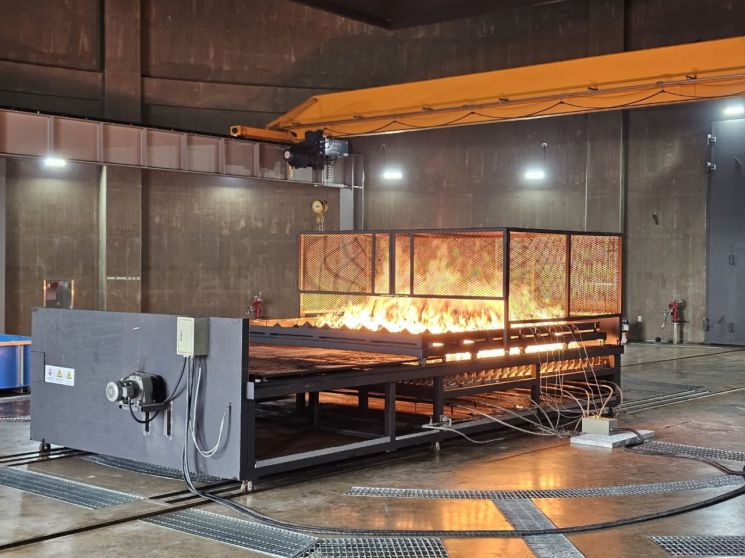 A battery fire test is being conducted in the fire test chamber at the Eco-friendly Automotive Parts Certification Center of the Korea Automotive Safety Research Institute. The battery surrounded by flames in the center is from a Kona electric vehicle. Photo by Korea Automotive Journalists Association
Before manufacturing and sales, compliance with safety standards is checked, and conformity inspections are also conducted to ensure that the manufacturing process remains compliant after certification. If the product is not manufactured exactly as certified, corrective actions will be taken. The Ministry of Land, Infrastructure and Transport explained, "This is significant in that it secures safety for new technologies in advance and shares the risk burden of introducing new technologies between the government and industry."
A battery traceability system will also be introduced. Each battery will be assigned an identification number at the manufacturing stage, which will be registered in the vehicle registration database. This will enable tracking of the battery's entire lifecycle from manufacturing to operation and disposal. Maintenance and inspection histories during vehicle operation can also be confirmed. The government expects that this will allow for faster cause analysis in the event of fire accidents.
When batteries are replaced, the identification number will also be changed and registered to manage the history meticulously. By 2027, a battery traceability management system will be established to verify the entire lifecycle history at the battery unit level. Related industries, such as those dealing with used batteries, are also expected to be revitalized.
© The Asia Business Daily(www.asiae.co.kr). All rights reserved.

















