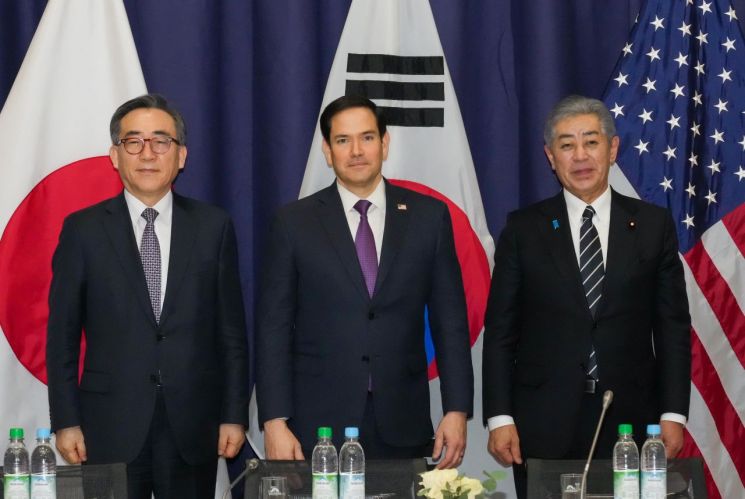
 Foreign Minister Cho Tae-yeol (left), U.S. Secretary of State Mark Rubio, and Japanese Foreign Minister Iwaya Takeshi pose for a commemorative photo at the Korea-U.S.-Japan Foreign Ministers' Meeting held on the 15th (local time) at Commerzbank near the Bayerischer Hof Hotel in Munich, Germany. Photo by Yonhap News
For the first time since the second Trump administration took office in the United States, the trilateral foreign ministers' meeting of South Korea, the U.S., and Japan was held in Munich, Germany.
On the 15th (local time), Foreign Minister Cho Tae-yul, U.S. Secretary of State Mike Pompeo, and Japanese Foreign Minister Takeshi Iwaya confirmed the importance of trilateral cooperation at the Commerzbank near the Bayerischer Hof Hotel in Munich, where the Munich Security Conference (MSC) was held.
The Ministry of Foreign Affairs stated that the three ministers discussed ways to enhance South Korea-U.S.-Japan cooperation, respond to North Korea and the North Korean nuclear issue, regional situations, and ways to expand economic cooperation.
The three countries sent a clearer message of checking China than before. The joint statement expressed "support for Taiwan's meaningful participation in appropriate international organizations."
This was the first time such content was included in the trilateral statement. It is interpreted as reflecting the Trump administration's intention to take a hard line against China. China is expected to react strongly as Taiwan is still unable to join the United Nations (UN).
However, a Ministry of Foreign Affairs official said, "Our basic position on Taiwan remains unchanged," which is interpreted as respecting the 'One China' policy.
Additionally, the three countries strongly opposed "any unilateral attempts to change the status quo by force or coercion in the Indo-Pacific waters, including the South China Sea," and emphasized "the importance of maintaining peace and stability in the Taiwan Strait."
They also stated, "We emphasized the will to maintain a free and open Indo-Pacific and to prioritize international law." This too is aimed at China.
The three ministers agreed on the importance of peace and stability in the Indo-Pacific region and decided to cooperate to strengthen a free and open region. The South Korea-U.S.-Japan ministers also reaffirmed their firm commitment to the complete denuclearization of North Korea and agreed to further strengthen sanctions against North Korea.
To this end, they decided to respond firmly to North Korea's sanctions violations and evasion activities along with strong pressure. They also expressed strong concern over the illegal military cooperation between North Korea and Russia and agreed that North Korea should not receive any compensation.
Furthermore, the three ministers reaffirmed their commitment to enhancing defense and deterrence, including conducting trilateral exercises and strengthening the capabilities of the South Korean military, U.S. forces, and Japan Self-Defense Forces.
The three ministers noted that the scope of South Korea-U.S.-Japan cooperation is expanding beyond diplomacy and security to economic security and advanced technology fields such as artificial intelligence (AI), quantum technology, and semiconductors, and agreed to actively continue communication at all levels to expand this cooperation.
They also agreed to continue joint efforts to establish a reliable and stable supply chain and to explore ways to expand trilateral cooperation in the energy sector, including liquefied natural gas (LNG).
© The Asia Business Daily(www.asiae.co.kr). All rights reserved.

















