Social Exclusion Worsens,
Economic Deprivation Shows Little Improvement
Social disconnection and isolation among single-person households have worsened compared to the past. Although the overall economic poverty level of all households was improving, the improvement rate for single-person households was relatively slower.
On the 16th, Yonhap News reported this by citing the Korea Institute for Health and Social Affairs' report titled "Trends in the Concept and Measurement of Poverty and Policy Implications."
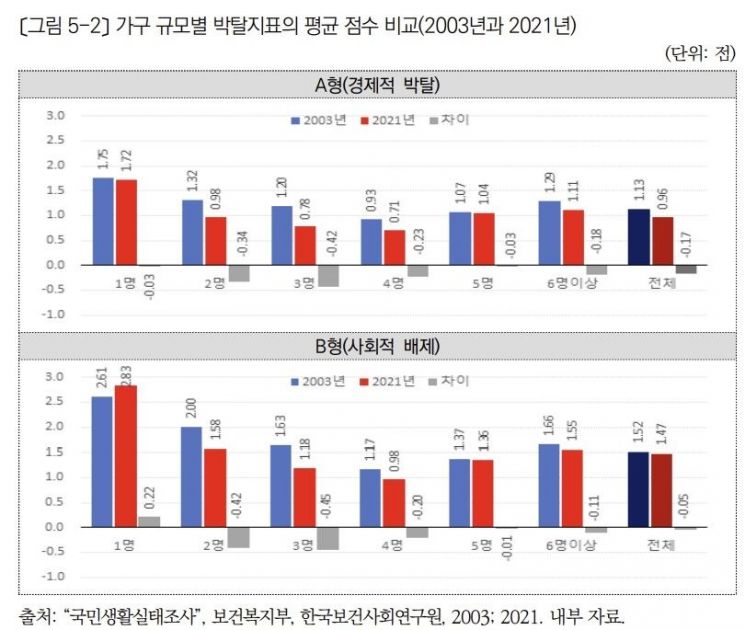
According to the report, an analysis of the National Livelihood Survey from 2003 to 2021 showed that the "economic deprivation" score for all households decreased by 0.17 points, from an average of 1.13 points (1 point per deprivation indicator out of 10) to 0.96 points during this period. The "social exclusion" score also decreased slightly from 1.52 points to 1.47 points, a 0.05-point drop.
For single-person households, the economic deprivation score decreased marginally by 0.03 points, from 1.75 to 1.72 during the same period. However, the social exclusion score increased by 0.22 points, from 2.61 to 2.83.
These figures indicate that economic deprivation among all households significantly decreased over 18 years. Social exclusion also slightly decreased, but for single-person households, social exclusion actually increased. Both economic deprivation and social exclusion are sociological terms indicating states of "deprivation." The report defined economic deprivation as closer to material deficiency, while social exclusion includes participation and relational aspects.
The economic deprivation measurement items include questions about skipping meals due to lack of money or being unable to pay utility bills. The social exclusion measurement items include questions such as whether there are relatives or friends to talk to or receive comfort from during difficult times, and whether the household eats out with family at least once a month.
The report interpreted this as showing that social relationship disconnection and isolation among single-person households have deepened.
Additionally, single-person households have a higher absolute level of economic poverty and a slower improvement rate compared to households with two or more people.
According to the report, the poverty rate for single-person households was 41.4% in 2021 (based on 50% of the equivalized median disposable income), which is three times higher than the 13.7% for all households. Compared to 2003, the poverty rate for two-person households decreased significantly from 34.8% to 21.3%, and for households with three or more people, it dropped to about half or one-third of the previous level. However, for single-person households, it only decreased by 5.9 percentage points, from 47.3%.
Meanwhile, the number of single-person households, or those "living alone," surpassed 10 million for the first time in April last year, reaching 10,021,413 households. The increasing trend continued, and as of December last year, single-person households numbered 10,122,587, accounting for 41.9% of all households.
© The Asia Business Daily(www.asiae.co.kr). All rights reserved.


















