Hong Kong SCMP: "Attractive for Economic Efficiency, Quality, and Low Political Risk"
As Southeast Asian countries increase their military spending due to disputes in the South China Sea, it is analyzed that South Korea's defense industry will benefit.
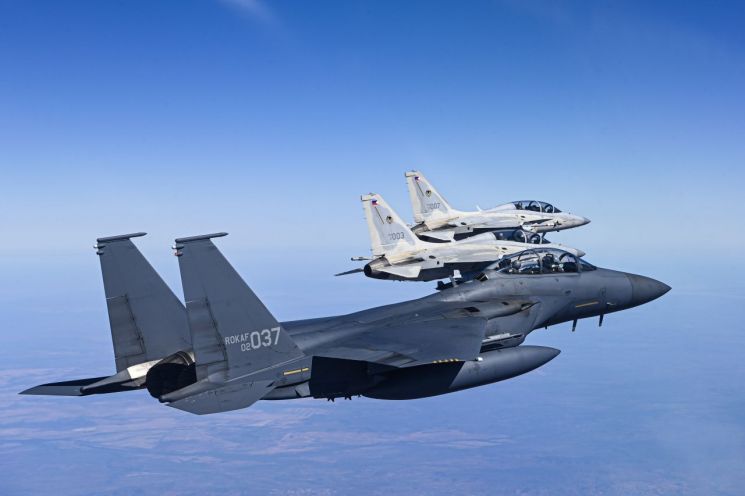 On the 31st, South Korean Air Force F-15K and Philippine Air Force FA-50PH participated in the Pitch Black exercise, flying in formation over the Australian Darwin base. Photo by Yonhap News
On the 15th, Hong Kong's South China Morning Post (SCMP) published an article titled "Why China's Loss Becomes South Korea's Gain as Southeast Asia Seeks New Arms Suppliers," evaluating that countries experiencing geopolitical friction with China are seeking alternative arms suppliers to replace China, which was a major arms supplier, and that South Korean weapons, known for their excellent price-performance ratio, are gaining attention.
Currently, the South China Sea is a region of severe military tension due to territorial disputes. China claims sovereignty over about 90% of the South China Sea, causing friction with Southeast Asian countries such as Vietnam, the Philippines, Taiwan, Malaysia, and Brunei.
Among these, the Philippines, which has frequently clashed with China, is considered the fastest-growing South Korean arms export market in Southeast Asia. However, countries like Thailand, which are not entangled in sovereignty issues with China, and Vietnam, which has used former Soviet weapons, are also emerging as new customers for South Korean weapons, according to the analysis.
The Philippines is currently negotiating to purchase an additional 12 units of the South Korean-made FA-50 fighter jets, which it introduced and operates since 2014, and is expected to deploy more than 12 South Korean-made vessels, including six offshore patrol vessels (OPVs), by 2028. Vietnam is reportedly in the final stages of negotiations to acquire about 20 South Korean-made K9 self-propelled howitzers, with a contract expected to be signed soon.
In the case of Thailand, which was the largest customer of Chinese-made weapons in Southeast Asia, there is a possibility that it will not purchase more Chinese weapons following the failure to acquire Chinese submarines, according to Ian Storey, a senior researcher at the Singapore think tank ISEAS-Yusof Ishak Institute.
Thailand signed a contract in 2017 with China State Shipbuilding Corporation International Trade Co., Ltd. (CSOC) to import three S26T Yuan-class submarines, but effectively canceled the acquisition in 2023 after being unable to install German-made engines due to the European Union's (EU) arms export ban on China.
Experts diagnose that China was able to export weapons to Southeast Asian countries based on political commonalities such as "tensions with the West," economic ties, and experience using former Soviet weapons compatible with Chinese arms, but now these driving forces have weakened.
Additionally, due to the South China Sea dispute, trust in China among Southeast Asian countries is declining, and preference for Western-standard weapon systems is increasing, leading experts to say that South Korean weapons are being recognized as an alternative in the region.
From the perspective of Southeast Asian countries, the advantage of South Korean weapons is that they are cheaper than Western weapons such as those from the United States while maintaining reliable quality. Professor Rami Kim of the Daniel K. Inouye Asia-Pacific Center for Security Studies in Honolulu, Hawaii, said, "South Korean weapons have stood out in terms of excellent quality, cost-effectiveness compared to American and Western products, and delivery efficiency," and added that "South Korea will play a greater role as a weapons supplier in Southeast Asia, where demand for weapons is increasing due to geopolitical tensions."
Another major attractive factor is that South Korea is almost unrelated to Southeast Asia's geopolitical issues. Purchasing weapons from the United States, China, or Russia can heighten geopolitical tensions, but South Korean weapons are relatively free from such risks.
Colin Koh, a senior researcher at the Rajaratnam School of International Studies (RSIS) at Nanyang Technological University in Singapore, pointed out that the appeal of South Korean weapons in Southeast Asia lies in the "political trust" that comes from not carrying "historical or political baggage." Koh said, "No one in Southeast Asia views South Korea as a threat," and added, "Moreover, Korean culture has considerable inclusiveness. Such soft power is a very useful tool for South Korea to promote political and economic agreements as well as military agreements in Southeast Asia."
Timothy Heath, a senior researcher at the U.S. think tank RAND Corporation, also said, "The arms trade relationship with South Korea (for Southeast Asian countries) carries less political risk compared to cooperating with China or the United States," and added, "South Korea is in a favorable position to leverage tensions between China and the United States in Southeast Asia."
© The Asia Business Daily(www.asiae.co.kr). All rights reserved.

















