"I Will Present Our Opinion as Soon as Possible"
Health and Welfare Minister Cho Kyu-hong reaffirmed the government's position to reconsider next year's medical school quota from a 'zero base' through supply and demand projections.
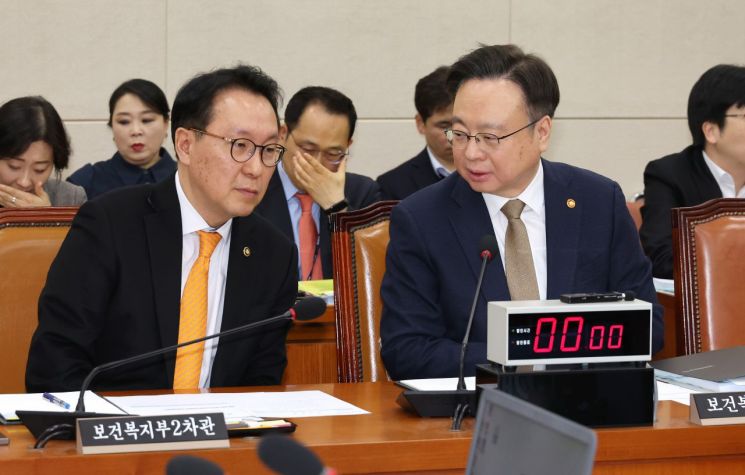
On the afternoon of the 14th, during a government questioning session at the National Assembly, Minister Cho responded to a question from Baek Seung-ah, a member of the Democratic Party of Korea, asking, "What does the government's zero-base consultation policy mean?" by saying, "The current university admission plan states that the increase for next year is 2,000 students, but we intend to properly discuss it through supply and demand projections without being bound by that number."
When Representative Baek asked, "Does this mean starting discussions from the pre-increase quota of 3,058 students?" he replied, "We will adjust by listening to field opinions through supply and demand projections without focusing on a specific number, within the range of 3,058 to 5,058 students."
The medical school quota, which was 3,058 students, increased to 5,058 after the government announced an increase of 2,000 students last February. For the 2025 academic year, the quota was finalized at 4,567 students, an increase of 1,509.
When asked when the Ministry of Education would be notified of next year's quota, Minister Cho said, "The Ministry of Health and Welfare provides opinions based on supply and demand projections looking 6 to 10 years ahead," adding, "It is difficult to specify a particular time, but we will present our opinions as soon as possible to alleviate the concerns of examinees and parents, and because schools preparing for university admissions also need preparation time."
Minister Cho expressed that injecting national treasury funds into the National Pension Service is inappropriate.
He emphasized, "Injecting national treasury funds into the National Pension Service is regressive and therefore inappropriate," and added, "Since the National Pension is also social insurance, it is principled to resolve issues by adjusting contribution rates and benefit levels according to insurance principles."
In response to a question from Ahn Sang-hoon of the People Power Party asking, "Isn't the primary goal of National Pension reform financial sustainability?" Minister Cho answered, "I agree."
Regarding proposals from some quarters to raise the income replacement rate to 45% or 50%, he said, "While it would strengthen old-age income security, it would significantly reduce financial sustainability."
Minister Cho stressed the automatic stabilizer included in the government's reform plan, saying, "If it is not introduced, even if the income replacement rate is adjusted to 42%, sustainability will be very limited," and added, "It is a necessary condition for maintaining sustainability."
© The Asia Business Daily(www.asiae.co.kr). All rights reserved.

















