Possibility of Raising Issues Over EV Subsidies
Cheap Electricity Rates and Platform Regulations as Key Issues
KCCI Private Delegation to Visit the U.S. on the 19th
As the United States has decided to impose reciprocal tariffs on countries around the world, domestic companies are finding it increasingly difficult to avoid a tariff bomb. In particular, since the U.S. plans to review not only tariffs but also non-tariff barriers by country to derive specific tariff rates, various regulations implemented by our government are expected to come under scrutiny.
Korea ranks eighth among countries with which the U.S. has a trade deficit. It is pointed out that the significant trade imbalance in key export industries such as automobiles and semiconductors is likely to become a major issue. However, since the U.S. administration announced on April 2 that it intends to negotiate with each country before implementing reciprocal tariffs, the importance of government-level responses has increased.
According to the industry on the 14th, non-tariff barriers such as government subsidies for electric vehicles are expected to serve as grounds for the U.S. to raise tariff rates. The trade imbalance in automobiles between Korea and the U.S. is larger than in other items, and the industry anticipates that the U.S. will take issue with the national subsidies for electric vehicles provided by our government.
The Ministry of Environment provides full subsidies for electric vehicles priced below 53 million KRW according to the 2025 electric vehicle purchase subsidy processing guidelines, and 50% of the subsidy for vehicles priced between 53 million KRW and 85 million KRW. Vehicles priced above 85 million KRW do not receive subsidies.
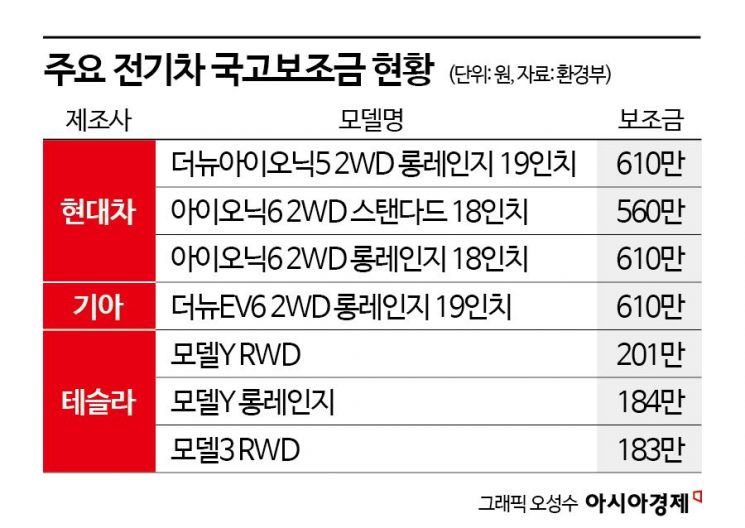
In the case of Tesla in the U.S., the government subsidies for the Model Y last year ranged from 2.1 million to 2.35 million KRW, and for the Model 3 from 2.26 million to 2.35 million KRW, but this year they have significantly decreased to 1.69 million to 2.02 million KRW and 1.83 million to 2.02 million KRW, respectively. An industry official said, "Considering logistics costs for imported cars produced in the U.S., there are almost no vehicles within the price range eligible for subsidies," adding, "This could be used as a pretext to raise issues."
Cheap electricity rates are also cited as a non-tariff barrier that the U.S. is dissatisfied with. The logic is that producing steel products with inexpensive electricity domestically inevitably increases the price competitiveness of automobiles exported to the U.S.
Regulations on platform companies are also a major issue. The Platform Competition Promotion Act (Platform Act) being promoted by the Korea Fair Trade Commission includes not only domestic platforms such as Naver and Kakao but also U.S. platforms like Google and Meta within its regulatory scope.
For this reason, there are also opinions that the role of the government has become more important. Han Areum, a senior researcher at the Korea International Trade Association (KITA), said, "Former President Trump has stated that he will approach countries causing trade deficits individually, but it is difficult to respond at the level of individual companies," adding, "Our companies’ automobile factories in the U.S. are expanding, and a message should be given to manage the reduction of automobile exports by increasing production within the U.S. in the long term."
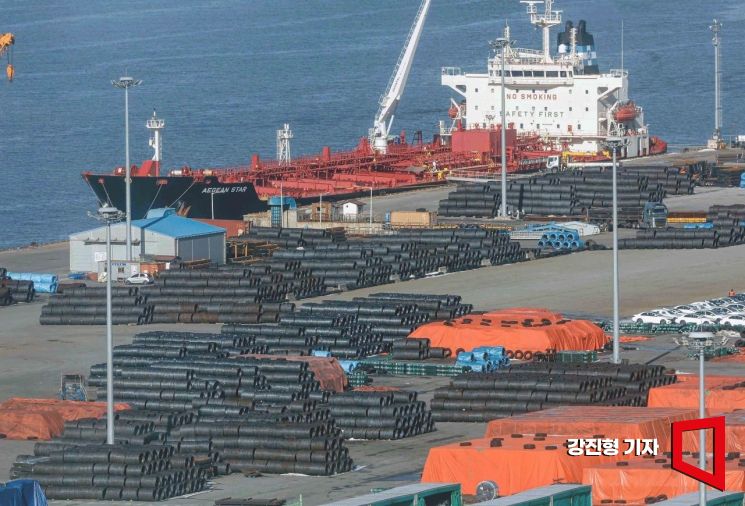 Steel products are piled up at the export yard of Pyeongtaek Port in Gyeonggi on the 13th, as major countries such as Japan, the United Kingdom, and the European Union (EU) rush to respond following President Donald Trump’s signing of a proclamation imposing a 25% tariff without exception on steel and aluminum products imported into the United States. 2025.2.13. Photo by Kang Jin-hyung
Experts advise that since most non-tariff barriers pertain to institutional aspects, regulatory improvements should be considered together. Professor Heo Yoon of Sogang University, who serves as the chairman of the government’s trade policy advisory committee, said, "From our perspective, this can be used as an opportunity to review regulations." Researcher Han Areum also noted, "During the past Korea-U.S. Free Trade Agreement (FTA), the U.S. demanded the establishment of copyright law, which eventually led to an increase in the competitiveness of domestic content," adding, "The government needs to review the U.S. points of concern."
With the negotiation period granted, movements by domestic business organizations are already active. The Korea Chamber of Commerce and Industry (KCCI) is organizing a private economic delegation composed of CEOs from the top 20 groups to visit the U.S. on the 19th and 20th. The delegation is expected to include KCCI Chairman and SK Group Chairman Chey Tae-won, as well as HS Hyosung Vice Chairman Cho Hyun-sang.
The Federation of Korean Industries recently sent Jeong Cheol, president of the Korea Economic Research Institute, to the U.S. This is because Chairman Ryu Jin is tied up with the board meeting and general assembly scheduled for the 20th, where his reappointment will be decided. President Jeong is leading the ‘Trump 2nd Term Task Force (TF)’ launched by the Federation on March 23 through an organizational restructuring.
President Jeong, who flew to the U.S. alone without any accompanying personnel, plans to meet with government officials, members of Congress, and opinion leaders over the next two months to gather their views. He is also scheduled to meet with representatives from local think tanks such as PIIE, KEI, AFPI, CSIS, AEI, and the Heritage Foundation. Additionally, he will check the preparations for the Korea-U.S. Investment Forum that the Federation will hold locally next month.
The Korea International Trade Association (KITA) is also planning to send a delegation of about 10 members, including Chairman Yoon Jin-sik and executives, to visit the U.S. from the 15th to the 23rd of next month. They will focus on southern U.S. states such as Arizona, Texas, and Tennessee, meeting with governors, commerce ministers, and state legislators to exchange opinions. KOTRA holds an ‘Export and Investment Emergency Response Team’ meeting every Tuesday chaired by President Kang Kyung-sung.
There are also opinions that the government’s role has become more important in the upcoming negotiations with the U.S. Han Areum, senior researcher at KITA, said, "Former President Trump has stated that he will approach countries causing trade deficits individually, but it is difficult to respond at the level of individual companies," adding, "Our companies’ automobile factories in the U.S. are expanding, and a message should be given to manage the reduction of automobile exports by increasing production within the U.S. in the long term."
He also emphasized the need to consider regulatory improvements together since most non-tariff barriers relate to institutional aspects. He said, "During the past Korea-U.S. Free Trade Agreement (FTA), the U.S. demanded the establishment of copyright law, which eventually led to an increase in the competitiveness of domestic content," adding, "The government should organize and review the U.S. points of concern and find areas to integrate regulatory modernization."
© The Asia Business Daily(www.asiae.co.kr). All rights reserved.



















