A total of 3,490 Moa Housing units will be supplied near Seokgwan-dong in Seongbuk-gu and Wonhyo-ro 4-ga in Yongsan-gu, Seoul.
On the 13th, the Seoul Metropolitan Government held the 3rd Small-scale Housing Maintenance Integrated Review Subcommittee and announced on the 14th that it had passed the integrated review for two projects, including Moa Town in the area of 71 Wonhyo-ro 4-ga, Yongsan-gu.
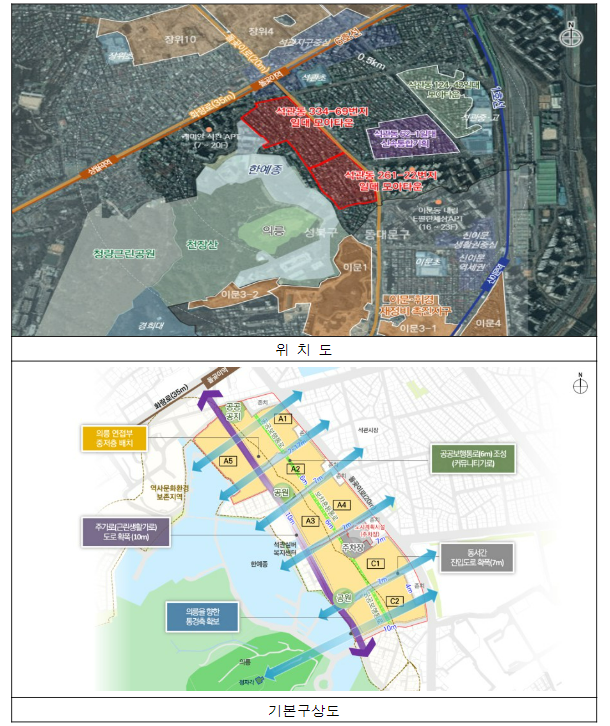 Moa Town in the area including Seongbuk-gu Seokgwan-dong 334-69 and one other location. Provided by Seoul City
The projects that passed the integrated review this time are △the area around 334-69 Seokgwan-dong, Seongbuk-gu and one other site △the area around 71 Wonhyo-ro 4-ga, Yongsan-gu.
As a result of this review, five Moa Housing sites and 1,703 housing units will be supplied in the area around 334-69 Seokgwan-dong, Seongbuk-gu. In the area around 261-22 Seokgwan-dong, Seongbuk-gu, two Moa Housing sites and 1,183 housing units will be supplied. This area is an old low-rise residential district where aging buildings are densely concentrated and infrastructure is lacking, but redevelopment has been difficult. Additionally, it adjoins Uireung, a historical royal tomb, and has been subject to height restrictions as it falls within a historical and cultural environment preservation area.
According to the management plan, Hwarang-ro 32-gil will be linked with local cultural resources such as Uireung and the Korea National University of Arts, and street activation facilities and community facilities along public pedestrian paths will be arranged. The management plan also reflects the upgrade of land use zones, plans for maintenance infrastructure such as roads, parking lots, and parks, as well as the Moa Housing project promotion plan and design guidelines.
In the area around 71 Wonhyo-ro 4-ga, one Moa Housing site and 604 housing units will be supplied. The target site is a low-rise residential dense area where the rates of aging buildings and semi-basements reach 74% and 42%, respectively. The management plan includes upgrading land use zones and supplying local necessary facilities such as public offices and open shared-use facilities.
Furthermore, the main road, Hyochangwon-ro, will have building setback lines established to create pedestrian spaces, and existing traffic islands will be converted into plazas.
The plan also includes integrating the project area into a single development zone by closing internal roads, minimizing the application of height restrictions. This area has been subject to height restrictions due to nearby national heritage sites (Yongsan Theological Seminary, Wonhyo-ro Sacred Heart Cathedral).
The city plans to create an 8-meter-wide public pedestrian path within the housing complex to replace the closed internal roads. This is expected to improve the walking environment, allowing convenient access to the Yongsan Cultural Center and the newly established community center.
© The Asia Business Daily(www.asiae.co.kr). All rights reserved.

















