Relief Amount Increased 2.5 Times in the Last Three Months of Last Year
About 80% of Victims with Losses Over 200 Million KRW Are Women
"Fund Transfers Requested by Those Impersonating Prosecutors or the FSS Are Scams"
As voice phishing scams targeting the elderly related to fake card deliveries increase, the Financial Supervisory Service (FSS) has raised its consumer alert level from caution to warning. It emphasized that if someone impersonating prosecutors or FSS staff requests funds for card delivery, people should not comply.
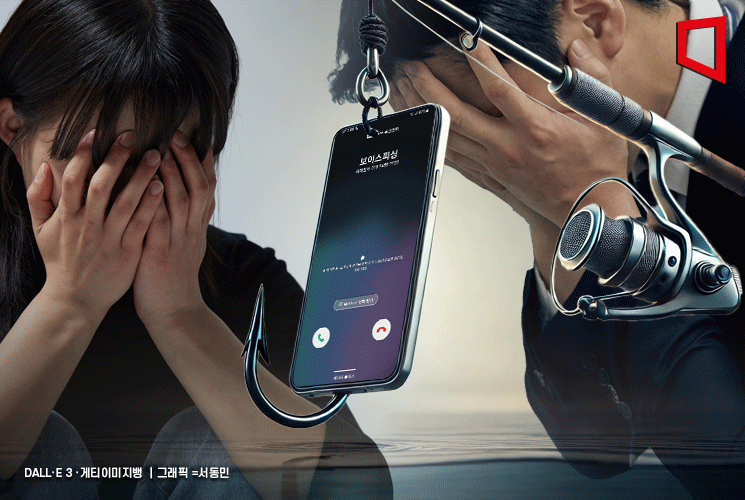
According to the FSS on the 13th, the amount of damage reported in voice phishing relief applications received by the FSS last year increased about 2.5 times from 24.9 billion KRW in September to 61 billion KRW in December.
The FSS reported that cases of high-value damage among the elderly due to voice phishing scams using unsolicited card deliveries as bait have increased.
Scammers mainly use the method of making victims mistakenly believe that a card they did not apply for has been issued, then induce them to call a fraudulent contact number disguised as the card company’s customer center. When victims call the fake customer center, their personal information is leaked, and they are led to install a remote control app under the pretext of security checks due to identity theft. After installing the remote control app, if a malicious app is installed on the victim’s phone, calls to official numbers such as the FSS or the Prosecutor’s Office are connected to the scammers. The scammers exploit this to freely track the victim’s location and record conversations.
They also impersonate prosecutors and the FSS, using sophisticated scenarios to manipulate the victim’s psychology. Scammers impersonating prosecutors threaten victims by saying that many other victims have been involved in fraud crimes related to them and that they will be arrested and investigated. Then, other scammers impersonating the FSS deceive victims by saying they can help with summary investigations. They threaten that if the victim informs their family, the family will also become subjects of investigation. They manipulate victims into sending money to the scammers themselves under the pretexts of asset protection and summary prosecution deposits.
The FSS revealed that about 80% of those who suffered damages of 200 million KRW or more from such voice phishing in the second half of last year were women. In particular, women in their 60s accounted for more than half. In Seoul, the damage amount in the Gangnam 3 districts accounted for about 30% of the total damage in Seoul.
Earlier, the FSS issued a consumer alert of "caution" for voice phishing cases in December last year, but similar damage cases continued to occur. Accordingly, the FSS raised the consumer alert level to "warning" and urged consumers to be especially cautious.
The FSS advised that if money has been transferred due to deception by scammers, people should contact the police or the financial institution’s call center as quickly as possible to request a payment stop.
An FSS official said, "If you receive contact about a card delivery you did not apply for, you should directly verify with the card company," adding, "Financial companies and public institutions do not require app installations, and the FSS and prosecutors never directly request fund transfers."
© The Asia Business Daily(www.asiae.co.kr). All rights reserved.

















