Seeking Ways to Foster a Healthy Cell Phone Use Culture
Discussing Various Guidance Measures with Participation from the Educational Community
Ulsan Metropolitan Office of Education (Superintendent Cheon Chang-su) held a "Roundtable Discussion for Creating a Healthy Culture of Student Cell Phone Use in Schools" on the 13th at the Oesol Meeting Room.
This discussion was organized to prevent issues arising from students' cell phone use in schools, such as disruption of classes and digital device overdependence, and to seek ways to foster a healthy learning environment and smooth communication culture.
About 60 participants attended the discussion, including students, parents, and teachers from the Ulsan area representing the three educational stakeholders, Ulsan City Council member Moon Seok-ju, representatives from teacher organizations (Ulsan Teachers' Association, Jeon-gyo-jo Ulsan Branch, Ulsan Teachers' Union), and education office officials.
The discussion was held under the theme of "Establishing Desirable Measures to Improve the Learning Environment Regarding Student Cell Phone Use and Restrictions in Schools."
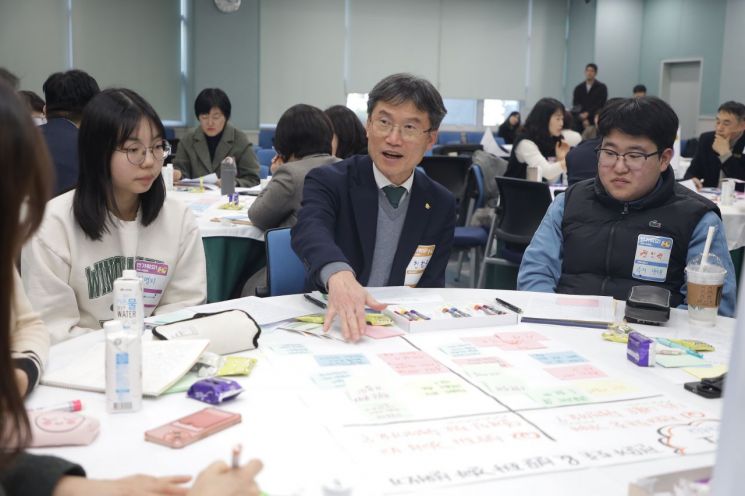 Ulsan Office of Education is holding a roundtable discussion on student mobile phone use within schools. Photo by Ulsan Office of Education
Prior to the discussion, in December last year, the Ulsan Office of Education conducted a survey on "Student Cell Phone Use and Restrictions in Schools" targeting all students from 4th grade and above in Ulsan, their parents, and teachers, using online and mobile QR code methods. A total of 7,610 people responded to the survey.
The survey results showed that 52.51% of students responded that "collection is unnecessary," while 70.16% of parents and 74.62% of teachers responded that "collection is necessary."
The reasons for considering collection unnecessary included "it does not affect school life" and "needed in emergencies," whereas all respondents cited "prevention of class disruption" as the primary reason for collection being necessary.
During the discussion, based on the survey results, participants shared the positive and negative aspects of student cell phone use, discussed the advantages and inconveniences of not using cell phones, and explored ways to foster a healthy usage culture.
Especially, in the expert discussion held prior to the roundtable, city council members, teacher organization representatives, and student and parent representatives participated and engaged in a heated debate on various guidance measures regarding students' possession, use, and restriction of cell phones in schools.
The Ulsan Office of Education plans to inform all schools of the discussion results and support them in establishing rules suited to each school's circumstances.
An official from the Ulsan Office of Education stated, "We hope that the diverse opinions presented at this roundtable discussion will help develop student cell phone use and management measures that fit the conditions and environments of schools at all levels."
© The Asia Business Daily(www.asiae.co.kr). All rights reserved.

















