This month, Seoul's apartment move-in outlook index dropped sharply compared to a month ago, reaching its lowest level in two years. This index predicts whether those who purchased apartments will be able to pay the remaining balance and move in as scheduled.
According to a survey released by the Korea Research Institute for Human Settlements on the 13th, Seoul's apartment move-in outlook index this month was 75.8, down 12.2 points from a month earlier. After reaching 111.4 in October, the index stayed above 100.0 until the end of the year but fell below the baseline (100) to 88.0 last month. It has been declining for four consecutive months, marking the lowest point in two years since 2023.
The index is based on 100; a value above 100 indicates that more people have a positive outlook on the move-in market, while a value below 100 indicates the opposite. Until the second half of last year, Seoul's index was above the baseline, showing a predominantly positive outlook. However, as expectations for market recovery faded, the index plummeted to the 70s within a few months.

The nationwide apartment move-in outlook index rose 7.2 points from a month ago to 75.6. By region, the metropolitan area fell by 2.2 points, while metropolitan cities and provincial areas increased by more than 9 points. All regions except Seoul, Gangwon, and Chungbuk showed an upward trend.
Regarding the rise in the apartment move-in outlook index in provincial areas, the institute explained, "This is due to the government's slight easing of loan regulations for provinces last month and a base effect from the significant decline over the past two months." Although the index rebounded, political uncertainties remain, and loan regulations persist, so the market contraction is expected to continue.
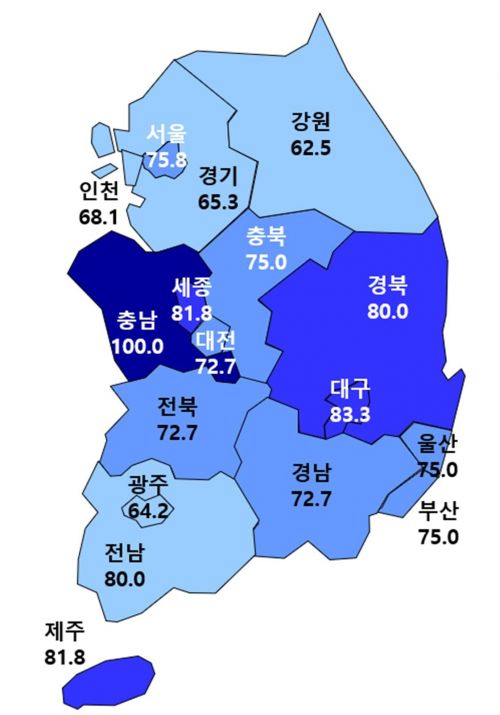
Last month's move-in rate was recorded at 63.5%, down 6.2 percentage points from the previous month. In the metropolitan area, Seoul saw a slight increase, but Incheon and Gyeonggi dropped by more than 9 percentage points, falling below 70%. The institute attributed this to oversupply controversies in Yeonsu-gu, Incheon, and the delayed start of the metropolitan express railway, which dampened sales sentiment.
The move-in rate in the Gangwon region was 40.0%, the lowest since the survey began in 2017. This was because the jeonse (long-term lease) rate was higher than the provincial average, leading to sales focused on existing homes rather than jeonse.
The most common reason for non-move-ins was delayed sales of existing homes, cited by 42.1% of respondents, an increase of 10 percentage points from the previous month's survey. Other reasons included failure to secure balance loans (26.3%), failure to secure tenants (21.1%), and delayed sales of pre-sale rights (5.3%). The institute analyzed, "Some commercial banks still manage loan limits on a daily basis, beyond quarterly and monthly controls, so loan regulations remain strict. Easing loan regulations is necessary to improve the sluggish market for actual buyers."
© The Asia Business Daily(www.asiae.co.kr). All rights reserved.
![Clutching a Stolen Dior Bag, Saying "I Hate Being Poor but Real"... The Grotesque Con of a "Human Knockoff" [Slate]](https://cwcontent.asiae.co.kr/asiaresize/183/2026021902243444107_1771435474.jpg)












