Trump and Putin Agree to Launch Peace Talks
"Time to Begin Cooperation" After Phone Call
"European Countries Must Take Responsibility for Their Own Security"
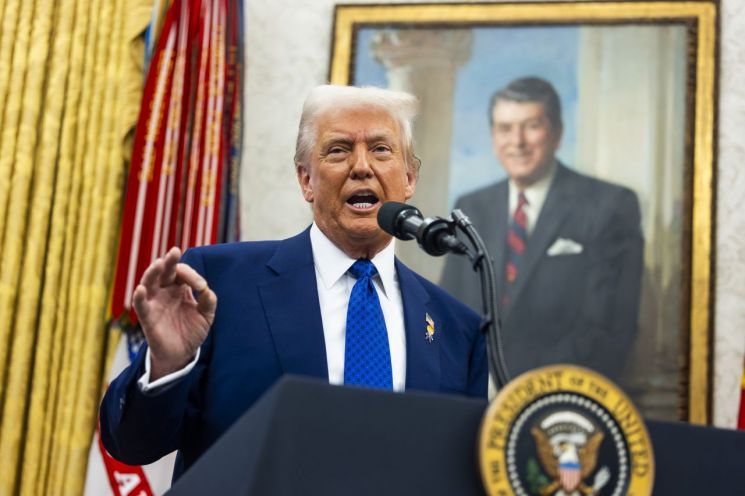 On the 12th (local time), U.S. President Donald Trump is speaking at a press conference held after a phone call with Russian President Vladimir Putin. President Trump announced that during the call, they agreed to immediately start negotiations to end the war in Ukraine. Photo by UPI and Yonhap News.
Although U.S. President Donald Trump and Russian President Vladimir Putin have agreed to begin negotiations to end the war in Ukraine, European countries remain lukewarm due to security concerns. This is because if the Trump administration, aiming for a swift end to the war, accepts most of Russia's demands, European countries will have to spend enormous sums to respond to heightened security threats.
The Trump administration maintains that, after the end of the war, security in Ukraine and the rest of Europe should be the responsibility of European countries. As a result, there is analysis suggesting that European nations will need to invest at least 4,500 trillion won (approximately $3.1 trillion) in security costs over the next decade. The economic blow to European countries is inevitable, as energy costs have risen and inflationary pressures have mounted since the imposition of sanctions against Russia.
Trump, after call with Putin: "Agreed to immediately begin negotiations to end the war"
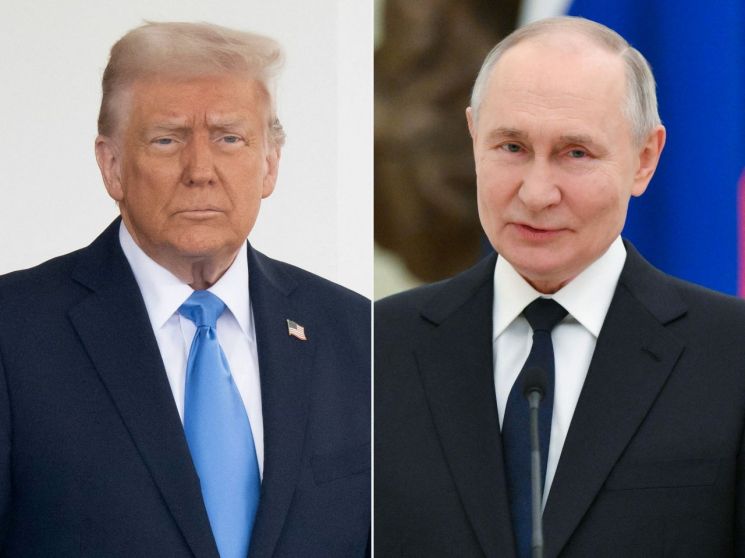
On the 12th (local time), President Trump announced at a press conference following his phone call with President Putin that "we have agreed to immediately begin negotiations to end the war in Ukraine." Dmitry Peskov, spokesperson for the Kremlin, also stated in a media briefing that "the two leaders spoke by phone for one hour and thirty minutes," adding, "They discussed the situation in Ukraine and ways to resolve the conflict peacefully. President Trump supported the prompt cessation of hostilities and a peaceful resolution, while President Putin emphasized the need to address the root causes of the conflict." This is the first time since the outbreak of the war in Ukraine in February 2022 that the leaders of the United States and Russia have directly discussed negotiations to end the war by phone.
The Trump administration is expected to accept most of Russia's demands in pursuit of a swift end to the war. Russia's demands include recognition of effective control over occupied territories in Ukraine and rejection of Ukraine's NATO membership.
The European Union (EU) opposes the Trump administration's "rapid conclusion" plan for ending the war. In a recent interview with major foreign media, EU High Representative for Foreign Affairs Kaja Kallas stated, "Supporting Ukraine further will ultimately cost much less than an early end to the war. Russia still does not want peace," leaving open the possibility of further escalation. An anonymous senior EU official also warned Bloomberg, "If the war ends in this way, Russia could attack NATO member territories within the next five to eight years."
"Europe must provide for its own security"... Security costs at least 4,500 trillion won
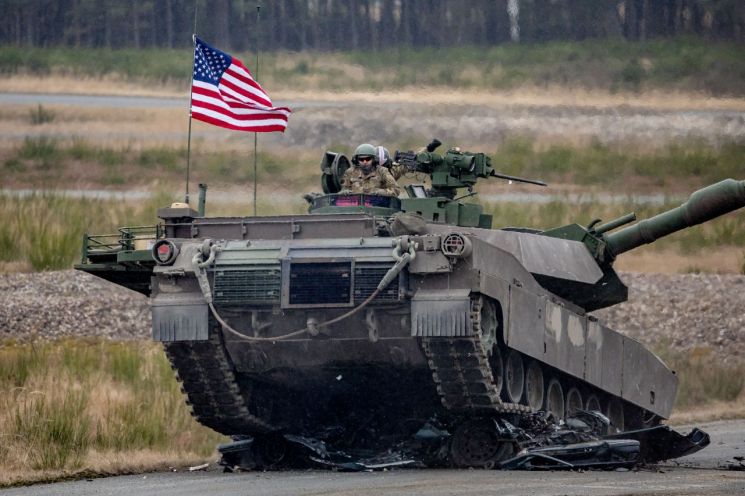 On the 11th (local time), an armored unit of the US Forces in Germany conducted training at the Grafenwoehr military base in Germany. Photo by EPA and Yonhap News Agency
However, the Trump administration's stance remains firm. U.S. Secretary of Defense Pete Hegseth stated at last week's Ukraine Defense Contact Group (UDCG) meeting at NATO headquarters in Brussels, Belgium, "We must acknowledge that returning Ukraine's borders to their pre-2014 state is an unrealistic goal," adding, "Ukraine's NATO membership is also not seen as a realistic outcome of the war negotiations."
Secretary Hegseth also stressed that European countries must be responsible for their own security after the end of the war. He stated, "The United States is prioritizing deterring war with China in the Pacific," and emphasized, "The unbalanced relationship in which Europe continues to depend on the U.S. for its security must end, and we will focus on ensuring Europe takes responsibility for its own security." He further clarified, "There will be no deployment of U.S. troops in peacekeeping forces stationed in Ukraine after the negotiations," and "The activities of the peacekeeping force should not be part of a NATO mission, nor should they be covered by Article 5 of the NATO Treaty, which pertains to collective defense."
Accordingly, it is expected that European countries will need to secure enormous defense budgets after the end of the war in Ukraine. Bloomberg Economics estimated, "After a ceasefire, defending Ukraine will require rebuilding the Ukrainian military, forming and maintaining peacekeeping forces, and increasing the defense budgets of each country. This will require at least $3.1 trillion (about 4,500 trillion won) in security costs over the next ten years." The report added, "The peacekeeping force for Ukraine is currently expected to number 40,000 in Europe, but Ukraine claims it needs as many as 200,000. Considering reconstruction costs and other factors, much more funding may be required."
There are also assessments that if the Trump administration decides not to intervene in Ukraine's defense and even considers withdrawing from NATO, the possibility of further Russian escalation must be considered. Bloomberg Economics projected, "If NATO can no longer guarantee the defense of its member states and the possibility of a U.S. withdrawal becomes a reality, Russia will likely target the Baltic states after Ukraine." The report continued, "Eastern European countries close to Russia may lose faith in NATO and EU security guarantees, pursue separate negotiations with Russia, and the EU itself could face a crisis of division."
© The Asia Business Daily(www.asiae.co.kr). All rights reserved.



















