A harmless insect resembling a mosquito but unable to bite
Director Lee Daeam discovered it 20 years ago...
Official naming ceremony to be held at this year's Danjong Festival
A new insect species named ‘Danjongdaewang Gakdagwi’ (photo), bearing the name of ‘Danjong (端宗)’, has been newly identified among unrecorded insects in Korea. The Yeongwol Insect Museum (Director Lee Dae-am) in Yeongwol-gun, Gangwon Special Self-Governing Province (Governor Choi Myung-seo) announced on the 12th that through the Korean Entomological Society’s academic journal ‘Entomological Research Bulletin’ published on February 11, they officially announced a new genus ‘Daewang Gakdagwi genus’ (newly named) and a new species within it, ‘Danjongdaewang Gakdagwi’ (newly named), previously unrecorded in Korea.
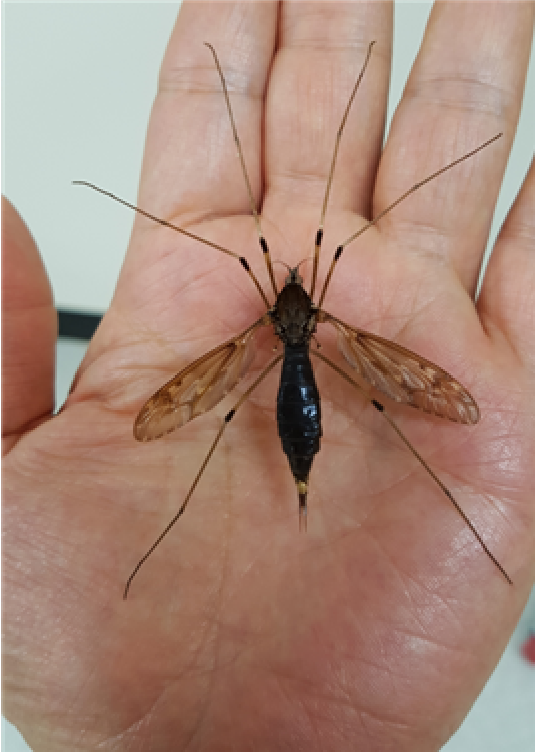
Gakdagwi are insects taxonomically belonging to the order Diptera and family Tipulidae, making them cousins of mosquitoes. They resemble mosquitoes in appearance but are characterized by their unusually long legs. Hence, their English name is Crane fly, as they resemble cranes.
Although often mistaken by the general public as giant mosquitoes, Gakdagwi do not have the blood-sucking proboscis like mosquitoes, so they cannot bite humans. They are harmless and are known to be beneficial insects.
The newly announced giant Gakdagwi has a body length of 4.5 cm, wings measuring 2.5 to 3 cm, and legs 5 cm long. Its official scientific name is ‘Brithura sancta Alexander, 1929’, and it is a large insect that can cover an adult’s palm. Until now, it was known worldwide as a rare giant Gakdagwi distributed only around Beijing, China.
Director Lee Dae-am first collected this insect on June 8, 2003, on the mountain behind the old Yeongwol Insect Museum in Mungok-ri, Buk-myeon, Yeongwol-gun. Considering its giant size, the fact that the initial discovery site is 3 km from Jangneung and only 4 km from Cheongnyeongpo, and especially that the adult emergence period is from June to September, coinciding with King Danjong’s exile period in Yeongwol (June to November), he explained that he named it
Director Lee visited the Smithsonian Museum in the United States, the British Museum in the UK, and the Museum of China Agricultural University in Beijing several times to confirm whether this species was a global new species (Species nova). After completing genetic testing last year, it was finally determined to be an unrecorded species in Korea.
This achievement was made as part of the native species survey research project conducted by the National Institute of Biological Resources to discover new and unrecorded species in Korea. The same paper also includes a total of 12 newly discovered unrecorded Gakdagwi species from various locations in Gangwon Province, in addition to ‘Danjongdaewang Gakdagwi’. Among the 12 unrecorded species announced by Director Lee this time, two species named after Yeongwol’s place names, ‘Munsan Naru Gakdagwi’ and ‘Donggang Cheonyeo Gakdagwi’, are included. Additionally, five species (‘Heungwol Aegi Gakdagwi’, ‘Heunggyo Aegi Gakdagwi’, ‘Yeongwol Jangsu Gakdagwi’, ‘Minhwa Jangsu Gakdagwi’, and ‘Gimsatgat Hwangra Gakdagwi’) have already been reported to the institute and are currently preparing for publication. Director Lee stated, “In the future, I plan to actively incorporate the name of the Yeongwol region into the scientific names of newly discovered insect species in the Yeongwol area of Gangwon Province,” and added, “At this year’s Danjong Festival, we plan to hold an official naming ceremony for ‘Danjongdaewang Gakdagwi’ in front of the residents of Yeongwol-gun.”
© The Asia Business Daily(www.asiae.co.kr). All rights reserved.

















