Surprised by the Second Review of Apache Attack Helicopter (AH-64E) Acquisition
On the 12th, Boeing addressed the so-called 'helicopter obsolescence theory' raised amid the Russia-Ukraine war, stating that “a hybrid solution involving both manned and unmanned systems, rather than exclusive investment in unmanned drones, is the most appropriate and effective approach on the evolving battlefield.”
At a media briefing titled ‘The Future of the AH-64 Apache’ held at the Royal Park Convention in Yongsan-gu, Seoul, Boeing said, “Investment in unmanned drones is effective in terms of ‘cost-performance ratio’ and is indeed an area that should be invested in going forward,” while emphasizing the hybrid approach.
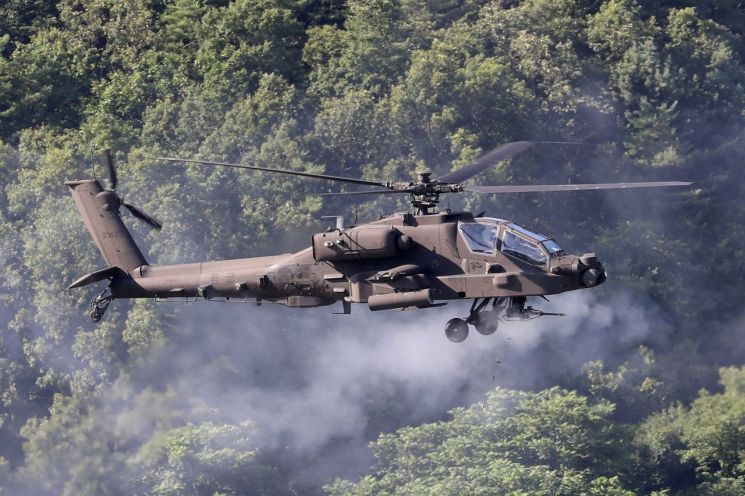
The military authorities have been considering acquiring 36 additional Apache attack helicopters (AH-64E) at a cost of about 3.3 trillion won, but due to a roughly 66% increase in unit price compared to the first procurement and vulnerabilities to attacks by unmanned drones and other systems, there is a growing atmosphere of reconsideration.
Seemingly aware of these concerns, Christina Yoo, Boeing Vice President and Attack Helicopter Program Manager, explained, “No unmanned system or drone can replace attack helicopters,” adding, “In future battlefields, the key is the smooth and integrated operation of both manned and unmanned systems.”
Terry T.J. Jamieson, Director of Attack Helicopter Business Development, also said, “In the 1950s, there were anti-tank guided missiles; in the 1960s, infantry portable defense systems like MANPADS; and during the Gulf War in the 1990s, Scud missiles. Each time, countermeasures were developed. Today, drones are emerging, but Boeing is proficient in developing counter-drone response systems,” adding, “We recently demonstrated drone countermeasure capabilities at a test site in Arizona; while the results are classified, the demonstration was successful.”
He emphasized that the next key step is the smooth operation of manned-unmanned teaming (MUM-T), stating, “The Apache helicopters first procured by Korea are version 1.2 and do not have MUM-T capabilities, but with the new acquisition of version 6.5, all these functions will be available. Based on this, the Launch Effective Area (LEA) is being custom-developed so that attack helicopters can operate and control it, significantly expanding the Apache’s reach, range, situational awareness, lethality, and survivability.”
Regarding the higher acquisition cost compared to the first procurement, he said, “Under the U.S. Foreign Military Sales (FMS) system, the stated price includes not only the airframe but also training, weapon systems, and parts as a package. Additionally, if costs identified later are added after U.S. Congressional approval, the administrative process must be restarted from the beginning, which is cumbersome. These factors were taken into account for a conservative approach.”
© The Asia Business Daily(www.asiae.co.kr). All rights reserved.

















