Hwang Launches Barrage of Questions at 7th Yoon Impeachment Hearing
Lists Election Fraud Conspiracy Theories in Witness Examination
Kim Yongbin, Secretary General, Says "Supreme Court Has Already Ruled"
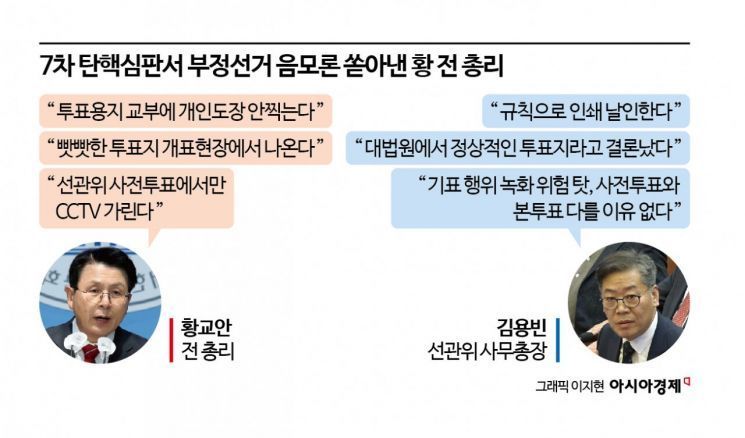
Former Prime Minister Hwang Kyo-ahn appeared at the 7th impeachment trial hearing on the 11th and unleashed various election fraud conspiracy theories. Hwang serves as the general representative of an organization called ‘Bubangdae (Election Fraud and Corruption Prevention Unit),’ which is identified as the source of the election fraud allegations. The origin of the ‘election fraud conspiracy theory’ began when Hwang and former lawmaker Min Kyung-wook contested the results immediately after the 21st general election. On the 5th, Hwang joined the legal team by submitting a power of attorney for President Yoon Suk-yeol’s criminal trial.
On that day, Hwang questioned Kim Yong-bin, Secretary General of the National Election Commission, who appeared as a witness, listing issues such as whether the ballot papers were stamped, the problem of stiff ballots, and CCTV partitions, implying there were flaws in election management. Kim responded, “The Supreme Court has already verified the results,” and asked, “Are you interpreting the law personally?” Hwang is a prosecutor from the 13th Judicial Research and Training Institute class, while Kim is a judge from the 16th class, the same as President Yoon.
Hwang asked, “According to Articles 157 and 158 of the Public Official Election Act, when issuing ballots, a private seal, that is, a personal stamp, must be affixed. Are you aware that the Election Commission is not using the personal stamps of election managers?” Kim replied, “The rules allow substitution with printed seals.” Hwang questioned, “Can something stipulated by law be changed by rules?” Kim answered that it does not violate the purpose of the law itself and that decisions have been made by the courts and the Constitutional Court. When Hwang insisted again, “Before amendment, the law must be followed,” Kim countered, “That denies the rulings of the Supreme Court and the Constitutional Court, and the Supreme Court holds the final authority on legal interpretation.” Kim especially said, “Even though the Supreme Court and the Constitutional Court have provided authoritative interpretations, if you personally interpret the law and claim it is wrong, I have nothing to say.”
Hwang also asked, “Is it possible for stiff ballots, which have never been folded, to appear during recounts or vote counting?” The ‘stiff ballot’ suspicion is a common topic in election fraud conspiracy theories when mentioning ‘faulty ballots.’ Kim responded, “This was also addressed in the 21st election fraud lawsuit, and the Supreme Court verified and concluded that the ballots were normal.”
Hwang questioned, “Unlike on election day, the Election Commission covers CCTV only at early voting sites. Are CCTV cameras supposed to be covered at early voting stations?” Kim answered, “That is understood as a measure taken because, without installing partitions, existing building CCTV cameras could record voters’ marking actions, which poses a risk.” He emphasized, “I did not interpret the guidelines that way, nor have I issued such guidelines. There is no reason for early voting and main voting to differ, and this is part of measures to prevent the marking process from being recorded,” drawing a clear line.
© The Asia Business Daily(www.asiae.co.kr). All rights reserved.
![Clutching a Stolen Dior Bag, Saying "I Hate Being Poor but Real"... The Grotesque Con of a "Human Knockoff" [Slate]](https://cwcontent.asiae.co.kr/asiaresize/183/2026021902243444107_1771435474.jpg)
















