Measures to Revitalize the Traditional Liquor Industry
Expansion of Liquor Tax Reduction Benefits for Small-Scale Traditional Liquor Manufacturers
The government has decided to allow distilled liquors such as soju, brandy, and whiskey to obtain small-scale liquor manufacturing licenses in order to revitalize the traditional liquor industry. Additionally, tax reduction benefits for small-scale traditional liquor manufacturers will be expanded.
On the 12th, the government announced the "Traditional Liquor Industry Revitalization Measures" containing these details at the Economic Ministers' Meeting.
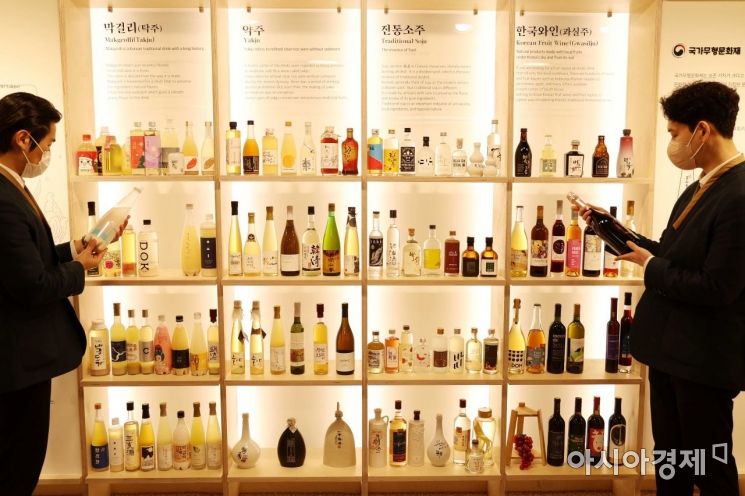
These measures were prepared focusing on strategies such as institutional improvements, strengthening production capabilities, expanding domestic distribution channels, and pioneering overseas markets to foster traditional liquor as a high value-added item in the future agro-food industry.
First, to promote brewery startups, the types of small-scale liquor manufacturing licenses will be expanded. Previously, only fermented liquors (takju, yakju, cheongju, fruit wine, beer) were allowed small-scale licenses, but from now on, distilled liquors such as distilled soju, brandy, and whiskey will also be permitted to obtain small-scale licenses. A government official stated, "Small-scale licenses can be obtained even if the facilities are about one-tenth the size of general ones," adding, "We expect a variety of liquors to increase through small-scale licenses with lower facility standards."
Also, tax reduction benefits for small-scale traditional liquor manufacturers will be expanded. Previously, only manufacturers producing 500㎘ or less annually of fermented liquors received a 50% liquor tax reduction benefit, but the tax reduction criteria will be relaxed to 1000㎘ or less, and a 30% reduction tier will be added to ease the burden on small-scale breweries.
Along with this, regulations on raw material procurement for regional specialty liquors will be eased to promote product development using various agricultural products. The requirement to use 100% regional agricultural products for the top three raw materials will be relaxed to use a certain proportion of regional agricultural products relative to the product's weight. Furthermore, to foster premium rice distilled liquors and export strategic products, the government will push for the revision of related laws such as the Traditional Liquor Industry Act and Liquor Tax Act.
To improve the quality of traditional liquors, the industry’s expertise will be enhanced and infrastructure strengthened. Brewing research using domestic microorganisms will be expanded, and a quality database and evaluation indicators will be established based on component analysis of excellent products. Additionally, technical consulting will be supported for new entrants so that small-scale breweries can secure basic technology. The government will also create a growth-friendly environment through dedicated traditional liquor funds and startup support centers for training entrepreneurial personnel.
The government will actively utilize traditional liquors as regional tourism resources to revitalize the domestic market. By establishing the "K-Gourmet Traditional Liquor Belt" and enhancing visiting brewery programs, experiential tourism programs linking regional traditional liquors and local foods will be strengthened and operated. Also, to expand distribution channels for traditional liquors, online and offline sales networks will be expanded. Collaborations with major online shopping malls such as Naver and Kakao will operate dedicated traditional liquor exhibitions, and entry into large supermarkets and convenience stores will be actively supported. Furthermore, public institutions will be enabled to easily purchase traditional liquors by expanding registration on the Nara Marketplace shopping mall and improving Clean Card usage guidelines.
Promotion targeting overseas markets will also be strengthened. Traditional liquors will be used as official toast drinks at major diplomatic events, and pairing education of traditional liquors with Korean cuisine will be newly established for diplomats. Moreover, to pioneer global distribution channels for traditional liquors, preferential entry into airport duty-free shops will be provided, and export councils related to traditional liquors will be operated to support export marketing and the establishment of country-specific tailored strategies. A traditional liquor toast guidebook linked with Korean cuisine will also be produced and distributed to actively promote the excellence of traditional liquors to overseas buyers.
Song Mi-ryeong, Minister of Agriculture, Food and Rural Affairs, said, "Based on these measures, the government will continue to spare no support to revitalize the traditional liquor industry brewed from domestic agricultural products such as Korean rice," adding, "We will strengthen policy support so that our traditional liquors can be more recognized in domestic and international markets."
© The Asia Business Daily(www.asiae.co.kr). All rights reserved.
![Clutching a Stolen Dior Bag, Saying "I Hate Being Poor but Real"... The Grotesque Con of a "Human Knockoff" [Slate]](https://cwcontent.asiae.co.kr/asiaresize/183/2026021902243444107_1771435474.jpg)











