Choi Jae-sung Points Out Lee Jae-myung's Recent Remarks
"Difficult for Sincerity to Be Accepted... Needs Clarification"
Criticism of Yoo Si-min's Comments on Opposition Figures: "The Worst Language"
Lee Jae-myung, leader of the Democratic Party of Korea, faced criticism from the opposition after suggesting exceptions to the '52-hour workweek' during a discussion on the Semiconductor Special Act and later mentioning a '4-day workweek' in a speech to the National Assembly negotiation group. Former Blue House Senior Secretary for Political Affairs Choi Jae-sung said on YTN Radio's 'News Fighting, Kim Young-soo' on the 11th, "The so-called rightward shift and the reduction of working hours in the AI era seem to be inconsistent policies or slightly different claims at different times," adding, "In such cases, it is difficult for Muksanism or Jalsanism to be sincerely accepted."
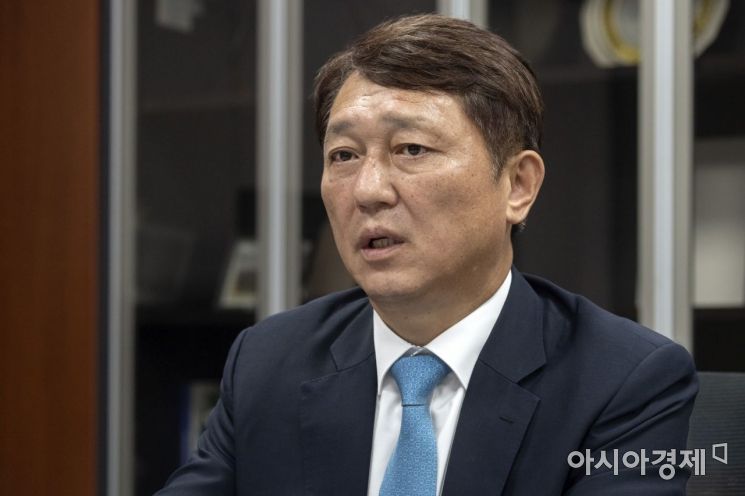 Choi Jae-sung, former Senior Secretary for Political Affairs at the Blue House. Photo by Asia Economy
Former Secretary Choi said, "He recently held a discussion on working hours related to the Semiconductor Special Act and seemed to accept the opinion that exceptions to the 52-hour workweek should be made," adding, "But on the 10th, he talked about a 4-day workweek. Since there was a discussion about making working hours flexible and now again about reducing working hours, it is necessary to organize the content well to understand how these fit together."
Regarding Lee's mention of 'exception recognition' for the 52-hour workweek, a reform project of the Moon Jae-in administration, Choi said, "It seems there was some misunderstanding of the content," explaining, "There are already exception provisions, and it is not limited to semiconductors. If truly necessary, the entire R&D sector should be observed and judged. Also, within the semiconductor industry, SK says there is actually no problem, but Samsung wants the 52-hour workweek exception applied to the production line."
On recent calls for 'unification' by candidates from the non-mainstream faction, he argued, "The leader needs to mention and express regret about the things that hindered unification, and then advocate and propose unification."
Regarding the necessity of unification, he said, "Since the imposition of martial law, we have all witnessed changes in the approval ratings of the two major parties. It must have been quite surprising," adding, "Due to the learning effect from Park Geun-hye's impeachment, 'impeachment means an early presidential election,' so the conservatives have united, and this has also triggered some dislike and antipathy toward the leader. Therefore, unification and expansion are necessary."
He continued, "The presidential election has already become a 51 to 49 game, and to overcome this, there is no choice but unification and expansion," adding, "That is what we are trying to do, but when we say 'let's unify,' it is met with accusations of 'internal sabotage' and 'division,' as if being attacked."
He criticized, "It's not like the Democratic Party declared martial law, but when someone says 'let's unify,' they respond with 'why are you sabotaging internally?'" He particularly criticized the remarks of writer Yoo Si-min, saying, "In my view, these are some of the worst words in recent politics." He pointed out, "Calling each Democratic politician 'ungrateful,' 'read a book,' 'stop acting like a leader,' 'find another job' is not just mockery and humiliation, but clearly means that they will not tolerate potential presidential candidates within the Democratic Party."
© The Asia Business Daily(www.asiae.co.kr). All rights reserved.

















