Residents Take Immediate Action When Fire Truck Is Blocked
Strict Penalties in China for Obstructing Fire Truck Passage
Only Four Cases of Forced Removal in South Korea in the Past Six Years
A fire truck heading to an apartment fire scene in China was blocked from entering an alleyway due to illegally parked vehicles, prompting local residents to step in and physically push the cars away. On the 11th, a post titled "Advanced Culture of China to Emulate" was uploaded on a domestic online community. The author, Mr. A, shared a video from social media and wrote, "There was a fire at an apartment in China, but the fire truck couldn't enter because of illegally parked cars on the roadside. They just flipped the cars over to secure the access road."
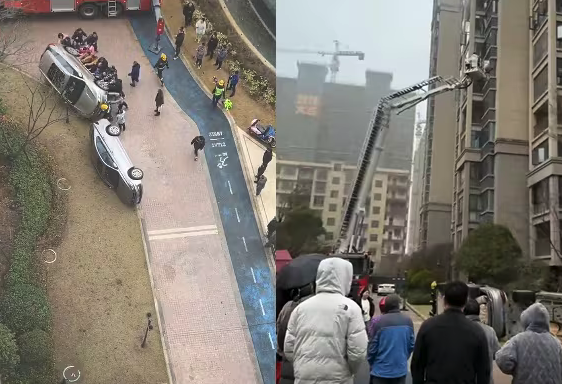 On the 11th, a post titled "Advanced Culture of China to Emulate" was uploaded on a domestic online community. The author, Mr. A, shared a video posted on SNS and wrote, "There was a fire in an apartment in China, but the fire truck couldn't enter due to illegally parked cars on the shoulder. They just flipped the cars over to secure the access road." Online community
According to reports from local Chinese media, the video was filmed at a fire scene in an apartment complex in Qingyang City, Hunan Province, China, on the 3rd. When the fire authorities arrived after receiving the fire report, the entrance and exit of the apartment were blocked by two illegally parked vehicles right in front of the fire scene. When the vehicle owners did not move their cars promptly, local residents who witnessed the situation immediately took action. The residents joined forces to overturn the two vehicles blocking the road, securing a passage for the fire truck. Thanks to the residents' swift response, firefighters were able to arrive at the fire scene on time.
The video shared on social media shows a fire truck stopped, unable to enter due to two vehicles parked side by side in a narrow access road. The vehicle parked in front was already flipped onto its side. Subsequently, residents worked together to flip the rear vehicle onto its side as well, clearing the way for the fire truck. Local netizens commented, "One car owner saw their car already flipped and joined the citizens in overturning the other car," while "the other car owner watched their car being flipped, probably fearing criticism if they intervened."
 According to reports from local Chinese media, the video was filmed at the scene of a fire that occurred on the 3rd in an apartment in Qingyang City, Hunan Province, China. When the fire authorities arrived after receiving the fire report, the apartment entrance and exit were blocked by two illegally parked vehicles right in front of the fire scene. Online community
Chinese law currently stipulates that no organization or individual may occupy, block, or close fire truck access routes. It also prohibits placing obstacles in evacuation routes or emergency exits. Specific penalties for obstructing fire truck passage are also outlined. In particular, Article 60 of China's Fire Protection Law orders organizations violating these regulations to correct the violations and imposes fines ranging from 5,000 to 50,000 yuan (approximately 1 million to 10 million KRW). Individuals face fines of up to 500 yuan (about 100,000 KRW) or warnings.
Unlike China, which strictly punishes blocking fire truck routes, South Korea still finds it difficult to enforce compulsory measures. In March 2018, the Fire Services Act was amended to allow forced removal of vehicles blocking fire trucks from entering fire scenes. However, a report released by the National Assembly Legislative Research Office in January last year showed that since the amendment took effect in June 2018, there have been only four cases of forcibly removing parked vehicles over nearly six years. Although forced removal drills were conducted about 4,000 times in 2022 and approximately 5,300 times last year, they have not been effectively implemented on site.
At the scene, the difficulty of forced removal is attributed to the administrative burden of post-processing. Some experts said, "For forced removal to be exempt from liability, fire authorities must prove it was an 'emergency situation,' which may cause individual firefighters to suffer during this process," and added, "It is worth considering a system where those who obstruct firefighting activities bear the burden of proving responsibility to claim compensation."
© The Asia Business Daily(www.asiae.co.kr). All rights reserved.


















