As market interest rates in South Korea and the United States move independently, there is an assessment that Korean government bonds could remain an attractive investment compared to those in the U.S. at least through the first half of this year.
On the 12th, Gong Dong-rak, a researcher at Daishin Securities, stated in his report titled "High Interest Rates: High (Painful) Interest Rates VS. Go Interest Rates" that "the differentiated market interest rate trends between South Korea and the U.S. are prolonging."
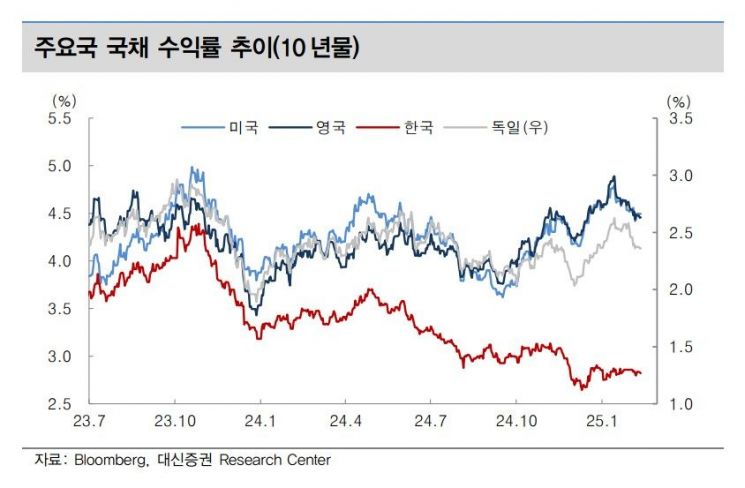
First, Researcher Gong pointed out that while U.S. market interest rates rose following the Federal Reserve's rate cuts, South Korea's market interest rates declined due to expectations of further cuts during the easing cycle.
He noted that this background is "significantly influenced not only by monetary policy and economic fundamental factors but also by supply and demand conditions in the bond market." Although the policy rate path usually exerts a strong influence on market interest rates, the recent burden of government bond issuance has led to persistently high market interest rates in the U.S.
He emphasized the impact of supply and demand variables by stating, "Despite the same easing cycle, the fact that market interest rates in countries similar to South Korea, such as the U.K. and the Eurozone, moved similarly to the U.S. suggests that previously overlooked bond supply and demand significantly influenced interest rate movements." He added, "This means that market interest rates can be more heavily affected by national fiscal conditions or government bond issuance volume," and further evaluated that "the given condition of bond issuance outstanding itself structurally influences interest rate trends."
Moreover, in the U.S., concerns over so-called 'sticky inflation' have made it difficult for prices to stabilize, leading to expectations that the rate-cutting cycle may remain in a pause mode for some time. Accordingly, Researcher Gong assessed that "the differentiation in market interest rates between South Korea and the U.S. is likely to persist for a considerable period." He evaluated, "for bond investors focused on capital gains, Korean government bonds could be perceived as a more attractive investment compared to U.S. bonds at least through the first half of the year."
© The Asia Business Daily(www.asiae.co.kr). All rights reserved.