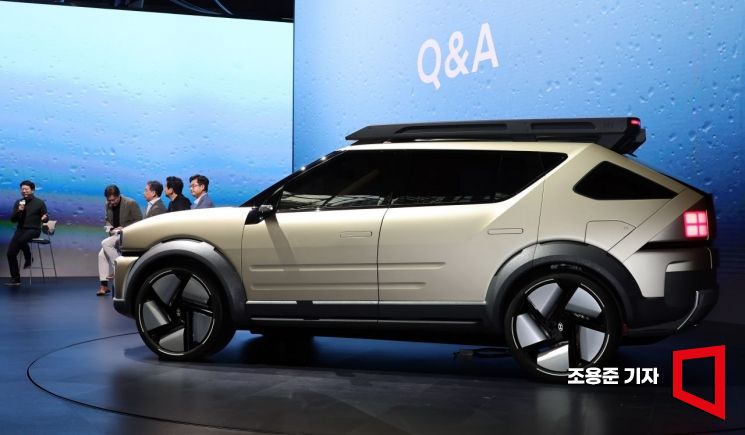
 President Jang Jae-hoon of Hyundai Motor Company, along with Executive Vice President Lee Sang-yeop and other developers, are answering questions from the press at the Hyundai Motor Company hydrogen concept car unveiling event held on October 31 at Hyundai Motorstudio Goyang in Gyeonggi Province. 2024.10.31 Photo by Jo Yong-jun
Last year, global sales of hydrogen fuel cell vehicles decreased compared to the previous year. This marks the second consecutive year of decline.
According to market research firm SNE Research on the 11th, the total number of hydrogen fuel cell vehicles registered worldwide from January to December 2024 was 12,866 units, down 21.6% from the previous year.
Global hydrogen vehicle sales peaked in 2022 at 20,704 units but began to slow in 2023 with sales dropping 20.7% to 16,413 units.
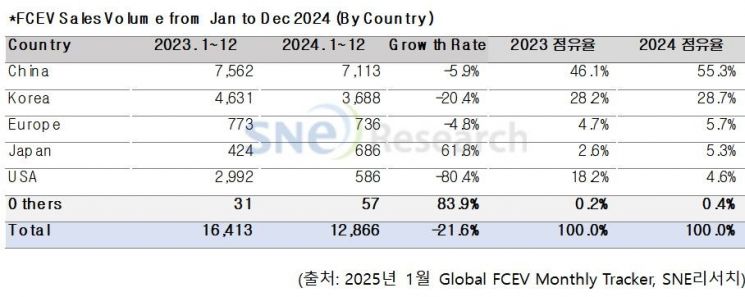
By country, South Korea saw a 23.5% decrease compared to the same period last year due to sluggish sales of Hyundai Motor's Nexo. Market share fell by 0.7 percentage points (P) to 29.8%. The government is adjusting its expansion strategy to focus more on hydrogen commercial vehicles rather than hydrogen passenger cars.
China recorded continuous growth centered on hydrogen commercial vehicles, holding the top market share at 55.3%. However, total hydrogen vehicle sales in China last year were 7,113 units, down 5.9% from the previous year.
Japan was the only major region to show growth, with the newly launched Toyota Crown selling 565 units last year, achieving a growth rate of 61.8%.
By manufacturer, Hyundai sold a total of 3,836 units centered on the Nexo and Elec City, marking a 23.5% decline compared to the same period last year. Hyundai plans to release a successor model to the Nexo this year. Toyota sold 1,917 units of the Mirai and Crown, down 50.1% from the previous year. Chinese hydrogen commercial vehicles accounted for 5,976 units, representing 46.4% of total sales.
SNE Research explained, "For the global hydrogen vehicle market to expand in the long term, strategies such as expanding charging infrastructure, growing the commercial vehicle market, and reducing hydrogen production costs must be pursued, and public-private cooperation will be essential."
© The Asia Business Daily(www.asiae.co.kr). All rights reserved.


















