The Korea Forest Service will operate the national collective trademark for edible forest products, ‘Sup Food.’ Through this, it aims to promote the consumption of forest products, increase the income of forestry workers, and revitalize the local economy.
On the 11th, the Korea Forest Service announced the ‘Edible Forest Products Consumption Activation Plan’ with these details. Edible forest products refer to various forest products produced in forests that are edible or can be processed into food, including plants, mushrooms, and their by-products.
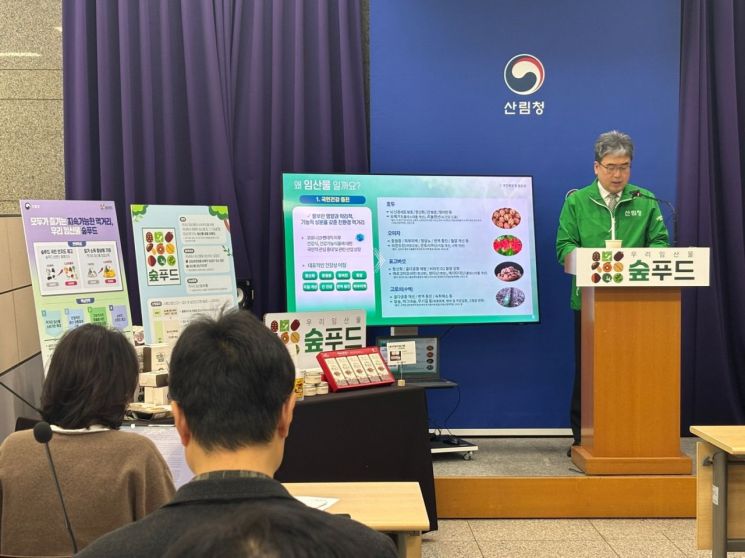 Im Sang-seop, Administrator of the Korea Forest Service, is announcing the "Measures to Revitalize the Consumption of Edible Forest Products" on the 11th at the Government Daejeon Complex. Photo by Korea Forest Service
Forest products are a type of health food containing abundant nutrients and pharmacological and functional components. In particular, they have the advantage of low carbon emissions and minimal use of chemical fertilizers and pesticides, resulting in less soil pollution compared to other food production processes.
However, unlike agricultural, livestock, and fishery products, forest products are strongly perceived as luxury foods, leading to relatively low consumption. The fact that they are produced in small quantities regionally and distributed sporadically has also been an obstacle to activating forest product consumption.
Accordingly, the Korea Forest Service plans to develop and operate the national collective trademark ‘Sup Food’ to help promote forest product consumption. Generally, a collective trademark is a trademark jointly introduced and used by two or more small and medium-sized enterprises to strengthen production or sales activities, and it is a group mark registered under the Trademark Act.
Forest products registered under ‘Sup Food’ will undergo certification and management in the agricultural and food sectors, such as residual pesticide testing, Hazard Analysis and Critical Control Points (HACCP), and Good Agricultural Practices (GAP), to enhance consumer trust.
Additionally, an honorary forest product monitoring system will be introduced to crack down on illegal harvesting and unfair distribution, and joint consumer forums and product evaluation meetings will be held to ensure quality management that reflects consumers’ on-site opinions.
The registration targets for ‘Sup Food’ include 91 types of edible forest products such as shiitake mushrooms, wild vegetables, and persimmons. The Korea Forest Service aims to register 300 products under ‘Sup Food’ this year and plans to have 1,500 products certified and managed under the ‘Sup Food’ umbrella by 2030.
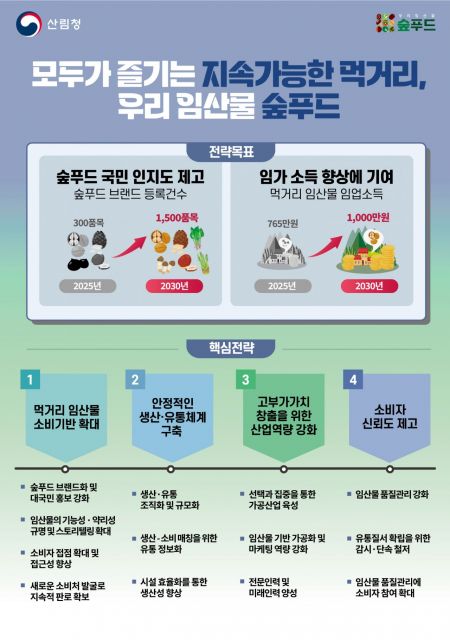
The forest product consumption activation plan also focuses on expanding the domestic consumption base of forest products and managing production, distribution, and quality control comprehensively and long-term. To this end, the Korea Forest Service has set four major strategies and 13 implementation tasks to promote related measures.
To promote forest product consumption, institutional capabilities will be concentrated on public relations and expanding sales channels. The Korea Forest Service’s strategy includes holding consumption promotion events (campaigns) such as the ‘Sup Food Grand Festival’ and ‘Sup Food Week’ to attract public attention, and promoting the development of local specialty products using forest products and expanding sales linked to local festivals.
By diversifying online and offline distribution networks, consumer accessibility will be increased, and labeling standards will be established to allow the use of functional and pharmacological properties of forest products in products and advertisements. This is expected to play a positive role in promoting edible forest products and enhancing product trust under the ‘Sup Food’ umbrella in the future.
Producer organization and scaling up for stable supply of forest products will also be promoted. To this end, the Korea Forest Service plans to support item-specific self-help fund organizations to strengthen cooperation among producers and increase productivity by introducing smart forestry technologies and machinery.
Furthermore, the Korea Forest Service explained that it will help operate production bases more efficiently by expanding the scope of subsidies for facility cultivation.
While increasing the industrial value of forest products, support for overseas market entry will also be expanded. First, medicinal materials produced in forests will be actively discovered, contributing to the revitalization of the pharmaceutical and health functional food industries using these materials.
In addition, products will be developed and sales channels opened focusing on promising forest products with high competitiveness in overseas markets, such as wild ginseng and chopi, to strengthen the overseas competitiveness of domestic forest products.
Im Sang-seop, Administrator of the Korea Forest Service, said, “Increasing forest product consumption will raise the economic value of forests and realize sustainable forest conservation. We will continue to promote support and policy reinforcement so that the public and forestry workers can coexist.”
© The Asia Business Daily(www.asiae.co.kr). All rights reserved.
![Clutching a Stolen Dior Bag, Saying "I Hate Being Poor but Real"... The Grotesque Con of a "Human Knockoff" [Slate]](https://cwcontent.asiae.co.kr/asiaresize/183/2026021902243444107_1771435474.jpg)

















