Ministry of Science and ICT to Gradually Expand and Enhance Participating Universities Through 2033
From May, master's students in science and engineering graduate programs are guaranteed a monthly research living allowance of 800,000 KRW, and doctoral students are guaranteed at least 1,100,000 KRW per month.
The Ministry of Science and ICT and the National Research Foundation of Korea announced on the 11th that they have prepared the "Implementation Plan for the Science and Engineering Research Living Allowance Support Project for 2025" and will open applications for participating universities until April 13.
The Ministry of Science and ICT plans to finalize the participating universities in April after receiving applications by April 13, and by May, after detailed operational plans and consulting with the participating universities, they aim to start disbursing the research living allowance as early as May.
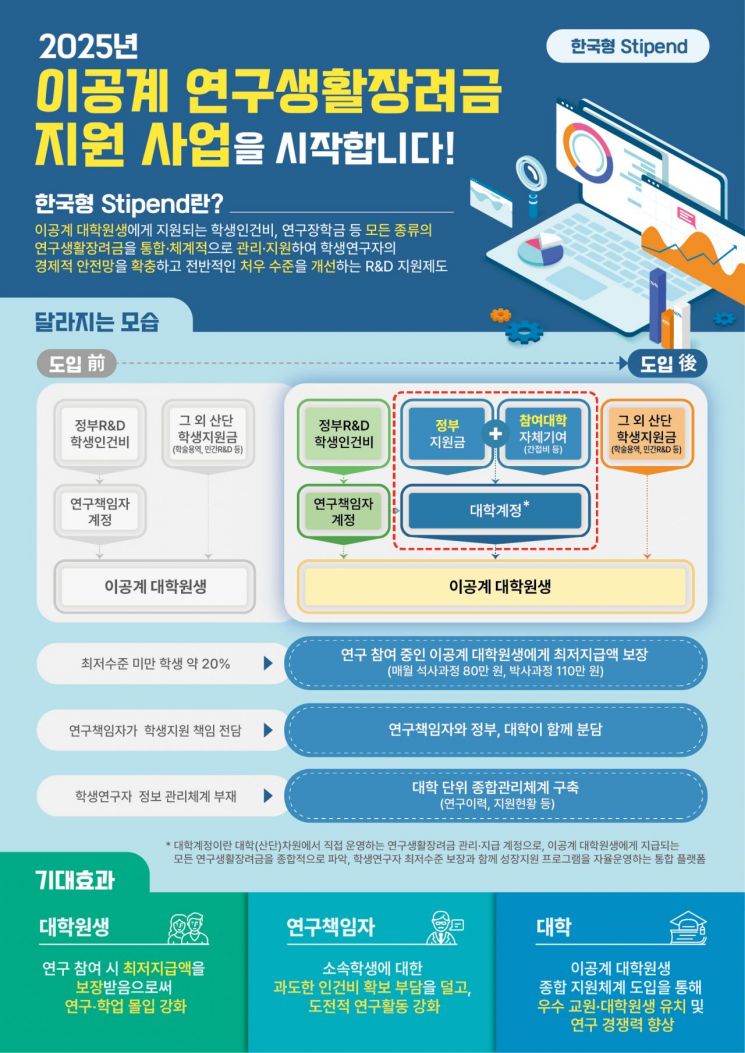 Support system diagram for science and engineering research living expenses. Provided by the Ministry of Science and ICT
The newly launched Science and Engineering Research Living Allowance Support Project (2025?2033) is a program implemented to introduce a "Korean-style Stipend" that provides stable research living support to science and engineering graduate students. The Korean-style Stipend is an R&D support system that integrates and systematically manages all types of student support funds previously provided through industry-academic cooperation foundations to science and engineering graduate students, thereby expanding the economic safety net for student researchers and improving overall treatment levels. A budget of 60 billion KRW has been allocated for this year.
The goal of the Science and Engineering Research Living Allowance Support Project is to guarantee a minimum allowance to student researchers who have chosen their career path aspiring to become researchers, enabling them to focus on their studies and research.
The research living allowance guarantees a minimum payment amount by combining the existing government R&D labor costs paid through industry-academic cooperation foundations, BK21 scholarships, private R&D labor costs, and other student support funds with additional government support funds. The minimum standard amount set for the first year is 800,000 KRW per month for master's students and 1,100,000 KRW per month for doctoral students.
For example, if a doctoral student A has been receiving 500,000 KRW from government R&D student labor costs and 200,000 KRW from academic service project scholarships, totaling 700,000 KRW, an additional 400,000 KRW in government support funds will be added to make a total of 1,100,000 KRW.
According to a survey by the Ministry of Science and ICT, about 20% of recipients in the past three years have received less than 800,000 KRW per month for master's students and less than 1,100,000 KRW per month for doctoral students.
This initiative is significant in that the responsibility for securing and disbursing student labor costs, which had previously been placed solely on individual principal investigators, is now shared between the government and universities to establish a more stable support system for student researchers.
The government plans to continuously expand the funding for student support by inducing university self-financing contributions along with government funds, and by allowing autonomous operation and management at the university (industry-academic cooperation foundation) level, it aims to improve the stability of student labor cost payments and gradually raise the support level.
Participating universities will receive support for ▲the shortfall amount to guarantee the standard amount, ▲university account fund formation contributions, and ▲university-specific operating expenses. To prevent fraud, each university will prepare and implement a management plan, be held accountable through annual inspections, and universities with excellent operational performance will receive additional incentive funds.
The Science and Engineering Research Living Allowance Support Project is divided into the introduction phase (2025?2027), development phase (2028?2030), and stabilization phase (2031?2033). In the short term, it will focus on expanding the economic safety net above the standard amount, and through performance reviews and evaluations, it will continuously refine and enhance future plans such as expanding participating universities and raising payment levels.
More detailed information on the 2025 research living allowance support project announcement and schedule can be found on the National Research Foundation of Korea website.
A Ministry of Science and ICT official explained, "This year, support will be provided to about 30 universities and approximately 50,000 master's and doctoral graduate students, and in the future, through the approval process for operating integrated student labor cost university accounts, the number of participating universities will be continuously expanded."
© The Asia Business Daily(www.asiae.co.kr). All rights reserved.

















