Inspecting Safety Management at the Old Jeonnam Provincial Government Office Restoration Site
Reviewing the Status of the "Korea Cultural City" Project in Sejong City
Minister of Culture, Sports and Tourism Yoo In-chon will visit Gwangju on the 11th to discuss measures to revitalize the tourism industry, which has been stagnant following the Jeju Air passenger plane disaster, with local tourism industry officials. Minister Yoo will also visit the restoration site of the old Jeonnam Provincial Government Office to inspect the safety management status. On the 12th, he will visit Sejong City, one of the 13 "Korea Cultural Cities" announced last December, to review the status of the cultural city development project.
The Ministry of Culture, Sports and Tourism announced on the 11th that Minister Yoo In-chon will visit cultural and tourism sites in Gwangju and Sejong from the 11th to the 12th.
First, at 3:30 p.m. on the same day, Minister Yoo will visit the joint memorial altar for the victims of the Jeju Air passenger plane accident, set up on the first floor of the Jeonil Building on Geumnam-ro, Dong-gu, Gwangju, to pay his respects. He will then meet with the mothers guarding the restoration site of the old Jeonnam Provincial Government Office in a small conference room on the 4th floor. A small fire broke out at the restoration site on January 4. Minister Yoo plans to express his regret for the concerns caused by the fire at the construction site and listen to the mothers' opinions.
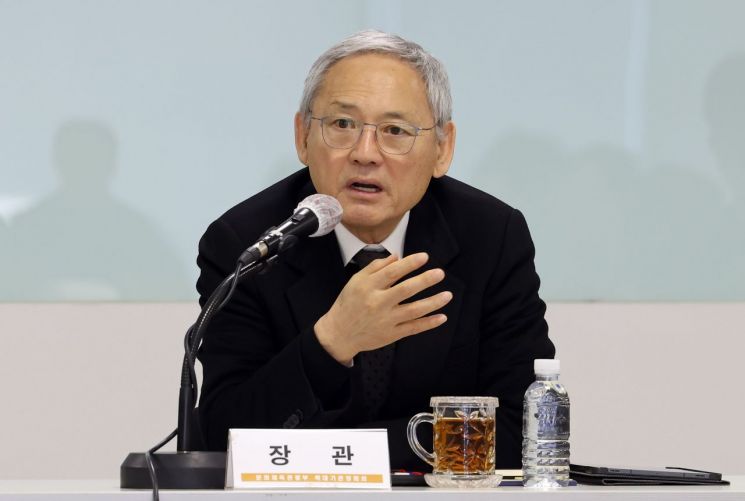
Minister Yoo will then hold a meeting with travel industry officials from the Gwangju and Jeonnam regions at the international conference room of the National Asia Culture Center (ACC). About 30 participants, including the president of the Korea Association of Travel Agents, the president of the Korea Tourism Association, the presidents of the Gwangju and Jeonnam Tourism Associations, representatives of travel agencies in Gwangju and Jeonnam, and the acting president of the Korea Tourism Organization, will attend the meeting.
The attendees will share the current status and future plans for supporting the local travel industry prepared by the Ministry of Culture, Sports and Tourism, Gwangju City, and Jeollanam-do, as well as the Korea Tourism Organization's regional tourism promotion plans. They will also listen to the coexistence plans proposed by the Korea Association of Travel Agents and the Korea Tourism Association, along with industry opinions and suggestions. In particular, the Ministry plans to strengthen practical support measures for the travel industry, such as special fund loans and temporary support for liability insurance, and seek multifaceted cooperation to enhance the competitiveness of the regional tourism industry.
On the morning of the 12th at 9 a.m., Minister Yoo will revisit the restoration site of the old Jeonnam Provincial Government Office to receive a report on the progress of the construction and the on-site safety management system. He will also review accident prevention measures for six buildings, including the Police Department main building where the fire occurred.
The Ministry of Culture, Sports and Tourism is promoting the restoration of six buildings of the old Jeonnam Provincial Government Office to their appearance during the May 18, 1980, Democratization Movement. To prevent a recurrence of the fire accident that occurred on January 4 on the third floor of the Police Department main building, measures such as appointing a fire safety manager at the construction site and supplementing a continuous monitoring system have been implemented. Currently, safety inspections of the affected building are being conducted by an external specialized agency, and construction on the remaining five buildings is proceeding as scheduled. The Ministry plans to successfully restore the old Jeonnam Provincial Government Office to widely publicize the noble spirit of the May 18 Democratization Movement and the Gwangju citizens' aspiration for democracy to the world.
Minister Yoo will then view the exhibition "Delivery Dancer's Line: Inverse" by artist Kim Ah-young, the recipient of the "ACC Future Award 2024," and the special exhibition (ACC Focus) "Koo Bon-chang: Portraits of Objects." The ACC established the "ACC Future Award" to discover creative artists in the convergent and complex arts field who expand innovative future values and possibilities, selecting Kim Ah-young as the first recipient.
Kim Ah-young's "Delivery Dancer's Line: Inverse" is a work presented using three large screens, each 11 meters wide, featuring computer graphic images based on a game engine and generative artificial intelligence. The exhibition runs until February 16.
Since the end of last year, the ACC has been presenting special exhibitions (ACC Focus) in the form of solo shows introducing world-renowned Asian contemporary art masters who have transformed the framework of human culture and arts. The first exhibition was by Koo Bon-chang, a pioneer of Korean contemporary photography. Through Koo's major series of objects, visitors can encounter works focusing on Korean identity and Asian sensibility. This exhibition is held until March 30 in ACC Complex Exhibition Halls 3 and 4.
Minister Yoo will then visit Sejong City to see the "Korea Cultural City" development project site and the Geumgang Pedestrian Bridge (Ieungdari), designated as one of the "Local 100." Since being selected as a "Korea Cultural City" themed on Hangeul at the end of 2024, Sejong City has been actively developing the "Hangeul Cultural City" starting this year, including establishing the "Hangeul Cultural City Center" at the Sejong Cultural Tourism Foundation. Minister Yoo will visit the project site in Jochiwon-eup, Sejong City, with experts to hear about the "Hangeul Cultural City" development plan and discuss ways to successfully promote the project.
The Geumgang Pedestrian Bridge, selected as one of the "Local 100," is the longest pedestrian-only bridge in Korea, connecting the central green space on the north side of the Geum River with the waterfront park on the south side. It was built to commemorate the year 1446, when King Sejong promulgated Hangeul, with a length of 1,446 meters. Its round shape has earned it the nickname "Ieungdari." The bridge has a double-deck structure, with the upper deck for pedestrians and the lower deck for bicycles, featuring an observatory and nighttime lighting. It has become a unique resting space visited by more than one million local residents and tourists annually.
© The Asia Business Daily(www.asiae.co.kr). All rights reserved.

















