"Issues in Public Sector Wage System... The Total Wage Cost Framework Must Change"
"Wage Gap Between Public and Private Sectors Directly Leads to Decline in Public Service Quality"
Bank of Korea and Financial Public Enterprises Unite... Committed to Improving Public Worker Treatment
Lee Jun-seok, a member of the Reform New Party, has supported the improvement of working conditions for employees of public institutions, including the Bank of Korea. On the 10th, he stated, "When the wage gap between the public sector and private companies widens several times, it cannot be sustained by pride or honor alone," and criticized, "The total wage cost limit system is a system that could even raise constitutional incompatibility issues."
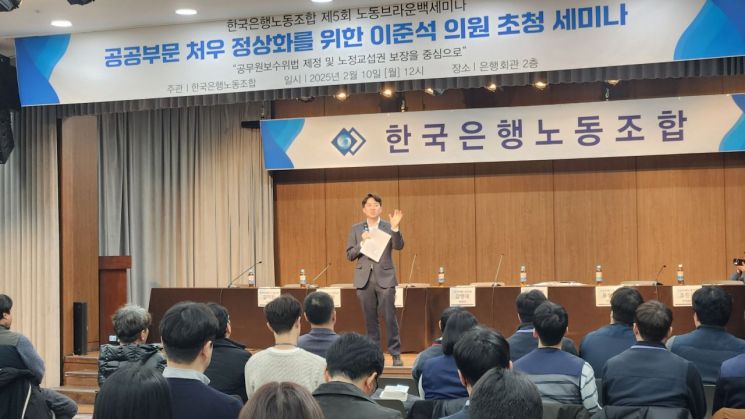 Lee Jun-seok, a member of the Reform New Party, is giving a presentation on the topic of "Normalization of Treatment in the Public Sector" at a seminar hosted by the Bank of Korea Labor Union on the 10th. (Provided by Bank of Korea Labor Union)
On the same day, Lee emphasized this at the 'Labor Brown Bag Seminar' hosted by the Bank of Korea labor union held at the Bankers' Hall in Seoul.
As a presenter, Lee pointed out, "The current wage determination structure for public institutions is a system uniformly decided by the Ministry of Economy and Finance," adding, "It is a system that has effectively reached the end of its lifespan." Currently, the wages of public institution employees are determined by the total wage cost according to the budget operation guidelines of the Ministry of Economy and Finance. Since the annual total amount is set by the Ministry's decision, wage negotiations between labor and management are virtually impossible.
He noted, "The only workers whose collective bargaining rights can be restricted under Article 33 of the Constitution are public officials or those working in defense industries," and stated, "It is unconstitutional for the Ministry of Economy and Finance to take wage determination authority over capital-free special corporations like the Bank of Korea." He further argued, "Decisions should not be made by the Ministry or some superiors with partial authority, but rather created through consensus reflecting the characteristics of each institution and company."
Lee emphasized, "If the wage gap between the public sector and the private sector deepens, talented individuals will avoid the public sector, which could directly lead to a decline in the quality of public services. A wage system must be established that these individuals will not give up on," and stressed, "It is important to ensure that they are not treated particularly disadvantageously compared to those doing similar work in the private sector."
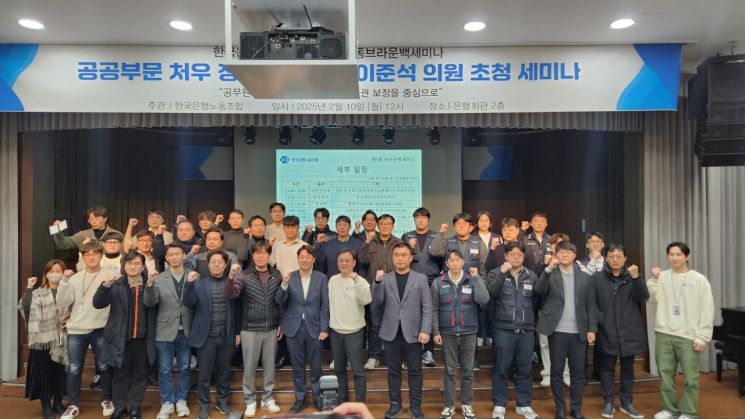 Lee Jun-seok, a member of the Reform New Party, is taking a commemorative photo with officials from the Bank of Korea labor union after the seminar on the 10th. (Photo by Bank of Korea labor union)
Recently, the Bank of Korea has experienced stagnation in wage increases, leading to an outflow of young talent due to the salary gap with the private sector, such as commercial banks. Among 37 mid-term retirees in 2022, 27 were aged 30 or younger.
In response, the Bank of Korea labor union is raising its voice for improved treatment in solidarity with 16 financial public enterprise unions (including the Financial Supervisory Service, Korea Development Bank, Industrial Bank of Korea, Korea Deposit Insurance Corporation, etc.). Specifically, they are demanding the enactment of the Act on the Establishment and Operation of the Public Officials' Salary Committee (Public Officials' Salary Committee Act) and securing wage negotiation rights with the government.
On the day, Kang Young-dae, chairman of the Bank of Korea labor union, demanded, "Negotiations between labor and government should be possible in accordance with the uniqueness, autonomy, and constitutional spirit of public institutions," and called for "guaranteeing collective bargaining rights for public institutions." He added, "There needs to be a national consensus on how poorly public sector workers are treated compared to the private sector and how much this lowers the quality of public services," emphasizing, "Public sector workers will unite to improve this."
© The Asia Business Daily(www.asiae.co.kr). All rights reserved.
![Clutching a Stolen Dior Bag, Saying "I Hate Being Poor but Real"... The Grotesque Con of a "Human Knockoff" [Slate]](https://cwcontent.asiae.co.kr/asiaresize/183/2026021902243444107_1771435474.jpg)

















