Lee Jae-myung Mentions Four-Day Workweek in Negotiation Group Speech
"Same Meaning as 'Flexicurity' During the Roh Administration"
The Democratic Party, which proposed a four-day workweek through the negotiation group representative speech, emphasized the need to simultaneously enhance labor flexibility and stability. The policy for the national recall system will be promoted in a direction to discuss it within the proposed bill, not through constitutional amendment.
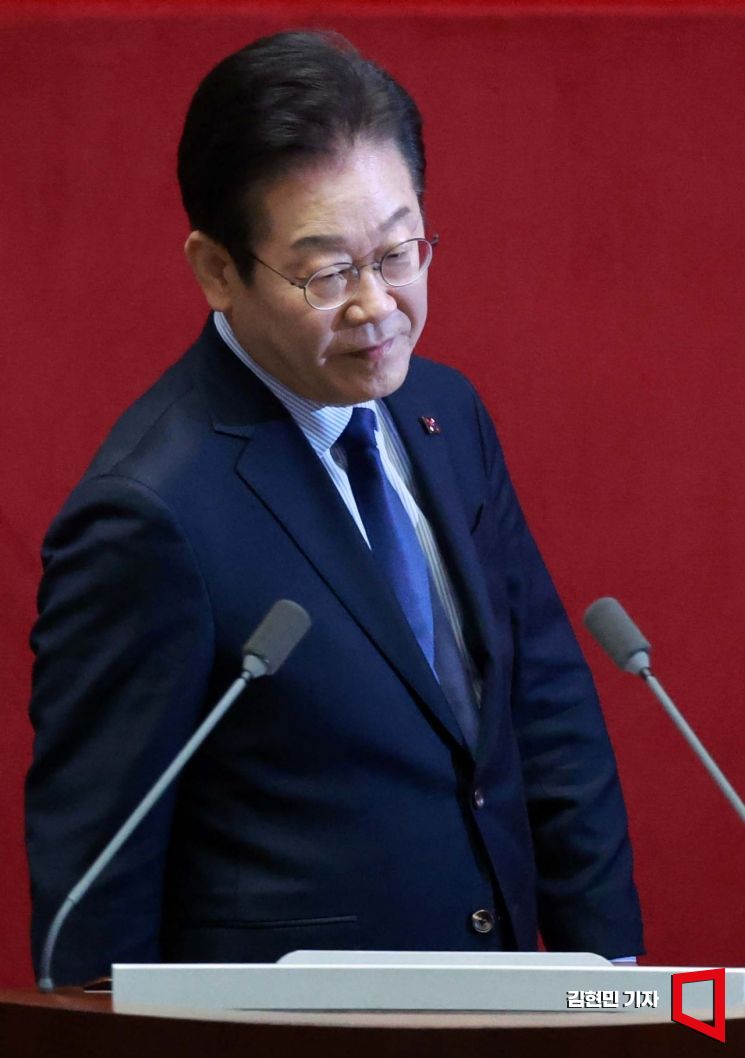 Lee Jae-myung, leader of the Democratic Party of Korea, is delivering a negotiation group representative speech at the plenary session held at the National Assembly on the 10th. 2025.2.10 Photo by Kim Hyun-min
On the afternoon of the 10th at the National Assembly Communication Office in Yeouido, Cho Seung-rae, the senior spokesperson of the Democratic Party, met with reporters and explained the intention behind Leader Lee's mention of the four-day workweek in his speech, saying, "During the Roh Moo-hyun administration, the concept of labor flexibility and stability was discussed, and what Leader Lee said has the same meaning," adding, "We need to enhance both flexibility and stability simultaneously."
Earlier that morning, Leader Lee stated in the negotiation group representative speech, "We must move toward a nation with a four-day workweek," and added, "Even if labor hours in certain areas are flexibly adjusted due to special necessity, it should not become a means to extend total labor hours or evade labor compensation."
Senior spokesperson Cho explained, "The reduction in annual working hours is a continuing trend, and there is also a demand to secure labor flexibility based on the individual needs of workers and companies," adding, "The challenge is how to harmonize these, and therefore a social public discussion process is necessary." He further added, "Rest and productivity are not conflicting concepts."
Although there are talks about the Democratic Party's 'rightward shift,' such as raising the issue of the exemption clause for 52-hour workweek for R&D workers under the Semiconductor Special Act, Senior spokesperson Cho expressed his personal opinion that it is a "practical judgment based on empirical evidence."
He said, "I do not know the leader's interpretation, but the concepts of left and right are not fixed and absolute; they are relative concepts," and added, "I personally think it is necessary to redefine positional values through given data values or empirical data."
Regarding the 'national recall system for members of the National Assembly,' which Leader Lee proposed as part of political reform, the direction was made clear that discussions will be based on the submitted bill, not constitutional amendment. The national recall system is a system where citizens can dismiss elected officials through voting.
Senior spokesperson Cho said, "(Regarding the national recall system) some people talk about constitutional amendment, but the most important principle in the constitution is based on popular sovereignty," adding, "Based on this, the national recall system can be designed." He further explained, "Representative Lee Kwang-hee has already proposed expanding the national recall system from local governments to members of the National Assembly."
© The Asia Business Daily(www.asiae.co.kr). All rights reserved.

















