An Old Issue Since 2004...
Repeatedly Failing to Pass the National Assembly
Former President Moon Jae-in Also Pushed for It
"We will strengthen direct democracy so that the sovereign will of the people is reflected in state affairs on a daily basis... (omitted) As the first measure, we will introduce the National Recall System for members of the National Assembly. (Part of the speech by the leaders of the parliamentary negotiation groups on the 10th)
Lee Jae-myung, leader of the Democratic Party of Korea, has ignited discussions on the introduction of the National Recall System. The proposal is to introduce the National Recall System to strengthen people-centered direct democracy. The recall system refers to a system where elected officials can be dismissed or recalled by the votes of eligible voters. When the target is members of the National Assembly, it is called the 'National Recall System'; when it is local government heads or local council members, it is called the 'Resident Recall System.' There is also a 'Party Member Recall System' applied to party leaders.
This is not the first time that calls for the introduction of the National Recall System have emerged in the political arena. In 2004, several parties including the Uri Party proposed the National Recall System as a pledge for the 17th general election. At that time, public support for the National Recall System was high because the current law did not allow for checks on elected members of the National Assembly until their term ended, but due to side effects and other reasons, it repeatedly failed to pass the National Assembly. In the current 21st National Assembly, lawmakers Park Ju-min, Choi Min-hee, and Lee Kwang-hee have already proposed bills to introduce the National Recall System.
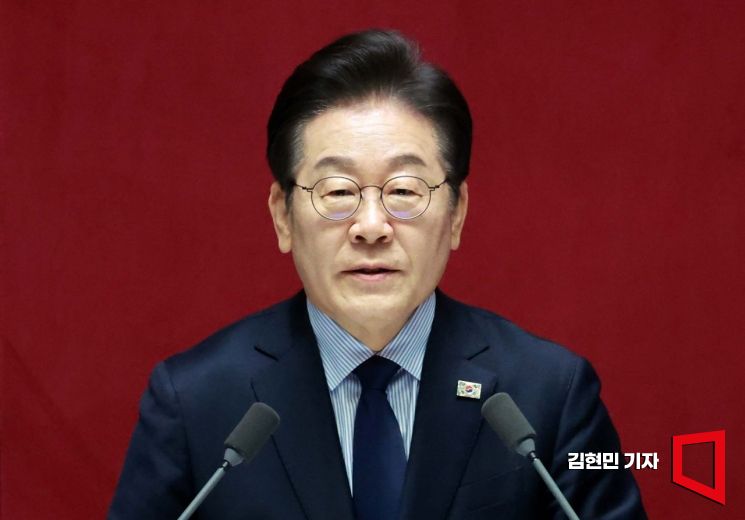 Lee Jae-myung, leader of the Democratic Party of Korea, is delivering a negotiation group representative speech at the plenary session held at the National Assembly on the 10th. 2025.2.10 Photo by Kim Hyun-min
Former President Moon Jae-in also pledged the National Recall System during the 2017 presidential election and included it in a constitutional amendment proposal in 2018 during his term. At that time, the Moon administration proposed the introduction of the National Recall System along with the National Initiative System, which allows citizens to directly participate in proposing legislation, stating, "Reflecting the people's demand to participate directly as overseers of power and legislators, we propose to significantly expand direct democracy to complement representative democracy by enabling citizens to recall members of the National Assembly and directly propose bills."
Public response was also high. In 2019, a petition on the Blue House's public petition board calling for the introduction of the National Recall System for members of the National Assembly received more than 200,000 signatures, meeting the threshold for an official response. At that time, Bok Ki-wang, the Blue House political secretary, said, "It is hard to accept as common sense that there is no institutional device to recall members of the National Assembly, while the president, local government heads, and local council members can be recalled," and added, "I sincerely hope that the National Recall Act currently pending will be completed through the 20th National Assembly."
Currently, the Resident Recall System is in effect. The Resident Recall System was first implemented in 2006 with the enactment of the 'Act on Resident Recall.' The most recent case involves Kim Jin-ha, mayor of Yangyang County, Gangwon Province, who was accused of violating the Act on the Prohibition of Improper Solicitation and Graft, bribery, and forced molestation. On the 3rd, the county election commission initiated a resident recall vote against Mayor Kim, and the vote is scheduled to be held on the 26th. If more than one-third of residents vote and more than 50% of voters approve, the official loses their position.
The Party Member Recall System has recently been applied in the Reform New Party. On the 24th of last month, a party member recall vote was held to dismiss leader Heo Eun-ah. In response, Heo filed for a provisional injunction to suspend the effect against the Reform New Party and floor leader Cheon Ha-ram on the same day, but on the 7th, the court dismissed the request, resulting in Heo losing her leadership position.
© The Asia Business Daily(www.asiae.co.kr). All rights reserved.