Financial Supervisory Service Announces 2024 Disclosure Violation Actions and Precautions
"Proportion of Severe Sanctions Rises Due to Application of Enhanced Measures"
Last year, a total of 130 cases of disclosure obligation violations were addressed. Among them, 66 cases received severe sanctions such as fines, accounting for more than half of the total.
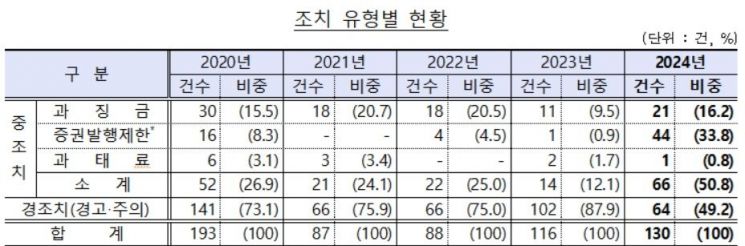
According to the '2024 Disclosure Violation Action Status and Precautions' announced by the Financial Supervisory Service on the 11th, the number of disclosure obligation violations under the Capital Markets Act by listed and unlisted corporations last year totaled 130 cases, an increase of 14 cases (12.8%) compared to the previous year.
Among these, the number of severe sanctions was 66 cases, a 371% increase from 14 cases the previous year. Severe sanctions are imposed on violations with intentional or gross negligence motives that have a significant impact on the market.
The most common sanction was restriction on securities issuance, with 44 cases. This was followed by fines (21 cases) and penalties (1 case). The Financial Supervisory Service explained that the proportion of severe sanctions significantly increased compared to the previous year due to the application of enhanced measures against corporations habitually violating the obligation to submit regular reports.
Additionally, 64 cases received minor sanctions. Minor sanctions involve warnings or cautions issued when the disclosure obligation violation is judged to be minor considering the impact on the market.
By disclosure type, violations of regular disclosures such as failure or delay in submitting business (quarterly/semiannual) reports and false statements of important matters accounted for the largest share with 71 cases (54.6%).
Next, issuance disclosures such as violations of securities registration statements and small-scale public offering disclosure documents totaled 35 cases (26.9%), followed by 22 cases (16.9%) of omission of important matters in major event reports when issuing convertible bonds (CB) or deciding on major asset acquisitions or disposals. There were also 2 cases (1.6%) of other disclosure violations, such as violations related to the appointment reporting of outside directors in listed companies.
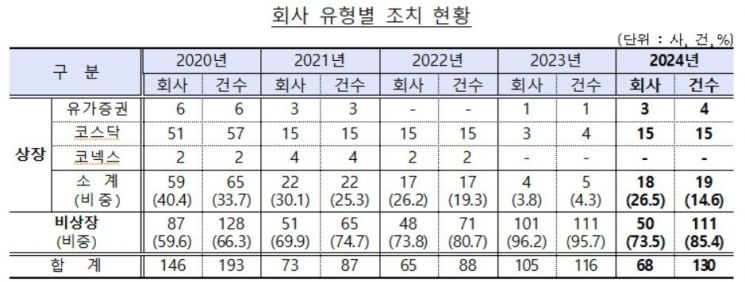
By company type, there were a total of 68 companies, including 18 listed companies and 50 unlisted companies.
Among the listed companies, 3 were on the Korea Exchange (KRX) and 15 were listed on KOSDAQ. The main violations involved important matters in major event reports. Omissions mainly occurred regarding collateral provision when issuing convertible bonds (CB) and bonds with warrants (BW), and external agency evaluation opinions when acquiring or disposing of major assets.
Unlisted corporations were mainly small-scale companies that violated disclosure obligations due to lack of awareness of the importance of disclosure tasks, unfamiliarity with related laws, and shortage of personnel responsible for disclosure.
© The Asia Business Daily(www.asiae.co.kr). All rights reserved.


















