Analysis by Yoo Yong-won from the People Power Party
"Dissatisfaction with Low Treatment and the Disgrace of Being Mobilized as Martial Law Troops"
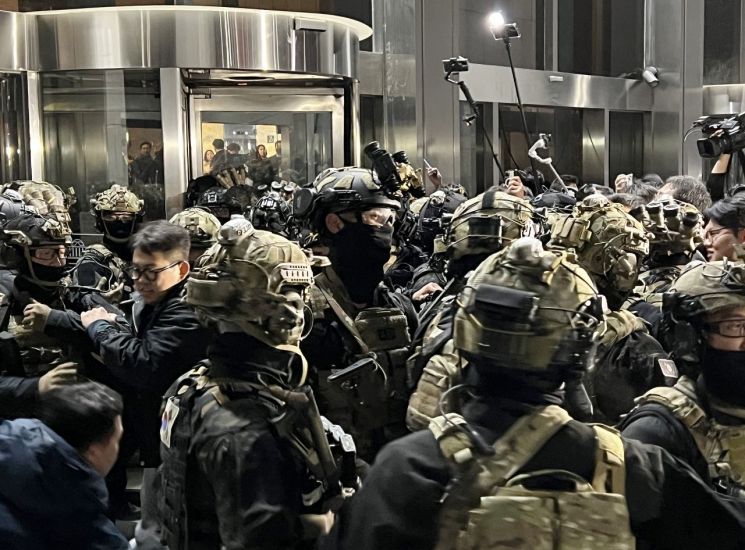
Since the 12·3 emergency martial law, the number of non-commissioned officers (NCOs) in the ranks of sergeant and staff sergeant from the Army Special Warfare Command applying for voluntary discharge has surged compared to previous years. This is interpreted as a complex reaction to dissatisfaction with low treatment and resentment over being mobilized as martial law troops during the 12·3 emergency martial law.
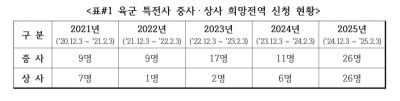
On the 10th, Yoo Yong-won, a member of the National Assembly’s Foreign Affairs and Unification Committee from the People Power Party, announced that after receiving and analyzing data from the Ministry of National Defense on ‘voluntary discharge applications by rank within the Army Special Warfare Command over a specific period in the last five years,’ the number of sergeants and staff sergeants from the Special Warfare Command who applied for voluntary discharge during the two months from December 3 last year to February 3 this year was 52, about three times the 17 applications during the same period the previous year.
Specifically, among sergeants, the number of applicants was 26, about 2.4 times higher than the 11 during the same period last year, and among staff sergeants, 26 applied, about 4.3 times higher than the 6 the previous year.
Sergeants and staff sergeants belonging to the Special Warfare Command constitute the core ranks, accounting for more than 70% of the current operational personnel of the Special Warfare Command. They are elite special forces capable of all-weather infiltration by land, sea, and air in emergencies, performing various special operations such as reconnaissance, intelligence gathering, assassination and kidnapping of key figures, hostage rescue, and guerrilla warfare.
Recently, in other frontline Army units as well, the number of voluntary discharge applications from mid-level officers such as sergeants, staff sergeants, and captains has shown an increasing trend year by year. Last year, the total number of voluntary discharge applications from these ranks was 2,310, an increase of more than 30% compared to 1,770 the previous year.
The higher rate of increase in the Special Warfare Command is mainly attributed to dissatisfaction with their low treatment and the stigma of being a unit directly mobilized during the declaration of martial law.
A colonel who served for about 20 years as a commander and staff officer in the Special Warfare Command and recently retired advised, “Special warfare NCOs require highly advanced operational capabilities and physical fitness, needing more than twice the training period and resources compared to general combat troops. News of fellow seniors and juniors leaving the service negatively affects the morale of the entire unit and can cause psychological unrest among personnel who wish to continue serving with commitment.”
Assemblyman Yoo Yong-won pointed out, “The rush of voluntary discharges among special warfare NCOs is a critical issue that could lead to a decline in our special operations capabilities and create a security gap, so comprehensive measures by the military authorities are urgently needed.” He also urged, “Some special warfare personnel mobilized during the 12.3 martial law were deployed under orders from their superiors without even knowing it was a martial law situation. Our people’s unwavering affection and support for the Special Warfare Command, who dedicate themselves to the nation and its citizens, are desperately needed.”
© The Asia Business Daily(www.asiae.co.kr). All rights reserved.


















