A total of 19,920 new hires at public institutions last year
Lowest proportion of young people among new regular employees in four years
COVID-19 and medical policy conflicts... Sharp decline in public hospital recruitment
Preference for experienced workers also contributes to drop in new hires
Number of young people giving up job search continues to rise
Quality jobs in medium-sized and large companies as well as public institutions are decreasing. The increase in employment in the private sector is gradually shrinking, and last year, the number of new hires in public institutions fell below 20,000. As a result, the number of young people who have left the job market and are 'just taking a break' continues to rise daily.
According to the National Statistical Portal (KOSIS) of Statistics Korea on the 10th, the average monthly number of employees at large businesses with 300 or more employees last year was 3,146,000. This is an increase of 58,000 compared to the previous year, marking the smallest growth in six years since 2018 (50,000). The increase in employment at large businesses was 182,000 in 2022 but halved to 90,000 in 2023, and last year it decreased by 36%.
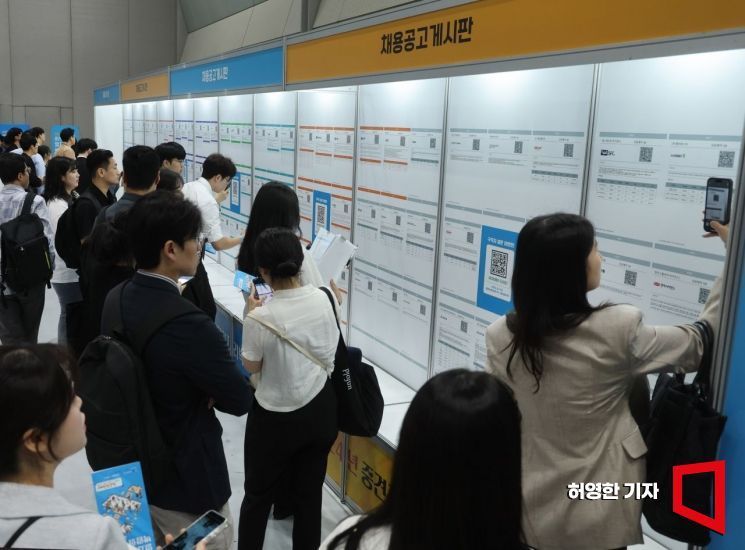
The employment slump is equally severe in the public sector. According to the Public Institution Management Information Disclosure System (Alio), 1,9920 regular full-time employees (excluding indefinite contracts and executives) were hired by 339 public institutions last year. The number shrank from 40,116 in 2019 to 29,480 in 2020, then further down to 20,207 in 2023, and last year, even the scale of hiring in the 20,000 range collapsed.
Among the new regular full-time hires last year, 16,429 were young people, accounting for 82.5% of the total. This proportion was the lowest in four years since 2020 (74.8%). The government’s target for new hires in public institutions last year was 24,000 (20,000 young people). Ultimately, the sluggish hiring of young people led to the failure to meet the overall target.
The Ministry of Economy and Finance, which manages and supervises public institutions, announced early last year that it would make public institution jobs a solid support amid the youth employment cold wave by awarding additional management evaluation points to institutions with excellent performance in new hires or youth intern programs. It also encouraged institutions to conduct occasional hiring when vacancies arose due to retirements or resignations. Nevertheless, the government analyzed that the failure to meet the target due to a decline in new hires last year was mainly because public medical institutions significantly reduced hiring.
Last year, 11 hospitals under the Ministry of Education hired 3,228 regular full-time employees, a 40.7% (2,214 people) decrease from the previous year. The reduction was particularly large at Chonnam National University Hospital (-415), Chungnam National University Hospital (-330), Gyeongsang National University Hospital (-299), and Jeonbuk National University Hospital (-257).
An official from the Ministry of Economy and Finance said, "During the COVID-19 pandemic, there was high demand for medical personnel, especially nurses, but after the pandemic ended, additional staff were not needed, so hiring decreased." The medical-policy conflict triggered by the increase in medical school admissions last year, which led to a decline in revenue for public medical institutions, is also analyzed as a factor that closed the door to jobs.
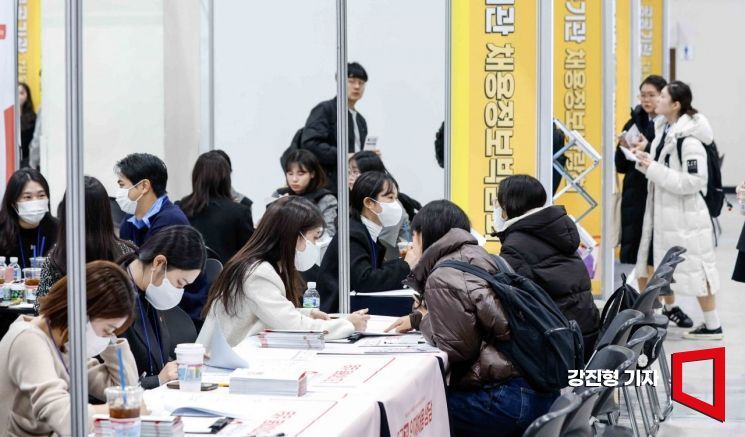 Job seekers participating in the '2025 Public Institution Recruitment Information Fair' held on the 14th at aT Center in Seocho-gu, Seoul, are receiving recruitment consultations.
Another reason for the decline in new hires is the growing tendency of public institutions to prefer experienced workers who can be immediately deployed, similar to private companies. A report released by the Bank of Korea on the 4th diagnosed that the probability of non-experienced, inexperienced workers securing regular employment is half that of experienced workers, which is likely to lead to a decline in employment rates among young people in their 20s, partially reflecting reality.
Accordingly, the number of young people giving up job searching is also significantly increasing. In the Economically Active Population Survey, the number of young people who answered that they were 'taking a break' increased by 21,000 from the previous year to 421,000. This is the second-highest figure since the statistics began in 2003, following 448,000 in 2020 when the COVID-19 pandemic started.
'Taking a break' refers to those who do not have serious illness or disability but answered "just resting" in the Economically Active Population Survey. They are classified as economically inactive population, not employed or unemployed. Despite the decrease in the youth population, the increase in young people 'taking a break' indicates a serious decline in their motivation to seek employment.
© The Asia Business Daily(www.asiae.co.kr). All rights reserved.


















