Expansion of Public Guardianship Service Beneficiaries and Integrated Support in Response to Low Birthrate and Aging Society
Proposal for Establishing a Guardianship Supervision Body for Support and Monitoring of Wards and Guardians
The Busan Institute released a comprehensive improvement plan for public guardianship services aimed at protecting vulnerable groups.
The core of this study is to expand the current services, which are limited to people with developmental disabilities and elderly dementia patients, to include minors and individuals with mental illnesses, and to enhance service quality through the establishment of integrated support organizations and guardianship supervision bodies.
Since 2013, Busan City has provided public guardianship services for people with developmental disabilities and, since 2018, for elderly dementia patients. In 2021, Busan City enacted the Public Guardianship Utilization Support Ordinance to expand the service target to minors, elderly abuse victims, and individuals with mental illnesses, but actual support has not been implemented.
The "guardianship system" is a system in which the court appoints a guardian to manage property and protect the personal welfare of individuals who have difficulty protecting themselves due to mental limitations such as illness, disability, or old age. When public funds are involved, it is called "public guardianship."
According to the report titled "Current Status and Improvement Plans for Public Guardianship Services in Busan City," published by the Busan Institute, service usage is low due to a lack of awareness about the guardianship system, complicated procedures, and a shortage of guardians. Meanwhile, demand for services among individuals with mental illnesses and minors is steadily increasing.
In particular, a 2023 survey by the Ministry of Health and Welfare found that 12% of all protected children face difficulties in adoption, hospital treatment, and opening financial accounts due to the absence of appointed guardians.
In response, the report proposed the following three improvement measures for Busan City's public guardianship services.
First, expand the scope of public guardianship service users in preparation for a low birthrate and aging society. In addition to existing users, extend the range to include individuals with mental illnesses living in the community and minors who are in situations where parental rights are difficult to exercise due to abandonment, abuse, parental death, or long-term unknown whereabouts.
Also, promote the use of services for current target groups such as people with developmental disabilities and elderly dementia patients through social awareness improvement, procedure simplification, and guardian training.
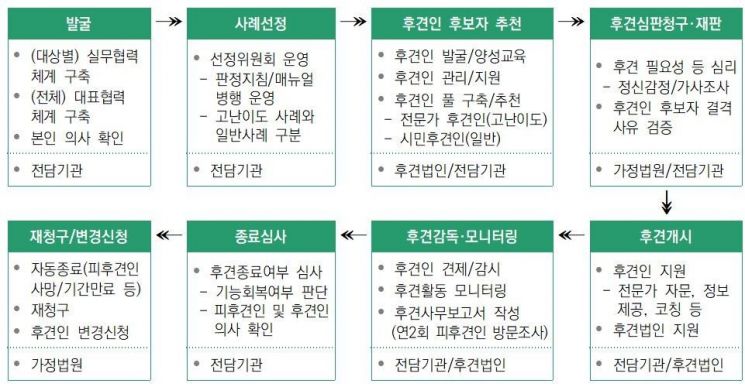
Second, an integrated support organization for users is necessary. For existing users, maintain the current support management system (with separate laws, budgets, and delivery systems for public guardianship services for people with developmental disabilities and elderly dementia patients), but for new users, establish an integrated support organization to manage each target group separately, thereby reducing costs and providing one-stop support in a single location.
Third, the establishment of a guardianship supervision organization is needed. A separate guardianship supervision body should be established to professionally carry out monitoring of guardianship activities by guardians and guardianship corporations, support and training of guardians, and promotion of the rights and welfare of wards.
Park Juhong, Chief Research Fellow at the Busan Institute, said, "With aging and the increase of single-person households, the demand for public guardianship will continue to rise," adding, "We hope that through the establishment of integrated support and guardianship supervision organizations, more citizens will benefit from systematic public guardianship services."
© The Asia Business Daily(www.asiae.co.kr). All rights reserved.

















