Interview with Jung-gu Mayor Kim Gilsung
A Symbolic Place Where 78% of Foreign Tourists Begin Their Journey
"Transforming Through Myeongdong Square and Easy Access to Namsan"
Jung-gu, Seoul, is bordered by Dongdaemun and Gwanghuimun to the east, Deoksugung and Gyeonghuigung, Sungnyemun to the west, Namsan Peak to the south, and Cheonggyecheon to the north. The area is home to numerous downtown hotels and department stores, and has historically developed large markets. It is also lined with headquarters of major corporations.
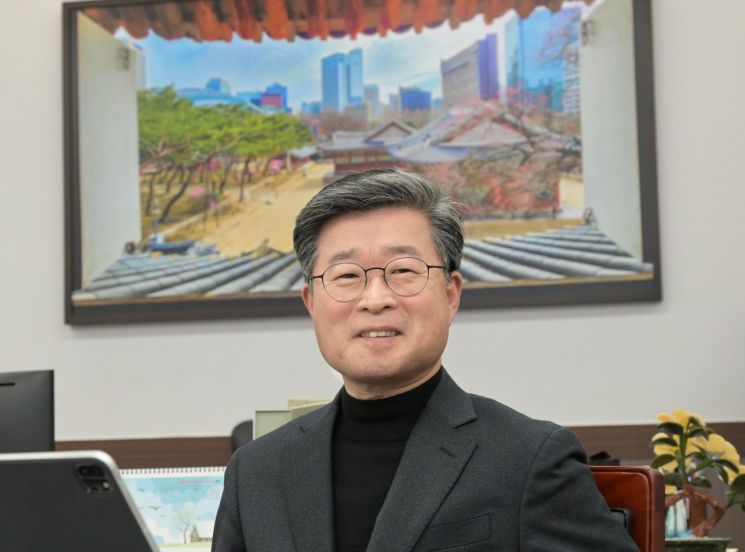 On the wall of Kim Gil-seong, Mayor of Jung-gu Office, hangs the first-place winning photo from last year's 'Jeongdong Night Walk' photo contest, titled 'Spring at Deoksugung' by Park Eun-gi. The view from the palace interior window looking outside beautifully captures the present Jung-gu, where history and modernity coexist. Provided by Jung-gu.
Although Jung-gu is what we refer to as the city center, it simultaneously carries an image of slow development and underdevelopment. Kim Gilsung, the 58-year-old mayor of Jung-gu, said, “Just as Manhattan comes to mind when thinking of New York, when thinking of Seoul, Jung-gu, Myeongdong, and Euljiro should come to mind,” adding, “We will now reclaim that status.”
Mayor Kim, who graduated from elementary, middle, and high schools in Jung-gu, said, “The position Jung-gu held in Seoul during my childhood is different from now,” and “When I became mayor and looked back at Jung-gu’s current state, it was almost humiliating.”
The reason Jung-gu must be special is not just because it is where he grew up. Mayor Kim said, “Myeongdong is a symbolic place where 78% of foreign tourists head straight from the airport to start their Korean tour,” but added, “We need to consider whether its infrastructure is truly comparable to that of the world’s leading cities.” Myeongdong is a ‘unique’ space, but we need to reflect on whether it is being well utilized, and whether Seoul, specifically Jung-gu, is realizing its potential.
One pillar of the policies he has promoted during his 32 months in office is connected to this direction. The 10-year long-term projects such as Myeongdong Square, ‘Hip Dang-dong’ (Hip Sindang-dong) and Jungang Market, the monorail connecting Daehyeonsan Reservoir Park and Namsan Forest Trail, the development of local tourism courses, and the tour pass program that offers free or discounted admission to major tourist attractions like Deoksugung, popular restaurants, cafes, and exhibition and experience facilities, are all policies aimed at upgrading Jung-gu to become the number one global tourism district.
He said that through the Myeongdong Square project, which started last year and is a 10-year project, he intends to transform ‘Myeongdong at night.’ Mayor Kim stated, “Myeongdong Square will become a new global tourist attraction where visitors can experience an overwhelming and immersive atmosphere surpassing the fame of New York’s Times Square.”
By 2033, dozens of giant LED billboards and street media devices similar to those installed at the Shinsegae Department Store main branch on Myeongdong Avenue will be installed. There is also a plan to generate over 50 billion KRW in annual revenue from this and reinvest a portion of it back into Myeongdong. Traditional markets in Jung-gu, including Namdaemun Market and over 50 others, as well as alleyway shopping districts like ‘Hipjiro’ (Hip Euljiro) and ‘Hip Dang-dong,’ are being supported to develop into places with attractions and content.
He cited ‘Namsan’ as a unique urban asset and a competitive advantage for Seoul. Mayor Kim emphasized, “Few global cities have such excellent natural environments like Namsan,” and added, “We will ensure that residents and tourists can comfortably access and enjoy it through various routes, and connect major commercial areas to revitalize the local economy.” The Namsan Forest Trail, which opened last year and was planned to be accessible from 15 neighborhoods and 50 courses in Jung-gu, is part of this plan.
Among the biggest achievements in the first half of his term, he counts the relaxation of height restrictions around Namsan, and the acceleration of redevelopment projects such as Sindang 10 District, Jungnim-dong 398, and the public housing complex near Yaksu Station, where the district office acted as a mediator. These are part of plans to fill the city center with orderly development that includes jobs, making it a livable and vibrant space.
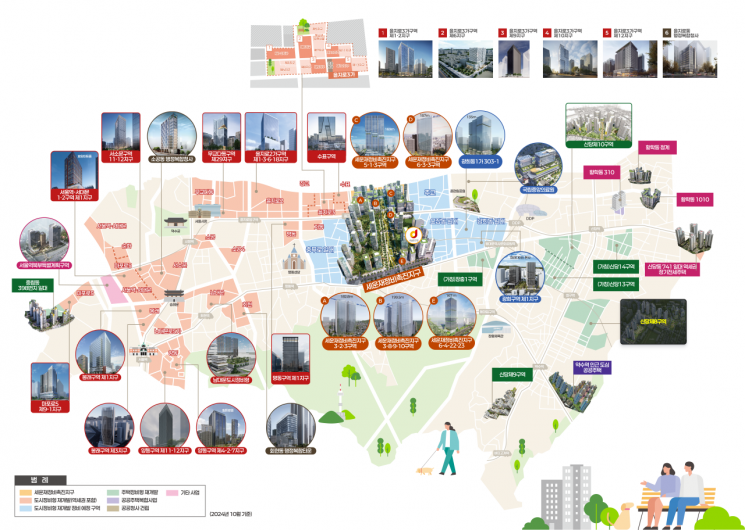 Jung-gu Re-born City Map. A map organized to provide an overview of redevelopment and public architecture projects in Jung-gu, Seoul. Provided by Jung-gu.
© The Asia Business Daily(www.asiae.co.kr). All rights reserved.


















