Kim Jong Un, Chairman of the State Affairs Commission of North Korea, reaffirmed the policy of strengthening nuclear forces, stating that the United States is the fundamental cause of the confrontation structure on the Korean Peninsula.
On the 8th, marking the 77th anniversary of the founding of the Korean People's Army, Kim visited the Ministry of Defense and mentioned a series of new planned projects to rapidly enhance all deterrent capabilities, including nuclear capabilities, reaffirming an unwavering policy to further advance nuclear forces, according to a report by the Korean Central News Agency on the 9th.
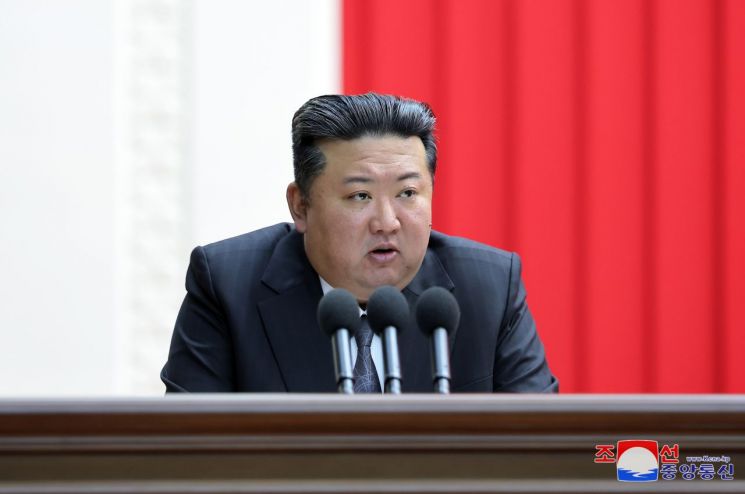
Kim pointed out, "The U.S. nuclear strategic means and the U.S.-led bilateral and multilateral nuclear war simulation exercises conducted at a practical level, the trilateral military alliance system of the U.S., Japan, and South Korea established according to the U.S. regional military bloc script, and the formation of an Asia version of NATO centered on it are the fundamental causes that create military imbalance and a new confrontation structure in the Korean Peninsula and Northeast Asia region."
He continued, "For those who worship the superiority of power, the only correct answer is to speak in a language that only they can understand," adding, "We do not wish for unnecessary tension escalation in the regional situation, but from the intention to prevent the outbreak of a new war and guarantee peace and security in the Korean Peninsula region, we will continuously devise countermeasures to ensure military balance in the region."
Kim also stated that the responsibility for the Russia-Ukraine war lies with the United States, expressing "serious concern over the reckless behavior of the U.S. and Western bloc, which deliberately prolongs the war with the unrealistic delusion of delivering a strategic defeat to Russia."
Kim said, "Our military and people will unwaveringly support and assist the just cause of the Russian military and people to defend their sovereignty, security, and territorial integrity in accordance with the spirit of the treaty on the comprehensive strategic partnership between North Korea and Russia."
Although a significant portion of Kim’s speech on that day was critical of the United States, it was close to a principled level and did not directly target the Trump administration, according to analysis. There was also no criticism directed at South Korea. Hong Min, Senior Research Fellow at the Institute for Unification Studies, analyzed, "He expressed a principled stance without directly mentioning the North Korean nuclear-related remarks from the Trump administration."
© The Asia Business Daily(www.asiae.co.kr). All rights reserved.

















