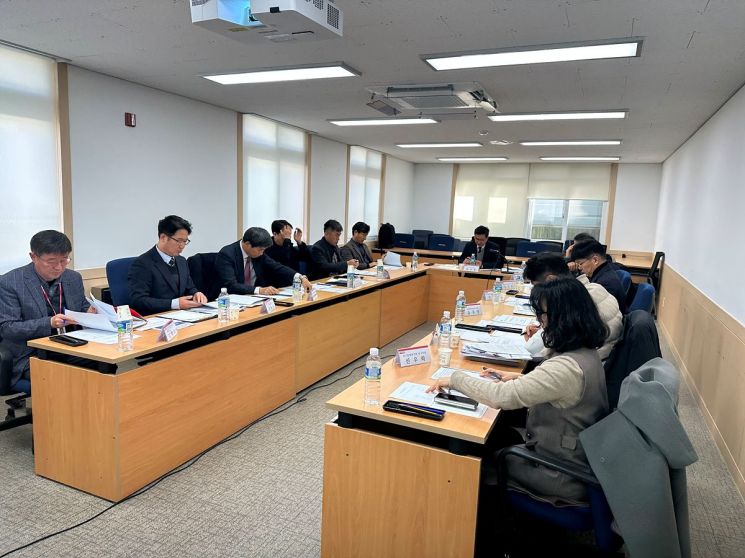
Daegu City held a public-private joint housing policy advisory meeting on the 6th at the Sangyeok Office of Daegu City Hall to resolve unsold housing units.
At this meeting, experts from various fields analyzed the local housing market and engaged in in-depth discussions on the government's housing policies. They sought joint solutions regarding differentiated measures between the metropolitan area and non-metropolitan areas to address the local unsold housing issue, as well as Daegu City's response strategies.
To resolve unsold housing, Daegu City implemented the highest level of measures available to local governments, including a complete suspension of approvals for new housing construction projects starting January 2023.
Additionally, in July last year, a public-private joint housing policy advisory group consisting of 14 members across 7 sectors was convened to identify dualized housing policies for the metropolitan and non-metropolitan areas and propose them to the central government.
As a result of these efforts, Daegu City's unsold housing peaked at around 14,000 units in February 2023 and decreased to approximately 8,800 units by December 2024. The government also partially reflected local unsold housing tax policies last year and is currently implementing them.
Meanwhile, at the advisory meeting, concerns were raised about the accumulation of unsold housing and the prolonged stagnation of the housing market leading to a contraction in construction investment and potential liquidity issues in the construction industry, which could worsen the local construction economy.
It was also pointed out that the government has mainly pursued policies centered on the metropolitan area and, although it recognized and prepared measures to resolve local unsold housing issues since last year, these efforts remain insufficient to solve the problem in local areas including Daegu.
To resolve local unsold housing, there was a consensus on the necessity of effective, customized policies for non-metropolitan areas, along with calls for easing loan regulations, expanding special loans, and strengthening tax support.
Furthermore, despite the base interest rate cut in the second half of last year, the implementation of Stress DSR Stage 2 and the policy to suppress household loans caused market interest rates to rise, further deteriorating the local housing market.
Accordingly, there was an opinion to postpone the implementation of Stress DSR Stage 3, scheduled for July this year, exclusively for local areas and to exclude DSR application when acquiring unsold housing in local regions.
There were also numerous suggestions to strengthen tax support for local areas, such as easing tax regulations for corporations and multi-homeowners and reintroducing temporary capital gains tax reductions when acquiring unsold housing in local areas.
In addition, voices called for expanding policy loans like newborn special loans, extending acquisition deadlines for CR REITs purchases of unsold apartments in local areas, the need for LH purchase agreements, and urged the construction industry to devise self-help measures and reflect on the unsold housing problem.
Meanwhile, advisory committee members forecasted a gradual recovery of the local housing market starting in the second half of this year but noted that political uncertainties and oversupply remain as risk factors.
In the short term, even if unsold housing resolution measures are pursued while maintaining a supply suppression stance, there was an opinion that continuous monitoring of supply is necessary in the long term to prepare for potential housing undersupply issues.
Daegu City plans to carefully review the various opinions raised at this advisory meeting and propose policies to the central government to resolve local unsold housing. It also intends to hold regular housing policy advisory meetings to respond flexibly to local housing market issues.
Moreover, Daegu City will consider joint proposals with other cities and provinces, strengthen proposals to the government through cooperation with political circles and related associations, and establish a response system for supply shortages and surpluses by continuously monitoring supply volumes through a consultative body with local housing supply institutions.
Jung Jang-su, Deputy Mayor for Economic Affairs of Daegu City, stated, “Based on the valuable opinions from this advisory meeting, we will strongly demand non-metropolitan policies from the central government,” adding, “We will continue to do our best to resolve unsold housing by responding to changes in the local housing market and government policies together with the housing policy advisory committee.”
© The Asia Business Daily(www.asiae.co.kr). All rights reserved.
![Clutching a Stolen Dior Bag, Saying "I Hate Being Poor but Real"... The Grotesque Con of a "Human Knockoff" [Slate]](https://cwcontent.asiae.co.kr/asiaresize/183/2026021902243444107_1771435474.jpg)
















