Korean short track speed skating swept up 4 gold medals, 2 silver medals, and 3 bronze medals in the five short track events held on the 8th at the 2025 Harbin Winter Asian Games. This achievement came despite fierce competition from the host country, China.
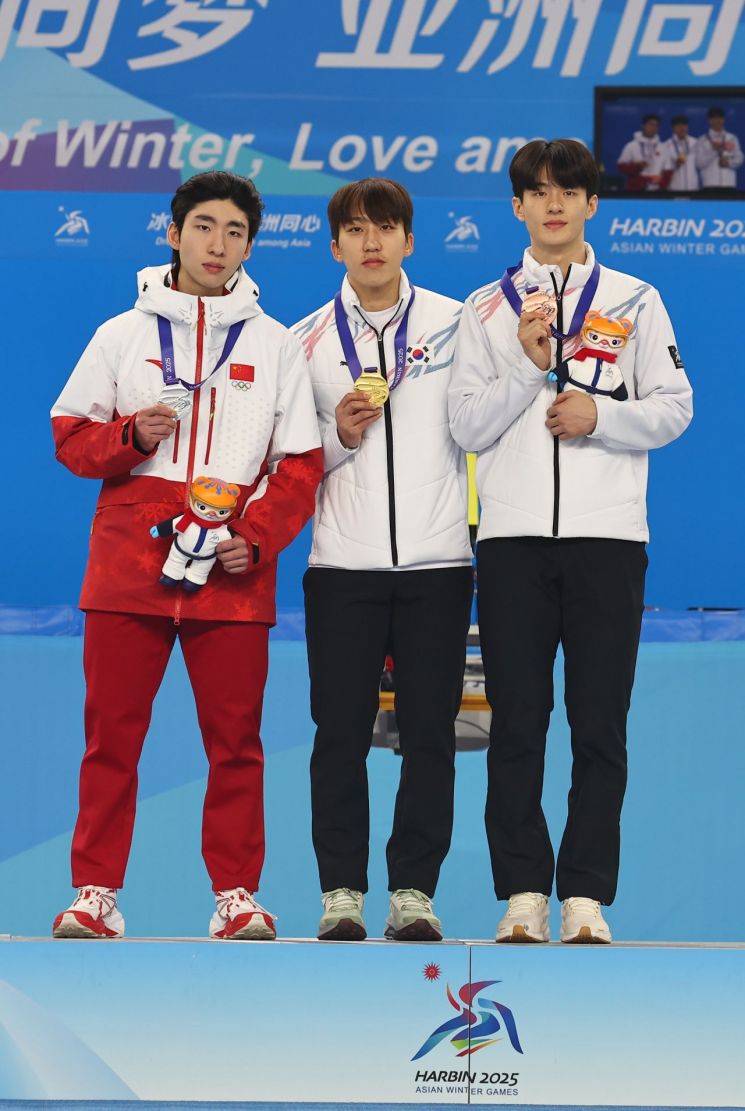
Korea, which had set a goal of winning at least six medals out of nine short track events, signaled a green light toward achieving that target.
The athlete who blocked Korea from sweeping all five events on the first day was Lin Xiaojun (Korean name Im Hyojun), who competed for Korea before naturalizing as a Chinese citizen in 2020. Lin Xiaojun won the men's 500m, delivering China's first gold medal in short track at this competition.
Men’s team member Park Ji-won (Seoul City Hall) and women’s team members Choi Min-jung and Kim Gilli (both from Seongnam City Hall) each won two gold medals.
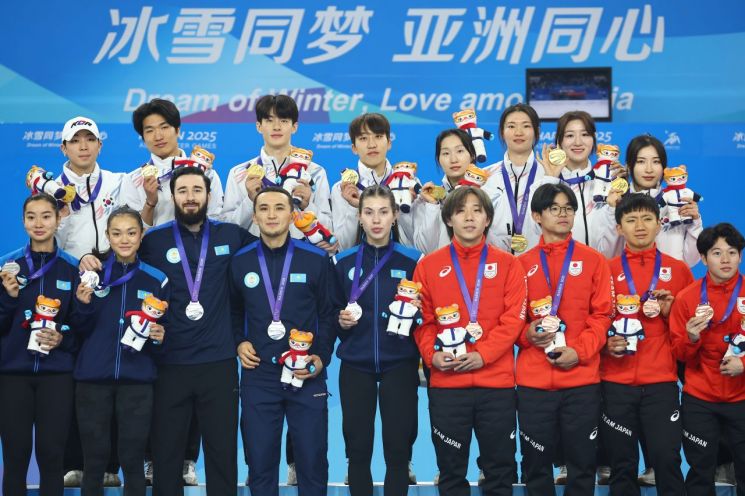
Korea won the gold medal in the mixed 2000m relay final, the first medal match event.
The mixed team, composed of Park Ji-won, Kim Taeseong (Hwaseong City Hall), Choi Min-jung, and Kim Gilli, recorded a time of 2 minutes 41.534 seconds in the mixed 2000m relay final held on the 8th at the Heilongjiang Ice Training Center Multipurpose Hall in Harbin, China. They triumphed over Kazakhstan and Japan.
Kim Geon-woo (Sports Toto), Jang Seong-woo (Hwaseong City Hall), Shim Seok-hee (Seoul City Hall), and Noh Do-hee (Hwaseong City Hall), who competed in the preliminaries, also received gold medals.
Korea was running in second place behind China. With two laps remaining before the finish line, China’s last runner Lin Xiaojun (Korean name Im Hyojun) fell alone, allowing Korea to take the lead. Ultimately, Korea’s last runner Park Ji-won crossed the finish line comfortably.
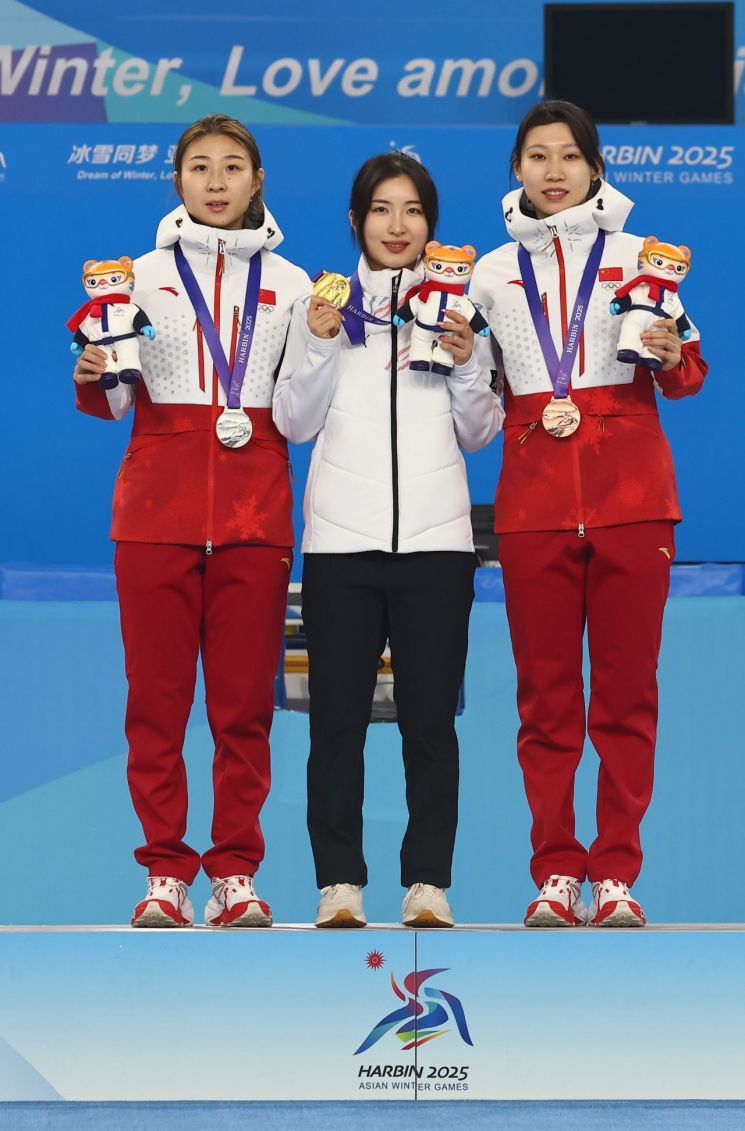
In the women’s 1500m final, Kim Gilli recorded a time of 2 minutes 23.781 seconds. She won the gold medal by beating China’s Gong Li (2 minutes 23.884 seconds) and Zhang Yize (2 minutes 23.965 seconds), who finished behind her. Choi Min-jung and Shim Seok-hee, who also competed in the final, placed 4th and 5th respectively.
With four laps remaining, Kim Gilli moved to the outside lane to attempt a comeback. China’s Yang Jinglu, who was leading, fell, allowing Kim to take the lead.
Kim Gilli increased her speed, shook off the Chinese challengers, and crossed the finish line first.
With Kim Gilli’s victory, Korean short track has built a six consecutive championship streak in this event since the 1999 Gangwon Games.
In the men’s 1500m final, Park Ji-won won the gold medal with a time of 2 minutes 16.927 seconds, edging out China’s Lin Xiaojun (2 minutes 16.956 seconds). Jang Seong-woo, who also competed, took the bronze with a time of 2 minutes 17.057 seconds. Kim Geon-woo finished 4th.
Park Ji-won took the lead early in the race and controlled the pace. He maintained first place and blocked Lin Xiaojun’s inside lane overtaking attempt in the final lap before crossing the finish line.
In the women’s 500m, a traditionally weak event for Korea, they swept gold, silver, and bronze medals.
Choi Min-jung won with a time of 43.016 seconds, followed by Kim Gilli (43.105 seconds) and Lee Soyeon (43.203 seconds, Sports Toto).
From the 2nd Asian Winter Games held in Sapporo in 1990 through the 2017 Sapporo Games, China had won seven consecutive gold medals in the women’s 500m. Meanwhile, the best result for a Korean female athlete in the Winter Asian Games 500m was a silver medal won by Choi Min-kyung at the 1999 Gangwon Games.
In the men’s 500m final, after two restarts, Park Ji-won took silver and Jang Seong-woo took bronze. The gold medal went to Lin Xiaojun.
Korean short track will aim for additional medals in the men’s and women’s 1000m and relay events at the same venue on the 9th.
© The Asia Business Daily(www.asiae.co.kr). All rights reserved.



















