Five Major Projects and Sixteen Tasks for Regional-University Co-Growth
Mayor Kang: "A Key to Fostering Both Industry and Education"
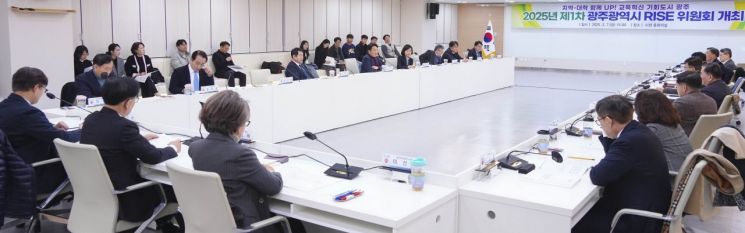 Gwangju Mayor Kang Kijeong is presiding over the '2025 1st Gwangju Metropolitan City RISE Committee' meeting held in the city hall's medium conference room on the afternoon of the 7th. Provided by Gwangju City
Gwangju City will invest 88.2 billion KRW this year to fully implement the RISE (Regional Innovation System for Education) framework, aiming for the co-growth of the region and local universities.
The main content includes the five major projects and sixteen sub-tasks of the Gwangju RISE Basic Plan (2025?2029), as well as support for Neulbom and Glocal University, which were selected through the Ministry of Education’s public contest.
On the 7th, Gwangju City deliberated and resolved four key agenda items, including the ‘2025 RISE Implementation Plan (draft)’ for the co-growth of the region and universities, at the city hall’s main conference room.
As part of the national agenda for ‘educational innovation to foster regional talent,’ this policy integrates five existing university financial support programs (RIS, LINC3.0, LiFE, HiVE, and the Regional University Revitalization Project), delegates budget and authority to the local level, and establishes a system for the co-growth of the region and universities.
The 2025 RISE Implementation Plan sets the vision as ‘Region-University Together UP, Gwangju as a City of Educational Innovation Opportunities’ and aims to: ▲ create shared values between the region and universities ▲ foster local industry-tailored talent ▲ establish an industry-academia-research conveyor for corporate growth ▲ provide Alpha (A) to Omega (Ω) lifelong vocational education.
The city will promote the ‘Five UP Projects’?Talent Skill UP Project, Corporate Value UP Project, Community Grow UP Project, University Inno UP Project, and Inter-Ministry/Ultra-Wide Bridge UP Project?along with sixteen sub-tasks.
From the 10th of this month to the 12th of next month, local universities can submit their project proposals through the ‘2025 Gwangju RISE Project Participation Institution Recruitment Notice.’ In March, the Selection Evaluation Committee will review the proposals, followed by a preliminary review by the Gwangju RISE Project Management Expert Committee and deliberation and resolution by the Gwangju RISE Committee, to finalize around 67 project-performing institutions (worth 77.4 billion KRW).
Additionally, in accordance with the Ministry of Education’s regulations on the operation of the regional innovation-centered university support system, the inclusion of institutions established and operated for the purpose of public interest was also deliberated and resolved. A total of 114 local institutions?including local public corporations, local investment and contribution institutions, and public agencies?will be able to participate in the project by forming consultative bodies with universities.
In line with last year’s resolution by the RISE Committee on the ‘Composition and Operation (draft) of the Gwangju RISE Expert Committee,’ matters regarding the appointment of members to the Project Management Expert Committee, Performance Evaluation Expert Committee, and RISE Linkage Expert Committee were also deliberated and resolved.
The three expert committees will efficiently carry out and support the work of the Gwangju RISE Committee, with 25 members to be appointed, including representatives from local industry-related organizations, field experts, and members recommended by the Central RISE Committee.
The city will establish and implement annual action plans based on the basic plan (2025?2029) formulated through a horizontal RISE decision-making structure with universities and collaboration among local government, industry, academia, and research institutes. In the Ministry of Education’s evaluation of the ‘RISE Basic Plan’ and ‘Governance Structure Establishment and Operation,’ Gwangju received the highest grade in both areas, securing an additional 17.3 billion KRW in incentives.
Kang Gijung, Mayor of Gwangju and co-chair of the Gwangju RISE Committee, stated, “Gwangju RISE will be the key to fostering both education and industry by leveraging the region’s unique strengths,” and added, “We will actively support the establishment of a co-growth system between the region and universities through the RISE project.”
© The Asia Business Daily(www.asiae.co.kr). All rights reserved.

















