Herculaneum Scroll Remains Rolled Up
Text Image Generated Using AI Technology
Word Appears Twice Across Two Lines
Through artificial intelligence (AI) technology, it has been confirmed that the word 'disgusting' was written on a charred ancient Roman scroll from the eruption of Mount Vesuvius 2,000 years ago.
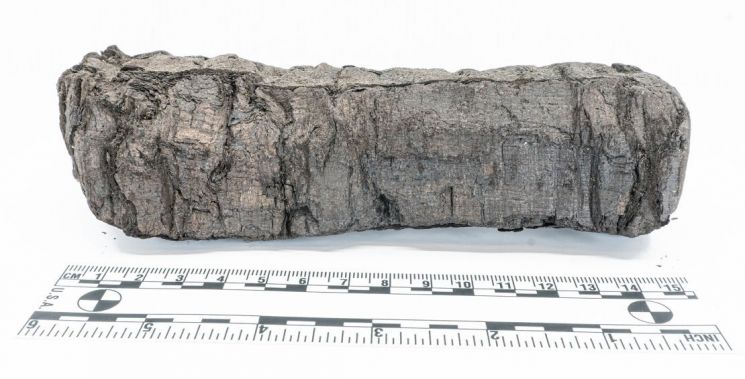 Herculaneum scrolls preserved in the library of the University of Oxford, UK. Vesuvius Challenge, CNN capture
According to CNN on the 6th (local time), the library of the University of Oxford in the UK succeeded in generating the first text image inside the rolled-up Herculaneum scroll using AI technology.
One of the first words the library was able to identify in the text image was the Greek word for 'disgust.' This word appeared twice as the text continued over two lines.
The document is one of about 1,000 scrolls excavated in 1750 from Herculaneum. Herculaneum was an ancient Roman city located in present-day Ercolano, Italy. It disappeared in AD 79 due to the eruption of Mount Vesuvius along with Pompeii, Stabiae, and Oplontis.
The documents were charred by volcanic ash heat during the eruption and have become fragile over more than 2,000 years. For this reason, researchers are attempting to decode them by virtually unrolling the scrolls and estimating the characters using computed tomography (CT) and AI.
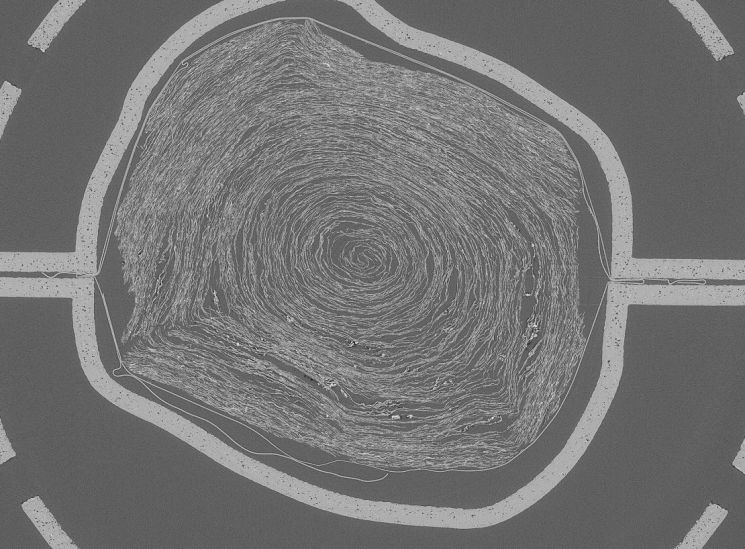
The title of the work has not been confirmed, but it is believed to remain in the innermost part of the scroll that has not yet been successfully imaged. The library plans to have researchers transcribe and translate the remaining text.
Richard Ovenden, the head of the University of Oxford library, said in a statement, "It is a truly remarkable moment in history for librarians, computer scientists, and classical scholars to collaborate to see the unseen," adding, "Thanks to advances in imaging technology and AI, we can now look inside scrolls that have not been read for about 2,000 years."
The most challenging task in this process is distinguishing black ink from the blackened, carbonized papyrus. According to Oxford University, AI is not used to decode the text itself but to enhance the readability of the ink on the papyrus.
Meanwhile, with the 2023 scroll reading competition called the 'Vesuvius Challenge,' participants began using AI technology to decipher the writing. The winning research team that year was the first to read the Greek word meaning 'purple' from the scroll.
In February last year, an international research team composed of university and graduate students from Egypt, Switzerland, and the United States deciphered more than 2,000 Greek characters from the scroll using AI technology. The scroll's author wrote about 'pleasure through goods,' stating, "As in the case of food, we do not believe that deficiency is more enjoyable than abundance," and added, "Such questions will continue to be asked in the future."
© The Asia Business Daily(www.asiae.co.kr). All rights reserved.


















