Busan Gijang-gun (Governor Jeong Jong-bok) recently urged local fruit farmers on the 7th to actively comply with the prevention guidelines for fire blight disease following the enforcement of the recently revised Plant Quarantine Act.
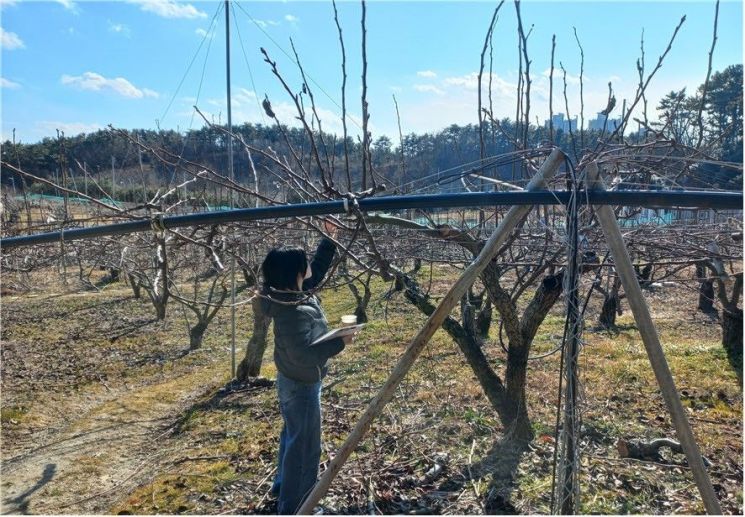 A representative from the Gijang-gun Agricultural Technology Center is conducting fire blight surveillance at a local pear orchard. Provided by Gijang-gun
Fire blight is a bacterial disease that appears on Rosaceae plants such as apples, pears, and quinces, causing the fruit to wither as if burned?apples turn red and pears turn black. The disease spreads rapidly and has no cure, making early detection and prompt field response extremely important.
To prevent fire blight, it is essential to thoroughly carry out ▲ removal of cankers during winter ▲ disinfecting tools when pruning branches ▲ spraying pesticides during the flowering period.
In particular, under the revised Plant Quarantine Act, from this year, fire blight prevention education and compliance with prevention guidelines by farmers have become mandatory.
Following the amendment of subordinate regulations of the Plant Quarantine Act last year and a six-month grace period, from January this year, fruit farmers must complete at least one hour of annual pest control education regarding fire blight. Additionally, farmers must comply with prevention guidelines such as disinfecting before and after farm work, timely application of preventive pesticides, purchasing seedlings with traceability, and conducting regular inspections. Failure to comply with these obligations will result in a reduction of compensation for losses caused by fire blight.
Farmers wishing to receive fire blight control education can complete the training through the region-specific specialized agricultural education held by the Agricultural Technology Center at 2 p.m. on the 17th of this month. Non-face-to-face education is also easily available by watching the video titled ‘Farmer Compliance for Fire Blight Prevention’ on the Rural Human Resources Development Center website of the Rural Development Administration.
A representative from the Gijang-gun Agricultural Technology Center stated, “Since fire blight outbreaks cause significant damage to farms, we ask farmers to strictly follow prevention guidelines and immediately report any suspicious cases to the Agricultural Technology Center.” They added, “We hope many farmers attend this training to familiarize themselves with the revised Plant Quarantine Act and prevention guidelines.”
The criteria for reduction of compensation due to non-compliance with mandatory fire blight measures are as follows. If cankers are found in an orchard where fire blight has occurred, compensation will be reduced by 10%. Failure to report fire blight results in losing 60% of compensation, while ▲ refusal, obstruction, or avoidance of investigation results in a 40% reduction ▲ failure to complete mandatory education results in a 20% reduction ▲ non-compliance with prevention guidelines results in a 10% reduction. Furthermore, falsifying or failing to prepare and preserve pest control information may result in a fine of up to 3 million KRW.
© The Asia Business Daily(www.asiae.co.kr). All rights reserved.

















