Kwak Jong-geun and Hong Jang-won’s Testimonies Contradict Yoon
Differences with Former Minister Kim Yong-hyun’s Statements
First Phase of Impeachment Trial: Martial Law Troop Deployment Reconstruction Concludes
Next Phase to Focus on State Council Meeting-Related Investigations
The impeachment trial of President Yoon Suk-yeol reached a milestone on the 6th with the conclusion of witness examination of former Special Forces Commander Kwak Jong-geun, marking the end of the evidence investigation phase concerning the martial law military leadership at the time of the emergency martial law declaration on December 3 last year. The 7th hearing on the 11th will feature former Minister of the Interior and Safety Lee Sang-min and Secretary General of the National Election Commission Kim Yong-bin as witnesses, while the 8th hearing on the 13th will include Police Commissioner General Cho Ji-ho and former Seoul Police Commissioner Kim Bong-sik. This concludes the first act of the Constitutional Court’s impeachment trial, which involved reconstructing the deployment of martial law troops during the emergency martial law period. The next phase is expected to involve evidence investigation targeting those related to the 'State Council meeting' held on the day the martial law was declared.
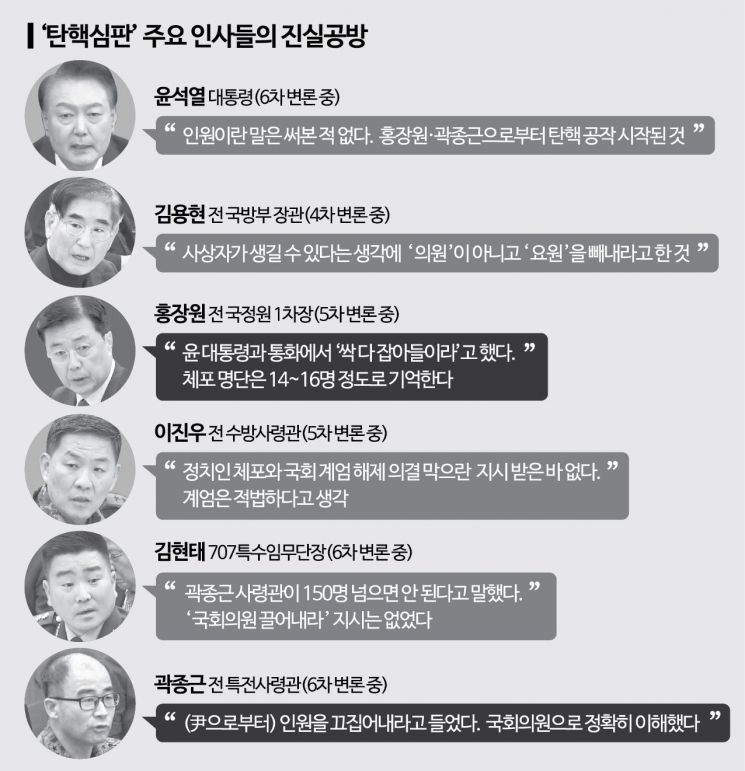
Kwak Jong-geun & Hong Jang-won vs Kim Yong-hyun & Lee Jin-woo
On the 6th, former Special Forces Commander Kwak Jong-geun gave testimony that directly contradicted President Yoon’s claims regarding the deployment and withdrawal of martial law troops from the National Assembly. Although there was a dispute over whether the exact term used to refer to those ordered to be "pulled out" from the National Assembly was "personnel" or "members of the assembly," Kwak repeatedly stated, "Considering the context of preventing the resolution to lift the emergency martial law in the National Assembly, I understood the target to be the members of the National Assembly." He also stated that the withdrawal of troops from the National Assembly was based on his own judgment.
Kwak explained, "At that time, personnel from the 707 Special Mission Unit were at the National Assembly main building, confronting at the front gate, and no personnel had entered inside the main building." He added, "Since I received the call in that situation, the parts you mentioned?issues about the quorum for the resolution and the order to pull out those inside?were understood by me as referring to the members of the National Assembly because there were no operatives inside the main building."
Earlier, on the 4th, former First Deputy Director of the National Intelligence Service Hong Jang-won, who appeared as a witness at the 5th hearing of the impeachment trial, testified, "I remember President Yoon saying, 'Arrest them all, I will give the National Intelligence Service counterintelligence investigation authority, so assist the Defense Counterintelligence Command.'" When asked if the exact term used by former Defense Counterintelligence Commander Yeo In-hyung was "arrest team," Hong answered, "Yes." Hong also stated, "Since the arrest list was short, I wondered what it was and did not add more details, but after recalling, I remember it was about 14 or 16 people."
The testimonies of these individuals differ significantly from those of former Minister of National Defense Kim Yong-hyun and others. Kim testified that regarding the phrase "pull them out," he instructed to withdraw personnel because "there was pushing and pulling between military personnel and National Assembly staff... I thought an accident might happen if things went wrong, so I ordered to pull them out." He clarified that he meant to withdraw operatives (martial law troops), not members of the National Assembly. Kim also testified that he personally wrote the 'emergency legislative body note' that Acting President Choi Sang-mok (then Deputy Prime Minister for Economy) received during the emergency martial law, and that President Yoon instructed to deploy only a small number of troops after the martial law declaration, lending support to President Yoon’s claims.
Other martial law military leaders, such as former Defense Security Command Commander Lee Jin-woo and former Commander Yeo, remained passive in their testimonies, citing criminal prosecution as the reason. The indictment against former Commander Lee states that in the early morning of December 4 last year, President Yoon called him and ordered, "Go to the plenary hall and have four people carry one person each out." However, at the Constitutional Court, he denied having received such an order.
Yoon: "Like Chasing the Moon’s Reflection on a Lake"
President Yoon’s position is encapsulated by his remark that it is "like chasing the moon’s reflection on a lake" to base accusations on events that never happened. He consistently denies the key points that led to the impeachment motion, such as the order to arrest politicians and the obstruction of the National Assembly’s proceedings. This denial strategy is expected to continue. While he admits to ordering the deployment of troops to the National Assembly and the National Election Commission, he firmly defends the 'purpose' behind it, which determines whether it was illegal or not. The core of President Yoon’s argument is that the impeachment motion over the declaration of martial law?a legitimate exercise of presidential authority and a political act not subject to judicial review?was a 'conspiracy' orchestrated by former Deputy Director Hong and former Commander Kwak in collusion with opposition parties.
During the trial proceedings, President Yoon was often seen taking notes with a pen placed in front of him and passing them to his lawyers or turning his body to give instructions to his legal team. The legal community analyzes that President Yoon is personally devising defense strategies and effectively 'commanding' his defense team.
© The Asia Business Daily(www.asiae.co.kr). All rights reserved.

















