Macroeconomic and Financial Issues Meeting Held
"Value-Up Support Bills for Capital Market Should Be Promptly Discussed at February National Assembly"
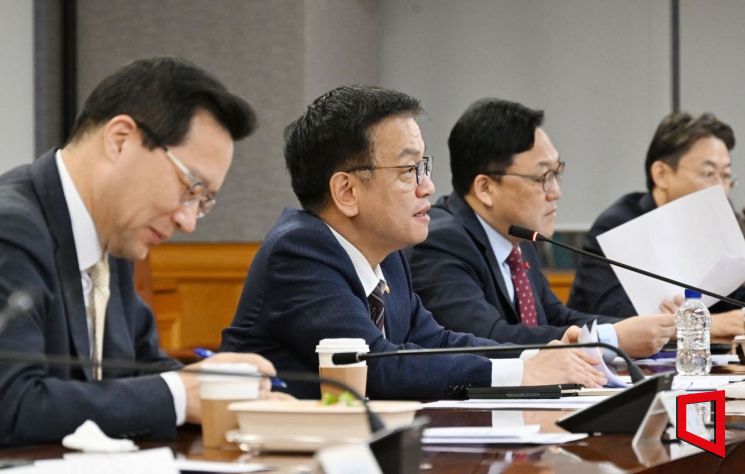 Choi Sang-mok, Deputy Prime Minister for Economic Affairs and Minister of Economy and Finance, is presiding over an emergency macroeconomic and financial issues meeting held on the 11th at the Bankers' Hall in Jung-gu, Seoul. Photo by Ministry of Economy and Finance
Choi Sang-mok, Acting President and Deputy Prime Minister as well as Minister of Strategy and Finance, stated at the Macroeconomic and Financial Issues Meeting (F4 Meeting) on the 7th, "We will prepare swiftly to submit the plan for establishing the Advanced Strategic Industry Fund to the National Assembly within March."
At the F4 Meeting held at the Government Seoul Office that morning, Acting President Choi said, "The domestic and international conditions surrounding our industry are urgent."
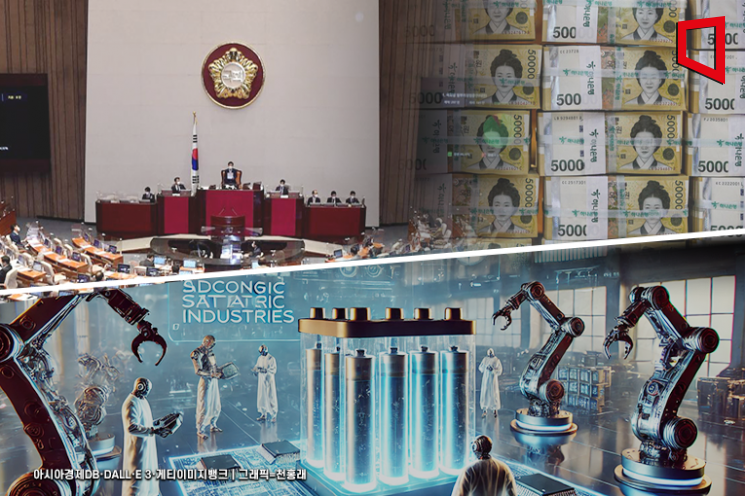
The government previously announced on the 5th at the 'Meeting of Ministers for National Affairs, Economic Affairs, and Industrial Competitiveness Enhancement' that it would establish an Advanced Strategic Industry Fund of over 34 trillion won at the Korea Development Bank to support advanced industries and technologies such as batteries and bio sectors. The fund size exceeds twice that of the semiconductor financial support program (17 trillion won).
Acting President Choi emphasized, "We will closely communicate with the National Assembly to ensure that value-up support bills, such as the corporate tax credit for companies expanding shareholder returns and separate taxation on dividend income, which are essential for capital market advancement, can be promptly discussed at the February extraordinary session of the National Assembly (amendments to the Restriction of Special Taxation Act)."
Attending the meeting were Yoo Sang-dae, Deputy Governor of the Bank of Korea; Kim Byung-hwan, Chairman of the Financial Services Commission; and Lee Bok-hyun, Governor of the Financial Supervisory Service. The meeting reviewed the impact of the new tariffs imposed by the U.S. administration and the ripple effects of China's Deep Seek on domestic and international financial and foreign exchange markets and discussed response strategies.
Acting President Choi requested, "Given the significant external uncertainties in domestic and international financial and foreign exchange markets due to global common factors such as the new tariffs imposed by the U.S. administration and the Deep Seek shock, each institution should meticulously monitor 24 hours a day the policies of major countries including the U.S. and their effects on domestic financial and foreign exchange markets and the real economy."
The previous day, the won-dollar exchange rate closed at 1,447.70 won, up 3.4 won from the previous session in weekly trading, influenced by inflows of low-priced buying.
The KOSPI and KOSDAQ indices continued their rise for the third consecutive day, increasing by more than 1%. The KOSPI index closed at 2,536.75, up 1.1% from the previous session, and the KOSDAQ index ended the day at 740.32, up 1.28%.
© The Asia Business Daily(www.asiae.co.kr). All rights reserved.


















