Trump and Ishiba to Hold First US-Japan Summit on the 7th
Focus on Economic and Security Cooperation
Joint Statement to Highlight Response to China and Alliance Enhancement
Japanese Prime Minister Shigeru Ishiba departed on the 6th for his first US-Japan summit meeting with US President Donald Trump. At the summit, scheduled for the 7th (local time) in Washington DC, Ishiba plans to confirm cooperation between the two countries in economic and security fields and share their views on countering China. Since tariff impositions and pressure to increase defense spending from President Trump are expected, Ishiba intends to emphasize that Japan was the top investor in the US for five consecutive years from 2019 to 2023 and propose expanding imports of US liquefied natural gas (LNG).
Before departure, Prime Minister Ishiba stated, "I will strive to establish a trusting relationship with President Trump," adding, "It would be good to confirm that the US and Japan will cooperate on economic and security issues and join forces for peace."
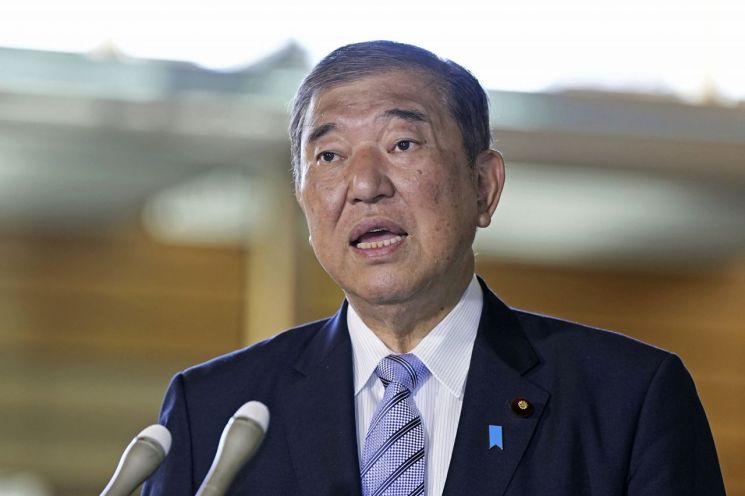
Prior to leaving, Ishiba met with Masayoshi Son (Japanese name: Son Masayoshi), chairman of SoftBank Group, and former Prime Minister Fumio Kishida to seek advice. Since last year, the Japanese government has been coordinating countermeasures among relevant ministries and prepared anticipated questions and answers for President Trump.
On the same day, the Nihon Keizai Shimbun (Nikkei) reported that the three main themes of the joint statement to be announced after the US-Japan summit are expected to be economy, security, and response to China. The two countries are discussing including the phrase "building a golden era of US-Japan relations" in the joint statement and plan to emphasize their stance to elevate the alliance to a new level to realize a "free and open Indo-Pacific."
In the economic sector, the importance of a trade system based on a free and fair economic order is expected to be highlighted, along with creating an environment conducive to investment by both countries. Cooperation in energy and advanced technology fields will also be included.
Regarding security, the statement is anticipated to specify enhancing the deterrence and response capabilities of the US-Japan alliance. It will likely include strengthening extended deterrence to protect Japan with nuclear and other forces, US involvement in East Asian affairs, improved command and control linkage between US forces and the Japan Self-Defense Forces, and promotion of defense equipment technology cooperation. Nikkei reported that Prime Minister Ishiba is expected to express his intention to expand purchases of US-made weapons at this summit.
On the issue of China, the statement is expected to oppose unilateral attempts to change the status quo in the East China Sea and South China Sea and emphasize the importance of peace and stability in the Taiwan Strait. It may also include that the Senkaku Islands (Chinese name: Diaoyu Islands), over which Japan and China have a territorial dispute, fall under the US-Japan Security Treaty. The Yomiuri Shimbun reported that the two countries are also coordinating to include cooperation in space and cyber domains in the joint statement, keeping China and Russia in mind.
The Japanese government announced that Prime Minister Ishiba and President Trump will hold a joint press conference after the summit.
Considering President Trump’s emphasis on personal trust with foreign leaders, the Japanese government assigned Sunao Takao, Director-General of the US Affairs Division at the Ministry of Foreign Affairs, who served as former Prime Minister Shinzo Abe’s English interpreter, to interpret. Takao also interpreted a phone call between Ishiba and Trump before Trump’s inauguration in November last year. President Trump has previously referred to former Prime Minister Abe as "a very close friend."
Since President Trump announced plans to impose tariffs on Mexico, China, and Canada, the top three US import partners from January to November last year, there is speculation that Japan, ranked fifth in imports, may also face tariff threats along with demands for increased defense spending.
Topics such as SoftBank Group, OpenAI (developer of ChatGPT), Stargate (a joint venture with Oracle), and Nippon Steel’s acquisition of US Steel may also be discussed at the summit table.
© The Asia Business Daily(www.asiae.co.kr). All rights reserved.

















