First Major Credit Rating Agency Assessment Since December 3 Martial Law Incident
Economic and System Stability Maintained Despite Political Uncertainty
International credit rating agency Fitch maintained South Korea's credit rating at ‘AA-’ in its first credit rating report since the December 3 emergency martial law incident. This decision was based on the assessment that, despite significant political uncertainty due to the presidential impeachment crisis, the economic conditions have not deteriorated substantially. However, Fitch warned that if the political deadlock persists for a prolonged period, it could negatively impact policy efficiency, economic performance, and fiscal soundness. Reflecting concerns over export slowdowns due to the universal tariff imposition by the new U.S. administration under Donald Trump, Fitch lowered its economic growth forecast to 1.7%.
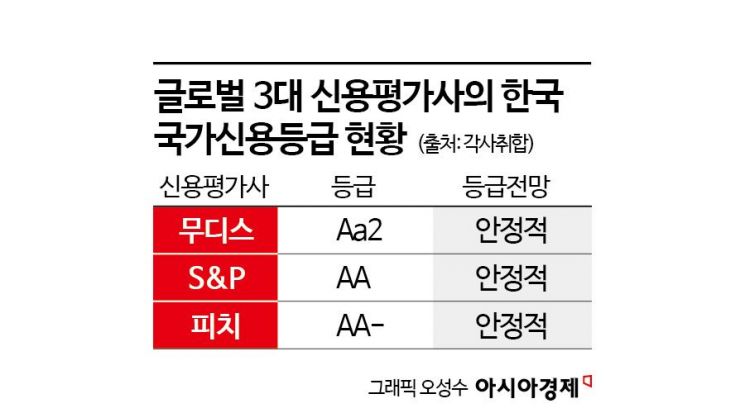
On the 6th (local time), Fitch released its evaluation opinion on South Korea's credit rating, maintaining the rating and outlook at ‘AA-’ and ‘Stable,’ respectively, the same as before. The ‘AA-’ rating is the fourth highest in Fitch’s credit rating system, following AAA, AA+, and Aa2. Compared to other major credit rating agencies, it is one notch below S&P’s AA and Moody’s Aa2. South Korea’s Fitch rating is on par with countries like the United Kingdom, France, and Belgium, and two levels higher than Japan. Fitch upgraded South Korea’s sovereign credit rating from ‘A+’ to ‘AA-’ in September 2012 and has maintained this rating for 14 years.
This evaluation is the first official assessment by an international credit rating agency since the December 3 emergency martial law incident last year. Fitch had previously issued a report immediately after the martial law incident, expressing concerns that if the situation was not resolved promptly, it could have negative effects.
However, in the actual evaluation, Fitch maintained both the rating and outlook. In this report, Fitch noted that “South Korea’s political uncertainty may persist for several months,” but also assessed that “this is not expected to materially impair South Korea’s governance and economy.” The agency evaluated that the ‘Fundamentals Stable’ remain intact despite the political uncertainty. Nevertheless, it mentioned that “if this political deadlock continues for an extended period, it could deteriorate policy decision-making efficiency, economic performance, and fiscal soundness.”
Fitch projected that “due to psychological contraction caused by political uncertainty and concerns over export slowdowns from the U.S. administration’s universal tariff imposition, South Korea’s economic growth rate will be 1.7% this year.” This is a 0.3 percentage point reduction from the initial forecast of 2.0%. However, Fitch expects that “from next year, growth will recover to 2.1% supported by improvements in consumption and investment in facilities and construction.”
In the fiscal sector, where Fitch takes a somewhat conservative stance, it forecasted that “due to continuous recovery in fiscal revenues and efforts to control expenditures, the fiscal balance will improve this year (-1.0% of GDP) compared to last year (-1.7% of GDP).”
However, Fitch expressed concerns that “uncertainty over future fiscal outlook has increased due to this year’s political situation, and if government debt continues to rise due to aging-related expenditures, it could pose a burden on the credit rating.”
Fitch also evaluated that “household debt is gradually improving” and analyzed that “despite prolonged high interest rates, financial market-related risks remain limited.” It judged that risks related to real estate project financing (PF) are manageable due to the government’s proactive policy responses and restructuring efforts.
Fitch also gave a relatively positive assessment of the current account balance and net external assets, which are directly linked to external creditworthiness. Fitch stated, “South Korea’s current account surplus is expected to remain at a high level (4.5% of GDP), and the sustained current account surplus along with net external assets amounting to 23% of GDP (Fitch’s own estimate) support South Korea’s robust external soundness.”
Fitch issues an official evaluation opinion on South Korea’s credit rating once a year. Last year, it also released an evaluation report in March. A Ministry of Strategy and Finance official said, “Given the increased political uncertainty since last December, the announcement of this result is expected to significantly alleviate overseas investors’ concerns about South Korea’s external creditworthiness.”
© The Asia Business Daily(www.asiae.co.kr). All rights reserved.


















