Ordinary Wages Now Include Holiday Bonuses
"Reflecting the Value of Prescribed Work"
In December last year, following the Supreme Court's ruling that expanded the scope of ordinary wages, the government issued guidelines. These included the interpretation that conditional regular bonuses, such as holiday bonuses or vacation allowances paid over a certain period, should be considered as ordinary wages.
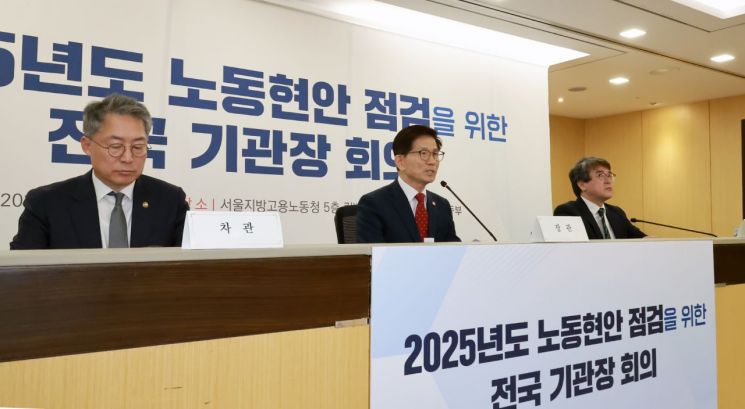 Kim Moon-soo, Minister of Employment and Labor (center), speaking at the first "National Agency Heads Meeting" of the year, urgently convened on the 6th at the Seoul Regional Employment and Labor Office to discuss major labor issues such as wage arrears reduction and ordinary wages immediately after the Lunar New Year holiday. Photo by Ministry of Employment and Labor
On the 6th, Kim Moon-soo, Minister of Employment and Labor, urgently convened the first "National Heads Meeting" of the year at the Seoul Regional Employment and Labor Office to discuss major labor issues such as wage arrears reduction and ordinary wages immediately after the Lunar New Year holiday. The meeting was attended by Kim Min-seok, Vice Minister of Employment and Labor, along with key department heads and heads of regional employment and labor offices nationwide.
At this meeting, the Ministry of Employment and Labor announced the revised "Guidelines for Labor-Management Guidance on Ordinary Wages," which had been amended for the first time in 11 years, and held related discussions. The revised guidelines were prepared to help field understanding and reduce confusion regarding the Supreme Court's plenary session ruling on December 19 last year, which changed the legal principles established in the 2013 Supreme Court ruling by excluding the 'fixity' requirement from the criteria for determining ordinary wages, such as ▲payment for prescribed work ▲regularity ▲uniformity ▲fixity.
The Ministry stated in the guidelines that companies should be strictly guided to prevent actions such as unilaterally changing payment conditions without complying with labor-management consultations and legal procedures solely to reduce ordinary wages due to cost burdens. In particular, it emphasized that when changing the conditions of ordinary wage payments to the disadvantage of workers, strict compliance with the procedures for disadvantageous changes to employment rules must be ensured.
Ordinary Wages Without Fixity: "Reflecting the Value of Prescribed Work"
Ordinary wages are used to calculate statutory allowances such as overtime, night, and holiday work allowances, as well as dismissal notice allowances. They serve as the basis for calculating wage items ancillary to the basic salary. The Supreme Court interpreted that holiday bonuses or regular bonuses paid regularly, even if attached with conditions such as "given to employees employed as of the payment date," should all be considered ordinary wages. The 'fixity' requirement, which determines the scope of ordinary wages, was removed.
The 'fixity' of wages means that when a worker performs prescribed work on an arbitrary day, payment is scheduled regardless of additional conditions. Whether the wage is paid or the amount is predetermined in advance, and wages should not vary according to conditions.
Based on this guideline revision, the Ministry of Employment and Labor decided that ordinary wages should be judged based on the substantive criteria rather than the name of the payment, focusing on the 'objective nature' such as payment conditions and operational practices rather than the names of bonuses and allowances.
Since the premise is that ordinary wages are "payments made when a worker fully provides prescribed work (working hours agreed upon in advance between the worker and the company)," payments that are temporary or variable are still excluded from ordinary wages. Bonuses such as encouragement money, incentives, and profit-sharing bonuses that are temporary based on company performance and discretionary by the employer do not qualify as ordinary wages.
On the other hand, payments such as holiday homecoming allowances or vacation allowances should be considered ordinary wages. If these are received at regular intervals by the company, they meet the requirements of 'regularity' and 'uniformity.' Here, regularity means continuous payment at fixed intervals such as monthly, quarterly, semi-annually, or annually. However, family allowances that vary according to the number of dependents are attached to conditions unrelated to the value of prescribed work and therefore cannot be considered ordinary wages.
The Ministry plans to promptly convey the revised guidelines to regional offices so that labor inspectors can utilize them in frontline field guidance. For workplaces seeking to improve wage systems, consulting support through the Korea Labor Foundation will be provided.
Minister Kim explained at the meeting, "The purpose of this ruling is to exclude 'fixity' from the criteria for determining ordinary wages according to the 2013 Supreme Court ruling to prevent unjust reduction of ordinary wages and to reflect the value of prescribed work."
He also urged, "Please enhance field understanding of the meaning and content of the recently changed Supreme Court ruling to minimize confusion, and labor and management should cooperate to use this as an opportunity to improve complex wage structures or seniority-based wage systems to better fit the changing labor market environment."
© The Asia Business Daily(www.asiae.co.kr). All rights reserved.

















