Korea Consumer Agency Investigates 30 Sliding Doors
Door Opening Sensors Fail to Detect, Collision Prevention Barriers Not Installed
Safety Accidents Involving Children and the Elderly Continue
Most sliding doors (automatic sliding doors) installed in multi-use facilities for pedestrian convenience do not meet the safety requirements of the Korean Industrial Standards (KS standards), raising concerns about entrapment accidents.

The Korea Consumer Agency announced on the 6th that after investigating 30 sliding doors installed in 19 multi-use facilities in the Seoul and Gyeonggi areas, most did not meet the safety requirements of the KS standards.
The KS standards for sliding doors require a gap of 8mm or less or 25mm or more between the moving door and the fixed door frame, as well as between the door and the floor, to prevent entrapment accidents, and also require the installation of anti-entrapment protective devices. Among the doors surveyed, 24 (80.0%) had a gap between the moving door and the fixed door frame, and 22 (73.3%) had a gap between the moving door and the floor that was wider than 8mm but narrower than 25mm, posing a risk of fingers getting caught. Additionally, 29 (96.7%) did not have anti-entrapment protective devices installed on the front edge or bottom of the door.
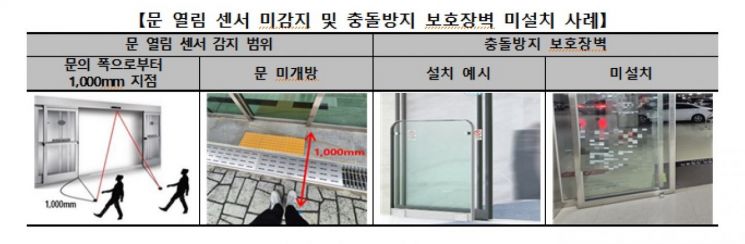
The KS standards specify that door opening sensors must detect pedestrians and objects within a vertical distance range of 1000 to 1500mm from the door opening width, and that protective barriers at least 900mm high must be installed in front of fixed doors. Of the 30 doors surveyed, 16 (53.3%) failed to detect pedestrians within the KS standard range, and 29 (96.7%) either did not install collision prevention protective barriers or installed them too low.
Currently, the KS standards are voluntary regulations, and sliding door installers are not obligated to comply with them during installation. In contrast, the European Union (EU) has mandated since April 2013 that newly installed sliding doors comply with installation standards to prevent safety accidents.
According to the Consumer Agency’s consumer hazard monitoring system, there were a total of 244 safety accidents related to sliding doors reported from 2021 until October of last year. The largest number of victims were under 10 years old with 99 cases, followed by 40 cases involving those aged 65 and older.
Accidents involving entrapment or crushing accounted for 133 cases (54.5%), and collisions or impacts accounted for 97 cases (39.8%). Injured body parts were mainly hands and arms with 106 cases (43.5%), and head and face with 82 cases (33.6%). The most common injuries were skin and subcutaneous tissue damage with 146 cases (59.8%), followed by concussions and bruises with 66 cases (27.1%).
The Consumer Agency recommended improvements to the management entities of facilities that were found to be deficient in meeting KS standards in this investigation and plans to propose mandatory safety installation standards for sliding doors to the relevant government departments.
A representative from the Consumer Agency advised, "When using sliding doors, do not stand close to the door while it is opening or closing, and pass through by walking, not running. Children should be guided not to put their fingers or toes into the door frame or between the doors."
© The Asia Business Daily(www.asiae.co.kr). All rights reserved.
![Clutching a Stolen Dior Bag, Saying "I Hate Being Poor but Real"... The Grotesque Con of a "Human Knockoff" [Slate]](https://cwcontent.asiae.co.kr/asiaresize/183/2026021902243444107_1771435474.jpg)

















