Industry Leaders Voice Challenges at Quantum Roundtable
"Urgent Need for Policy and Support"
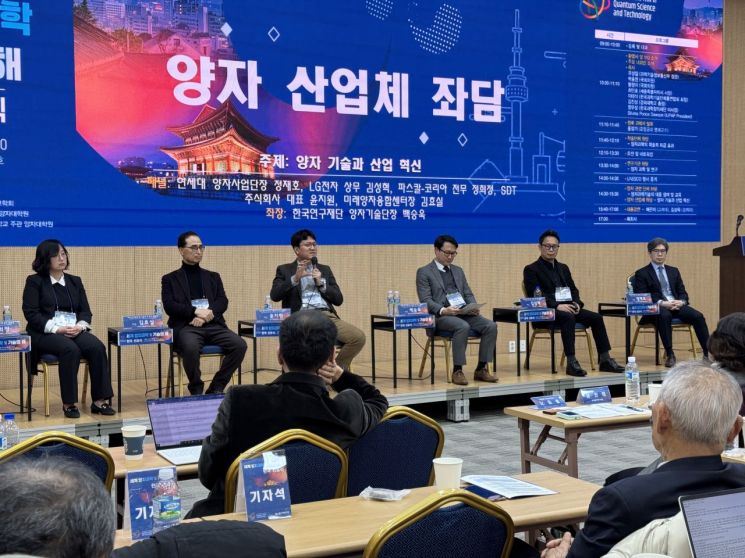 Participants of the Quantum Industry Roundtable held on the 5th at the Seoul Science and Technology Center are speaking. Photo by Baek Jong-min.
Interest in quantum computers is rapidly spreading, but related companies have voiced concerns about burdens such as hardware supply chain issues, a shortage of specialized personnel, massive research and development investments, and uncertainties, calling for active government support and direction-setting.
On the 5th, at the Korea Science and Technology Center in Seoul, during an industry roundtable held as a side event of the Korean Declaration Ceremony for the Year of Quantum Science and Technology hosted by the Korean Physical Society, participants including Kim Seong-hyeok, Executive Director of LG Electronics, Yoon Ji-won, CEO of SDT, Jung Hee-jung, Executive Director of the French quantum computing company Pasqal, Jung Jae-ho, Director of the Quantum Business Group at Yonsei University, and Kim Hyo-sil, Director of the Future Quantum Convergence Center, shared their concerns and solutions.
Executive Director Kim Seong-hyeok expressed difficulties, saying, “It is very unusual for a large corporation to create and maintain a dedicated quantum team for over five years.” He revealed, “Without any significant business achievements or a ‘big hit’ yet, we have been holding on with sheer determination every year to protect the organization and budget.”
Kim said, “We are still competing with artificial intelligence technology and undergoing an internal process to prove how valuable quantum technology actually is,” adding, “Despite a short research period, we have produced 15 related papers and 7 patents as achievements, but it is still difficult to claim that we have secured ‘Quantum Advantage’ or demonstrated a clear competitive edge over AI.” Quantum Advantage refers to quantum computing surpassing the highest performance of conventional computing.
Despite internal and external difficulties, Kim said he would not stop challenging. He emphasized, “Like offering water in the early stages of a marathon, if we start now by cooperating with leading overseas companies to support the ecosystem, there will be opportunities to run together later.”
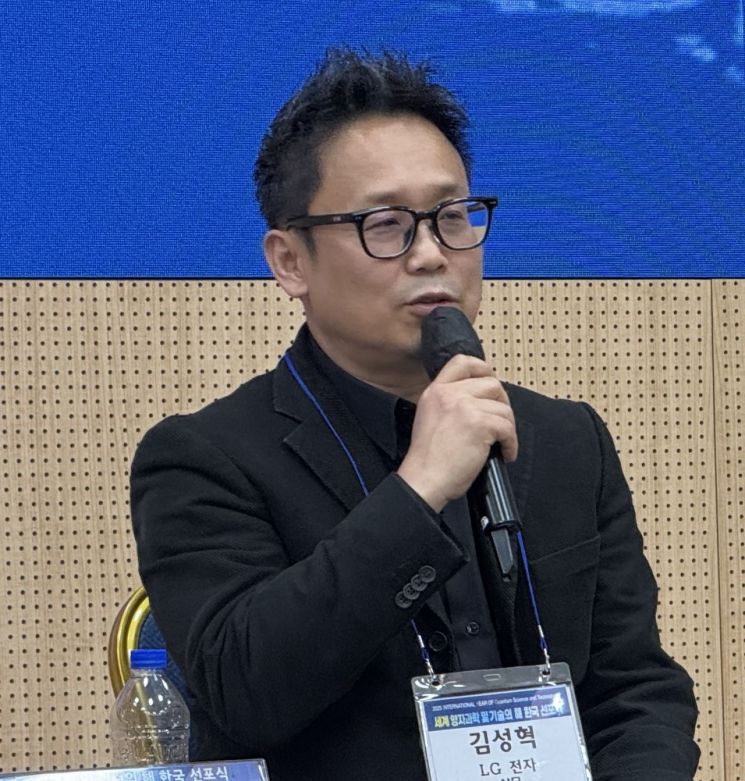 Seonghyeok Kim, Executive Director at LG Electronics researching in the quantum field, said, "I endured it with sheer willpower." Photo by Jongmin Baek.
Yoon, who founded a startup after separating from the Korea Institute of Science and Technology, said the situation for startups is no different. Yoon pointed out, “Especially in the quantum computing field, the bigger problem is the lack of clear strategies and ecosystems rather than regulations,” and said, “It is not that government or large corporations lack investment funds, but on the ground, many do not know where and how to use them to minimize risks and achieve tangible results.”
Yoon suggested focusing on “specific areas where our country can excel, such as ultra-precision electronic and mechanical devices or control software,” rather than vague goals.
Executive Director Jung said, "To compete in the global market in the future, companies capable of handling basic equipment and electromagnetic control technology must emerge domestically,” adding, “To achieve this, securing fundamental capabilities through industry-academia cooperation is the top priority, and nurturing talent in basic sciences such as physics, mathematics, and engineering fields is essential.”
Jung Jae-ho, Director of the Quantum Business Group at Yonsei University, which introduced quantum computers domestically for the first time, emphasized the role of universities. Director Jung stated, "Quantum computing requires a multidisciplinary approach from basic sciences like physics and mathematics to electronic engineering and computer science. Universities must actively collaborate with industry to establish educational programs that enhance ‘Quantum Literacy’ and build joint research platforms.”
Director Jung also spoke about the currently operating quantum computer, saying, “It should not be limited to simply providing equipment but should accurately analyze industry demands and, if necessary, form multidisciplinary teams to find solutions.” Yonsei University plans to expand joint research with domestic companies focusing on bio and new drug development.
Director Kim added, "Contrary to our perception, I was surprised to hear that overseas views consider Korea’s quantum investment to be substantial," further noting the high expectations for Korea’s quantum industry abroad. This suggests significant potential for joint research with overseas partners.
© The Asia Business Daily(www.asiae.co.kr). All rights reserved.


















