Number of New Elementary School Students Continues to Decline
Expected to Drop to 16,337 by 2029
As a result of population decline, it was found that there are 26 elementary schools in the Gyeongnam region with no new students enrolled this year.
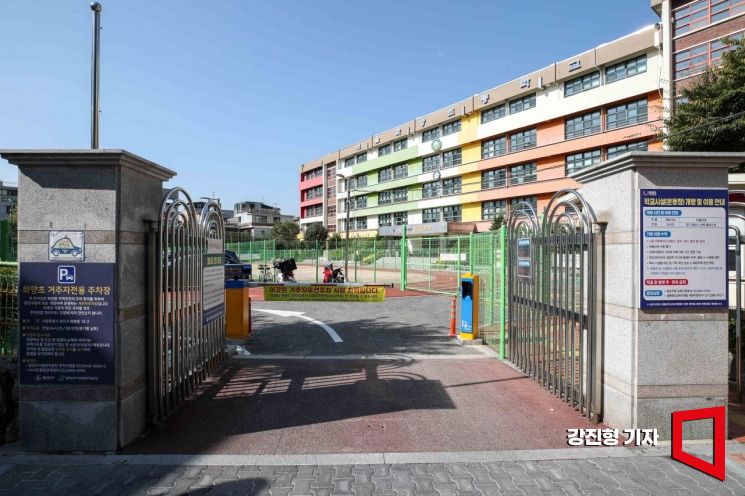 School closures due to the decline in the school-age population are also an issue in Seoul. This is the fourth school to be closed in Seoul as of February 2023, Hwayang Elementary School in Gwangjin-gu, Seoul. Photo by Kang Jin-hyung
The Gyeongnam Provincial Office of Education announced on the 6th that among the 18 cities and counties in the province, 13 have elementary schools with no new students. This includes large cities with populations exceeding 500,000, such as Changwon and Gimhae.
By region, there are 4 schools each in Tongyeong and Goseong, 3 schools each in Hapcheon and Hadong, 2 schools each in Changwon, Miryang, and Changnyeong, and 1 school each in Jinju, Gimhae, Geoje, Yangsan, Uiryeong, and Sancheong. There are also 33 schools with only one new student enrolled. These are located in 16 cities and counties excluding Changwon and Hamyang.
According to this year's preliminary elementary school enrollment results, the number of new students is 20,701, a decrease of 2,740 compared to last year. The number of schools with no new students increased by one.
Considering that the average number of students per first-grade class in elementary schools in the province is 23, approximately 119 classes have disappeared.
The number of new elementary school students continues to decline. It was 30,185 in 2021, dropped below 30,000 to 29,858 in 2022, 27,154 in 2023, 23,411 in 2024, and 20,701 this year. The number of new students is expected to decrease further over the next four years. It is projected to fall below 20,000 next year to 19,811, then to 18,177 in 2027, 17,338 in 2028, and 16,337 in 2029.
An official from the Provincial Office of Education stated, "We will respond to regional extinction caused by population decline through the Gyeongnam-type social care system, which is a care system jointly established by local governments and the education office."
© The Asia Business Daily(www.asiae.co.kr). All rights reserved.

















