Bank of Korea Releases "Preliminary International Balance of Payments for December 2024"
December Current Account Surplus Reaches $12.37 Billion, Third Highest on Record
Strong Export Performance in Semiconductors and Other IT Products
As semiconductor-centered export improvements continued, the current account balance in December last year recorded a surprising performance of $12.37 billion. This marks the 20th consecutive month of surplus and ranks as the third largest ever. The annual current account surplus reached $99.04 billion, surpassing the Bank of Korea's forecast of $90 billion.
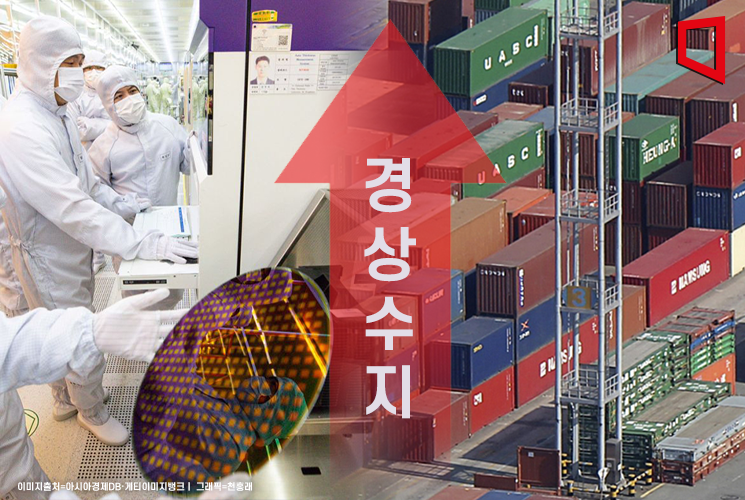
According to the 'Preliminary International Balance of Payments for December 2024' announced by the Bank of Korea on the 6th, the domestic current account recorded a surplus of $12.37 billion. This is an increase of $3.44 billion compared to the previous year's surplus of $8.93 billion.
By detailed item, the goods balance recorded a surplus of $10.43 billion. This was due to exports increasing by 6.6% year-on-year to $63.3 billion, and imports rising by 4.2% to $52.87 billion.
In terms of exports, the growth trend continued mainly in IT items such as semiconductors and information and communication devices, while the decline in passenger cars, petroleum products, machinery, and precision instruments slowed, expanding the surplus compared to the previous month ($56.3 billion).
Customs-based semiconductor exports increased by 30.6% year-on-year, and information and communication devices rose by 37%. Steel products increased by 6%. On the other hand, passenger cars (-5.8%), petroleum products (-11.9%), and chemical products (-0.4%) decreased.
By region, exports to the United States (5.5%) and China (8.6%) turned to growth, and the export growth trend expanded to Southeast Asia (15.4%) and the European Union (EU, 15.2%).
Imports amounted to $54.88 billion, up 3.3% year-on-year. Although raw materials (customs basis -9.6%) continued to decline, capital goods such as semiconductor manufacturing equipment (24.4%) increased, and consumer goods (1.2%) turned to growth. Excluding energy products (-18.2%), imports increased by 12.2% compared to the same month last year.
The services balance recorded a deficit of $2.11 billion, mainly due to travel and other business services. The travel balance (-$950 million) saw an expanded deficit due to the peak overseas travel season during winter vacation.
The primary income balance showed a surplus of $4.76 billion, centered on dividend income from securities investment. The secondary income balance recorded a deficit of $710 million.
The net financial account assets, calculated by subtracting liabilities from assets, increased by $9.38 billion. In direct investment, domestic investors' overseas investment increased by $6.95 billion, and foreign investors' domestic investment rose by $1.23 billion.
In securities investment, domestic investors' overseas investment increased by $860 million, mainly in stocks, while foreign investors' domestic investment decreased by $3.8 billion, also mainly in stocks.
The annual current account surplus last year was recorded at $99.04 billion, ranking as the second largest ever. The Bank of Korea had forecast a surplus of $90 billion in its revised economic outlook in November last year. Compared to the previous year ($32.82 billion), this is more than a threefold increase.
© The Asia Business Daily(www.asiae.co.kr). All rights reserved.

















