Alphabet plunges 8% on weak cloud sales
China and EU prepare big tech retaliation after Trump's tariff bombshell
US December trade deficit jumps 25%... Surge in imports before tariff threats
Mixed employment indicators... Focus on jobs report on the 7th
The three major indices of the U.S. New York stock market showed mixed trends on the 5th (local time). Technology stocks are weak due to poor earnings from Alphabet, Google's parent company, and semiconductor company AMD. News that China and the European Union (EU) are preparing retaliatory measures against U.S. big tech companies in response to President Donald Trump's tariff bombshell is also rapidly dampening investor sentiment, especially in technology stocks.
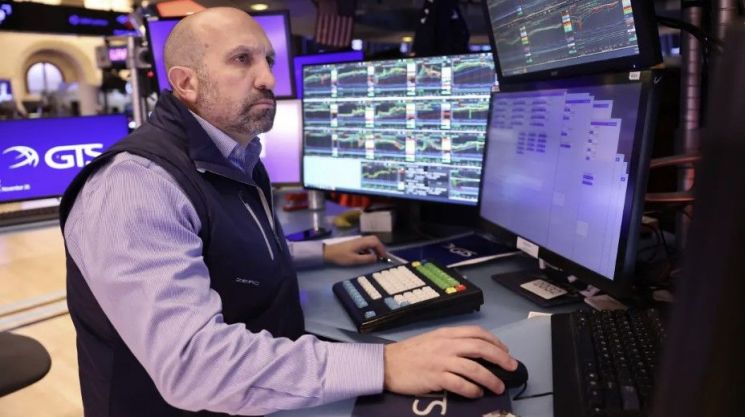
As of 11:16 a.m. in the New York stock market on the day, the Dow Jones Industrial Average (Dow Index), centered on blue-chip stocks, recorded 44,580.07, up 0.05% from the previous day. The S&P 500 Index, focused on large-cap stocks, was down 0.15% at 6,028.89, and the Nasdaq Index, centered on technology stocks, was trading down 0.43% at 19,569.98.
By stock, Alphabet is plunging 7.91%. The selling pressure continues as Alphabet announced cloud sales that fell short of market expectations the previous day. Overall sales were also below expectations. Alphabet announced after the market closed that its fourth-quarter sales last year were $96.47 billion, and earnings per share (EPS) were $2.15. The earnings forecasts compiled by LSEG were $96.56 billion and $2.13, respectively. AMD is down 9.15% as its data center sales failed to meet market expectations. Apple is down 1.39% on news that China, which has started a tariff war with the U.S., is preparing an antitrust investigation into App Store fees and practices.
Ed Yardeni, founder of Yardeni Research, analyzed, "Many people are skeptical that AI-related revenues will justify the massive spending of big tech."
Mike Dickson, chief research strategist at Horizon Investments, said, "As the topic shifts to who will provide AI to the public, there will be those who have and those who do not," adding, "As the AI theme matures, we will continue to see turning points."
The U.S. trade deficit for December last year, announced that morning, reached $98.4 billion, the largest in two years and nine months. The deficit increased by 24.7% compared to the previous month ($78.9 billion) and significantly exceeded experts' expectations ($96.5 billion). It is analyzed that the trade deficit sharply increased as companies proactively increased imports in response to President Trump's tariff threats.
The scale of private employment growth greatly exceeded market expectations. According to the employment report released by ADP, a U.S. private labor market research firm, private sector nonfarm payrolls in the U.S. increased by 183,000 in January this year. This surpassed both December last year (176,000 increase) and market expectations (148,000). The number of job openings released the previous day unexpectedly decreased, signaling a slowdown in the labor market, resulting in mixed employment indicators.
Accordingly, investors are focusing on the Labor Department's January employment report to be released on the 7th, which will show a more accurate status of the U.S. labor market. Experts expect that nonfarm payrolls increased by 154,000 last month, a significant decrease compared to the previous month (256,000). The unemployment rate is expected to have remained at 4.1%, the same as the previous month.
The dollar index, which indicates the value of the U.S. dollar against the currencies of six major countries, is down 0.45% from the previous day, recording 107.33.
Bond yields are falling. The U.S. 10-year Treasury yield, a global bond yield benchmark, is down 9 basis points (1bp=0.01%) from the previous trading day, recording 4.42%. The U.S. 2-year Treasury yield, sensitive to monetary policy, is moving at 4.17%, down 3 basis points from the previous day.
© The Asia Business Daily(www.asiae.co.kr). All rights reserved.

















