'3rd Korea CEO Forum' Held
Chairman Son Kyung-sik Urges Reform of Outdated Laws and Systems
Emphasizes Post-Retirement Reemployment Through Performance-Based Wages
"Strengthen Cooperation in Key Economic Sectors Such as Batteries"
Son Kyung-sik, Chairman of the Korea Employers Federation (KEF), stated on the 6th, "To lead growth through innovation, it is urgent to expand flexibility in the working hours system and reform the wage structure."
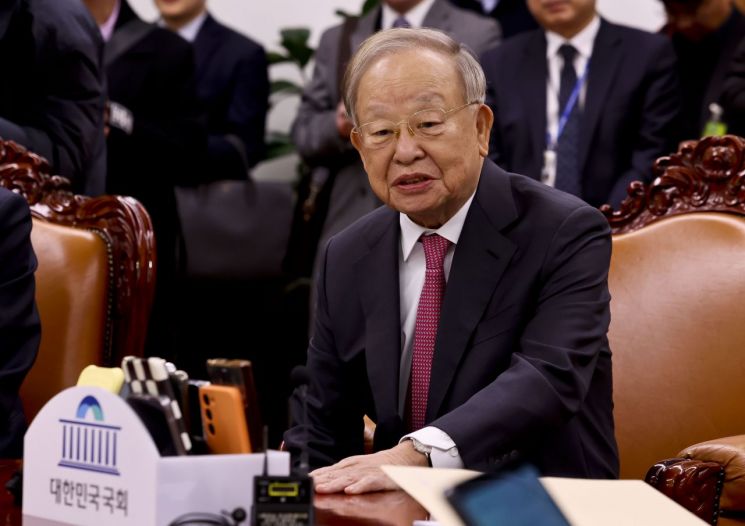
Chairman Son made these remarks at the '3rd Korea CEO Forum' held at the Westin Chosun Seoul that morning, saying, "We must boldly improve various outdated laws and systems that hinder national competitiveness and corporate activities."
This year's forum was held under the main theme of "Innovation as a Driving Force in an Era of Extreme Uncertainty." The purpose was to seek ways for companies to proactively respond amid a structural transition period.
He emphasized, "To overcome the current crisis and achieve a leap forward, our economy needs continuous innovation and investment," adding, "We must engage in focused future investments to create 'new growth engines'." In particular, he said, "In the new Korea-US trade environment, cooperation should be strengthened in key economic sectors such as semiconductors, batteries, and energy to ensure that the US remains a steadfast trade and investment partner." He continued, "The growth and development of companies is directly linked to the development of the national economy," urging national support.
Chairman Son pointed out that Korea's working hours regulations are an obstacle to utilizing core talent. He said, "Major advanced countries maximize the use of scarce human resources through flexible working hours systems," and added, "(Korea should) move away from uniform regulations based on quantity, broadly guarantee workers' choices, and flexibly adjust according to the nature of the work."
While maintaining the broad framework of the "52-hour workweek," it should be possible to work more hours when necessary to respond flexibly to rapidly changing situations. Chairman Son noted, "Research and development positions and high-income professional jobs should be allowed to work without restrictions on working hours with the employee's consent."
In fact, the ruling party and government plan to process the 'Semiconductor Special Act' this month, which applies the '52-hour workweek exception' to semiconductor development and research personnel. During the six months to one year of prototype intensive verification period within the two-year semiconductor new product development process, it is inevitable for core R&D personnel to work overnight 3 to 4 days. Applying uniform working hours here is analyzed to directly lead to a decline in the competitiveness of the semiconductor industry.
He said the wage system should be changed from seniority-based to productivity-centered. He stated, "A wage system disconnected from productivity lowers fairness in compensation and corporate competitiveness, and deepens wage gaps between company sizes and generations," adding, "The wage system should be restructured to focus on job performance, where not just those who have worked longer but those with higher productivity receive higher wages." He also added, "Based on such a wage system, more opportunities to work should be provided to the elderly through a 'post-retirement reemployment' method."
He pointed out the increased burden on management, such as rising labor costs, following the Supreme Court's December ruling that conditional regular bonuses must be included in ordinary wages. At that time, KEF expressed concerns, saying, "In a situation where companies' management environments are unfavorable, bearing unexpected financial burdens will further worsen the business environment."
In this context, he viewed the recently discussed 'statutory retirement age extension' as unreasonable. The labor sector argues that the current statutory retirement age of 60 should be raised to 65 to respond to the super-aged society. Chairman Son said, "Extending the retirement age is difficult for even large companies to bear the costs and will deepen the dual structure of the labor market," adding, "It is also feared to fuel generational conflicts over jobs."
The forum proceeded with Chairman Son's opening remarks, followed by a keynote speech by Jeon Kwang-woo, Chairman of the World Economy Research Institute (on the domestic and international economic environment in 2025 and corporate response directions), and a CEO special lecture by Lee Woo-hyun, Chairman of OCI Holdings (on corporate innovation and the global energy industry). The forum continues until the 7th.
© The Asia Business Daily(www.asiae.co.kr). All rights reserved.

















